About the Church
The Church of St Michael the Archangel in Nemenčinė is a site of special religious and cultural significance, located in Vilnius District, in Nemenčinė. It is a Classicist building, built of plastered masonry in 1855. The church stands out not only for its architectural elegance but also for its rich history.
The first church on this site was built as early as 1387, when Lithuania adopted Christianity, by order of Grand Duke Jogaila. The parish established at that time received property from another famous Lithuanian ruler — Vytautas the Great. The early church's holdings were confirmed in 1525, but owing to various misfortunes and wars the church had to be destroyed and rebuilt several times: the Muscovite army destroyed it in 1655, and during the Great Northern War (up to 1706) it burned down again. Nevertheless, each time the parishioners found the strength to rebuild it and keep it alive.
From 1774 to 1790, the parish priest in Nemenčinė was the poet Adam Naruszewicz, who later became Bishop of Łuck. In later years this place drew the attention of other notable figures too, such as the naturalist Stanisław Bonifacy Jundziłł, who served as parish priest here from 1807 to 1824. He was not only a priest but also a renowned scholar and professor at Vilnius University.
Over the course of history the church has drawn people of diverse origin and language. In the 19th century services were held only in Polish, but from 1892 to 1895 the curate Mykolas Masiulis began using Lithuanian as well. Although after his departure the parish again became more Polonised, in the early 20th century Lithuanian-speaking villages still existed around Nemenčinė. The use of Lithuanian in the church was resumed in 1939, when Lithuania regained the Vilnius region.
The church suffered from fires more than once, the last time in 1947, after which it was repaired in 1950. Today the Church of St Michael the Archangel in Nemenčinė is not only a centre of religious life but also a historical monument, testifying to a centuries-long struggle for faith and culture.
Architecturally the church has a rectangular plan, one tower and three naves. The churchyard fence is built of stone masonry, and in the churchyard itself stands the Parčevskis chapel, where the church's founder, Aleksandras Parčevskis, is buried.
A visit to the church in Nemenčinė allows one to feel not only spiritual peace but also to touch the rich history of Lithuania, which is reflected here in every corner.
Gallery and Resources
Archive captions are shown in Lithuanian.
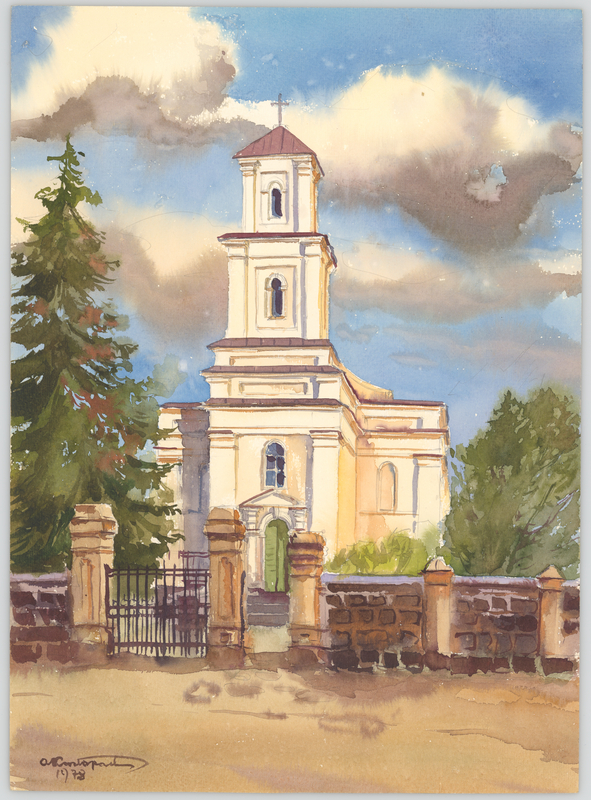
Kompozicijoje – Nemenčinės Šv. arkangelo Mykolo bažnyčia.
Signuotas akvarele averso apatinėje dalyje kairėje ir pieštuku revreso viršutinėje dalyje.
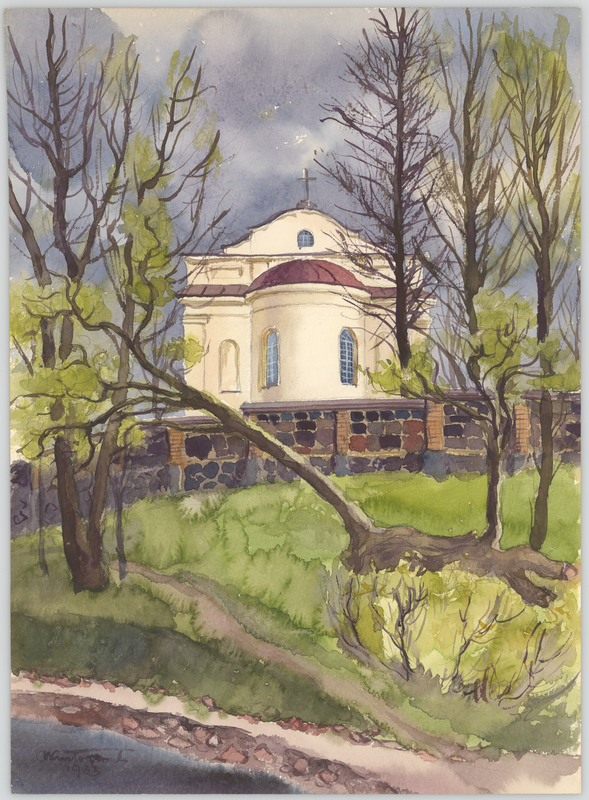
Nemenčinės Šv. arkangelo Mykolo bažnyčia.
Signuotas akvarele averso apatinėje dalyje kairėje, pieštuku reverso viršutinėje dalyje kairėje.