About the Church
The Church of St Joseph in Geležiai is one of those mysterious and charming Lithuanian village churches with a unique history and architectural beauty of their own. Standing in the small town of Geležiai, near the Subačius railway station, this wooden church is not only a spiritual centre but also an important cultural asset.
The first religious structure on this site was built as early as 1779. The owner of Naujadvaris manor, Puzinas, decided to set up a chapel in the Geležiai cemetery. This small wooden chapel was known by the name Naujadvaris until the mid-19th century. We can imagine how it served the local residents for many decades, a silent witness to various events of life: christenings, weddings and funerals.
As the parish community grew, the need arose for a larger church. And so in 1874 a new wooden church was built, adorned by Jonas Baruolis, who added a bell tower with a stone base and a wooden upper part. The church was also granted 6 hectares of land from Naujadvaris manor – a sign of how important this place was to the local residents.
Unfortunately, time and natural conditions were not kind to the old church. In 1935 both the church and the bell tower were demolished owing to their poor condition. This period, however, marked the start of a new revival. On the initiative of the priest Vincas Beinortas and with the funds of the parishioners, the present wooden church, which we see today, was built the very next year.
The church's architecture has Gothic Revival features, visible in its cruciform plan and in the tower adorning the left corner of the facade. The single-nave church gives a feeling of warmth and intimacy so typical of small village churches. The churchyard, enclosed by a stone-masonry and metal fence and containing an old cemetery, further strengthens the historical and cultural significance of the site.
It is also interesting that the church has a five-register organ, installed in 1938. This shows that the local community cared not only about the church's main function but also about its musical dimension, which added to the spiritual atmosphere.
Today the Church of St Joseph in Geležiai stands as a living witness to the past, recalling the people and events that shaped this region's history. On visiting this church, one can sense not only the spirit of religion but also the deep bond between the generations who built and preserved this special place.
The first religious structure on this site was built as early as 1779. The owner of Naujadvaris manor, Puzinas, decided to set up a chapel in the Geležiai cemetery. This small wooden chapel was known by the name Naujadvaris until the mid-19th century. We can imagine how it served the local residents for many decades, a silent witness to various events of life: christenings, weddings and funerals.
As the parish community grew, the need arose for a larger church. And so in 1874 a new wooden church was built, adorned by Jonas Baruolis, who added a bell tower with a stone base and a wooden upper part. The church was also granted 6 hectares of land from Naujadvaris manor – a sign of how important this place was to the local residents.
Unfortunately, time and natural conditions were not kind to the old church. In 1935 both the church and the bell tower were demolished owing to their poor condition. This period, however, marked the start of a new revival. On the initiative of the priest Vincas Beinortas and with the funds of the parishioners, the present wooden church, which we see today, was built the very next year.
The church's architecture has Gothic Revival features, visible in its cruciform plan and in the tower adorning the left corner of the facade. The single-nave church gives a feeling of warmth and intimacy so typical of small village churches. The churchyard, enclosed by a stone-masonry and metal fence and containing an old cemetery, further strengthens the historical and cultural significance of the site.
It is also interesting that the church has a five-register organ, installed in 1938. This shows that the local community cared not only about the church's main function but also about its musical dimension, which added to the spiritual atmosphere.
Today the Church of St Joseph in Geležiai stands as a living witness to the past, recalling the people and events that shaped this region's history. On visiting this church, one can sense not only the spirit of religion but also the deep bond between the generations who built and preserved this special place.
Gallery and Resources
Archive captions are shown in Lithuanian.
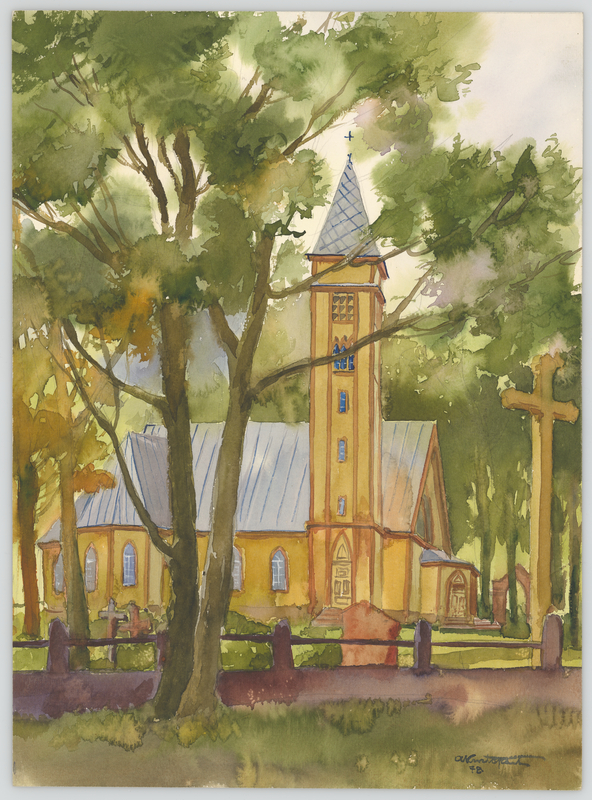
Geležių Šv. Juozapo bažnyčia.
Signuotas akvarele averso apatinėje dalyje dešinėje, pieštuku reverso viršutinėje dalyje kairėje.
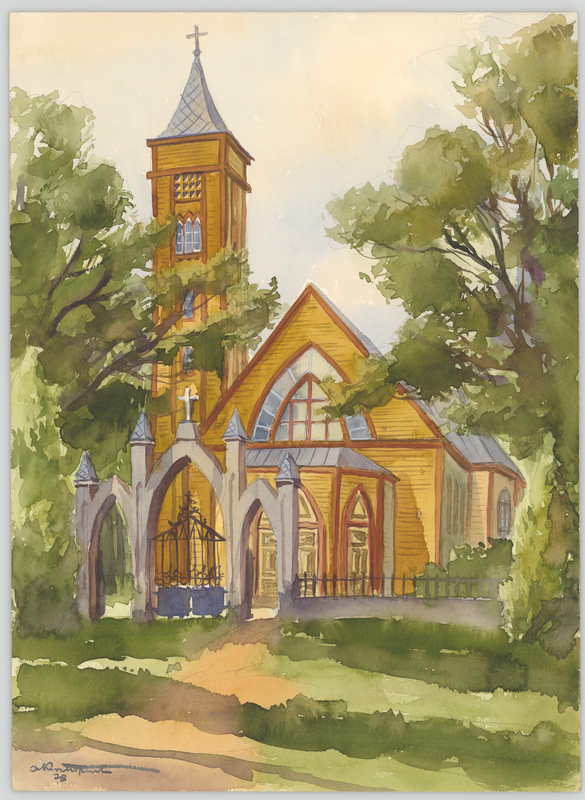
Geležių Šv. Juozapo bažnyčia.
Signuotas akvarele averso apatinėje dalyje kairėje, pieštuku reverso viršutinėje dalyje kairėje.