About the Church
The church of the Crucified Jesus at Imbradas is a shrine of special significance and beauty, situated in the small village of Imbradas, beside the road linking Zarasai, Bradesiai and Obeliai. This church, built in 1786–1787 on the initiative of Pranciškus Molis, reflects Classicist architecture with elements of folk art, which give it distinctiveness and individuality.
The church's history spans almost three centuries. In 1891 it was renovated with funds from Jonas and Pranciškus Prūsokas, a sacristy was added, and the churchyard was enclosed with a stone wall, which still protects this sacred site to this day. Between the wars, from 1930 to 1939, thanks to parish priest Matas Šapnagys and Fr Gvidas Prijalgauskas, further repairs were carried out and the church took on its present appearance. Until 1920 services were held in Polish, and from 1940 in Lithuanian.
Special mention is due to the long-serving parish priest Vytautas Antanas Samsonas, who served at Imbradas until his death in 1961. He distinguished himself not only as a clergyman but also as an active promoter of national consciousness among his parishioners. His life ended tragically in murder, but his memory lives on – he is buried in the churchyard, where his grave has become a place of reverence.
This church also became known for supernatural phenomena. In 1967, in the village of Kvintiškiai, part of the Imbradas parish, the Blessed Virgin Mary is said to have appeared, which strengthened the faith and religious life of the parishioners. In 2014 a new chapel was consecrated on the same site.
Architecturally the church of the Crucified Jesus at Imbradas is a wooden building with an elongated rectangular plan, a three-sided apse and an adjoining sacristy. Its roof is adorned with a small turret with a bell, and inside three altars can be found. The church holds many valuable works of art: the late-18th-century painting "St Jerome", the early-19th-century "St John the Evangelist" and other important works, such as "Christ in the Garden of Olives" and "St Martin and the Beggar". These artistic artefacts not only adorn the church but also give it historical and cultural value.
The church of the Crucified Jesus at Imbradas is not only a religious but also a cultural symbol of Zarasai district, which has retained its uniqueness and importance in the community over the centuries.
The church's history spans almost three centuries. In 1891 it was renovated with funds from Jonas and Pranciškus Prūsokas, a sacristy was added, and the churchyard was enclosed with a stone wall, which still protects this sacred site to this day. Between the wars, from 1930 to 1939, thanks to parish priest Matas Šapnagys and Fr Gvidas Prijalgauskas, further repairs were carried out and the church took on its present appearance. Until 1920 services were held in Polish, and from 1940 in Lithuanian.
Special mention is due to the long-serving parish priest Vytautas Antanas Samsonas, who served at Imbradas until his death in 1961. He distinguished himself not only as a clergyman but also as an active promoter of national consciousness among his parishioners. His life ended tragically in murder, but his memory lives on – he is buried in the churchyard, where his grave has become a place of reverence.
This church also became known for supernatural phenomena. In 1967, in the village of Kvintiškiai, part of the Imbradas parish, the Blessed Virgin Mary is said to have appeared, which strengthened the faith and religious life of the parishioners. In 2014 a new chapel was consecrated on the same site.
Architecturally the church of the Crucified Jesus at Imbradas is a wooden building with an elongated rectangular plan, a three-sided apse and an adjoining sacristy. Its roof is adorned with a small turret with a bell, and inside three altars can be found. The church holds many valuable works of art: the late-18th-century painting "St Jerome", the early-19th-century "St John the Evangelist" and other important works, such as "Christ in the Garden of Olives" and "St Martin and the Beggar". These artistic artefacts not only adorn the church but also give it historical and cultural value.
The church of the Crucified Jesus at Imbradas is not only a religious but also a cultural symbol of Zarasai district, which has retained its uniqueness and importance in the community over the centuries.
Gallery and Resources
Archive captions are shown in Lithuanian.
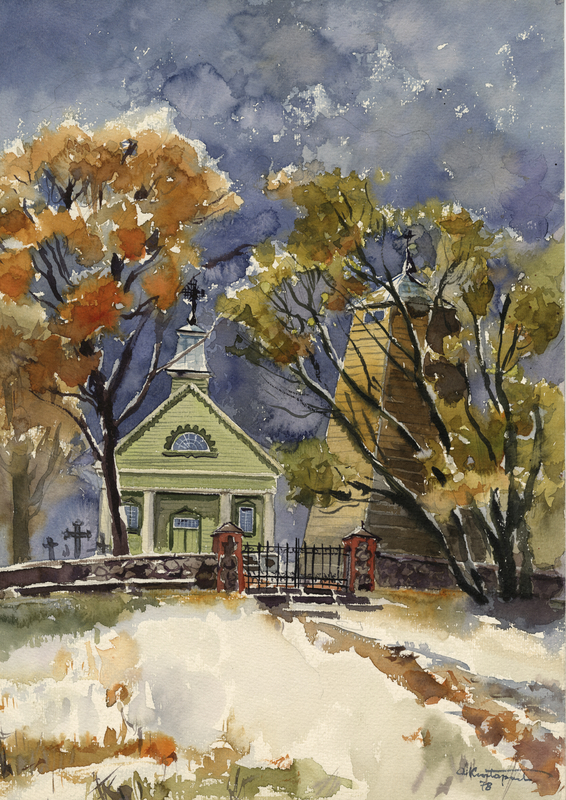
Imbrado Nukryžiuotojo Jėzaus bažnyčia.
Signuotas akvarele averso apatinėje dalyje dešinėje autoriaus parašu ir data: „78“, pieštuku revrese: „IMBRADAS / Obeliai-Zarasai / 1978. IX. 30 / labai snigo, dar visai nepašalus“.