About the Church
The Pandėlys Church of the Holy Name of Mary is one of the most important religious and historical sites in Rokiškis district, in Pandėlys. This striking church stands on the right bank of the Apaščia river, where for more than two centuries it has delighted the faithful with its architecture and rich history.
The church's origins reach back to 1591, when property was donated for the priest's upkeep. At the end of the 17th century (1674–1677) a small masonry church is recorded, which is believed to have been destroyed during the Great Northern War in the early 18th century. A wooden church is then recorded, which stood until the present church was built.
The present Pandėlys church was built in 1801 by Ignotas Koscialkovskis. This Classicist church, built of brick masonry, became not only a centre of religious life but also a place visited by notable figures. For example, in 1812 the poet-priest Antanas Strazdas served here.
The church also bears witness to Lithuania's turbulent history — the parish priest Adomas Jeselskis and the curate Petras Sinkevičius, who took part in the 1863 uprising, were arrested and removed from Pandėlys. After this unrest, in 1869, the church's thatched roof was replaced with sheet metal, and the interior was enriched with a vaulted ceiling and a new organ. In later years further renovations were carried out: the altars were repainted, and plaster Stations of the Cross were installed.
In the early 20th century the church changed its appearance once again — the parishioners decided to lengthen it and add a masonry tower. Sadly, the tower was pulled down during the First World War and not rebuilt. Only many years later, in July 2007, on the initiative of Albinas Jasiūnas, were the church's towers, destroyed during the war, rebuilt.
During the Second World War the church, together with its outbuildings, suffered great damage, but in the post-war period, under the parish priest Jurgis Šimonėlis, they were repaired. Sadly, in the same period (1946), the parish priest Fabijonas Kemėšis was arrested and died in exile.
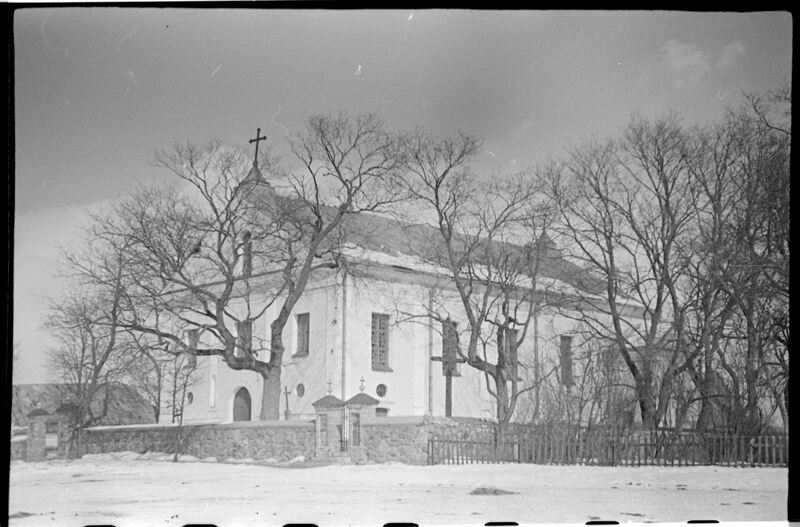
The Pandėlys church is Classicist in style, a hall-type, single-nave structure with a narrower apse. It contains five altars, and the churchyard is enclosed by a stone-masonry wall. Several notable priests are buried in the churchyard, among them the altarist Alfonsas Strielčiūnas, the parish priest Jonas Morkvėnas and Fr Titas Vinkšnelis.
The Pandėlys Church of the Holy Name of Mary is undoubtedly one of the most significant cultural and historical heritage sites in the Rokiškis region, whose history and architecture invite one to learn about past events and the legacy of a devout people.
The church's origins reach back to 1591, when property was donated for the priest's upkeep. At the end of the 17th century (1674–1677) a small masonry church is recorded, which is believed to have been destroyed during the Great Northern War in the early 18th century. A wooden church is then recorded, which stood until the present church was built.
The present Pandėlys church was built in 1801 by Ignotas Koscialkovskis. This Classicist church, built of brick masonry, became not only a centre of religious life but also a place visited by notable figures. For example, in 1812 the poet-priest Antanas Strazdas served here.
The church also bears witness to Lithuania's turbulent history — the parish priest Adomas Jeselskis and the curate Petras Sinkevičius, who took part in the 1863 uprising, were arrested and removed from Pandėlys. After this unrest, in 1869, the church's thatched roof was replaced with sheet metal, and the interior was enriched with a vaulted ceiling and a new organ. In later years further renovations were carried out: the altars were repainted, and plaster Stations of the Cross were installed.
In the early 20th century the church changed its appearance once again — the parishioners decided to lengthen it and add a masonry tower. Sadly, the tower was pulled down during the First World War and not rebuilt. Only many years later, in July 2007, on the initiative of Albinas Jasiūnas, were the church's towers, destroyed during the war, rebuilt.
During the Second World War the church, together with its outbuildings, suffered great damage, but in the post-war period, under the parish priest Jurgis Šimonėlis, they were repaired. Sadly, in the same period (1946), the parish priest Fabijonas Kemėšis was arrested and died in exile.
The Pandėlys church is Classicist in style, a hall-type, single-nave structure with a narrower apse. It contains five altars, and the churchyard is enclosed by a stone-masonry wall. Several notable priests are buried in the churchyard, among them the altarist Alfonsas Strielčiūnas, the parish priest Jonas Morkvėnas and Fr Titas Vinkšnelis.
The Pandėlys Church of the Holy Name of Mary is undoubtedly one of the most significant cultural and historical heritage sites in the Rokiškis region, whose history and architecture invite one to learn about past events and the legacy of a devout people.
Gallery and Resources
Archive captions are shown in Lithuanian.

Fotonegatyve įamžinta Pandėlio Švč. Mergelės Marijos Vardo bažnyčia.
Fotonegatyve įamžinta Pandėlio Švč. Mergelės Marijos Vardo bažnyčia.