About the Church
The Church of the Holy Trinity and St Casimir in Medininkai is one of those small Lithuanian shrines whose history and architecture charm and amaze visitors. It is not only a religious building but also an important object of culture and historical memory.
The church in Medininkai has a long and complex past. The first church here was built as early as 1391, shortly after Lithuania officially adopted Christianity. This fact bears witness to the establishment of Christian culture in the region. Although over the centuries the church and parish suffered many upheavals, they always managed to recover.
For the 17th and 18th centuries no specific records of rebuilding survive, but it is known that in 1655 the church was ravaged by the Russian army. Later, in 1788, a new wooden church was built, but it too was not fated to stand long — in 1812 it was plundered, and the monastery, library and archive burned down during the campaign of the French army.
The 19th century was not easy for the church either. Closed in 1832, it came back to life only in 1858, when the manor owner Kaminskienė built a chapel. This chapel too did not stand for long — it was closed in 1865 and demolished three years later.
A new chapter in the church's history began in the 20th century. Despite numerous obstacles and prohibitions, local residents continually sought permission to build a new church. Only on 29 May 1922 were the foundations of the present wooden church blessed, and the church itself was built in 1931. In this church, as in its predecessors, services are held in Polish, showing the strong Polish tradition of the community in this area.
Architecturally the church has a rectangular plan, a single tower, and a basilica-type three-nave composition with a porch and a small turret. A wooden bell tower stands in the churchyard, and the whole area is enclosed by a wooden fence, which gives the place a particular cosiness and authenticity.
Today the Church of the Holy Trinity and St Casimir in Medininkai is not only a house of prayer but also a historical monument, recalling the region's turbulent past and the strength of people's faith. Every visitor here can feel the passage of time and touch deeply rooted traditions.
The church in Medininkai has a long and complex past. The first church here was built as early as 1391, shortly after Lithuania officially adopted Christianity. This fact bears witness to the establishment of Christian culture in the region. Although over the centuries the church and parish suffered many upheavals, they always managed to recover.
For the 17th and 18th centuries no specific records of rebuilding survive, but it is known that in 1655 the church was ravaged by the Russian army. Later, in 1788, a new wooden church was built, but it too was not fated to stand long — in 1812 it was plundered, and the monastery, library and archive burned down during the campaign of the French army.
The 19th century was not easy for the church either. Closed in 1832, it came back to life only in 1858, when the manor owner Kaminskienė built a chapel. This chapel too did not stand for long — it was closed in 1865 and demolished three years later.
A new chapter in the church's history began in the 20th century. Despite numerous obstacles and prohibitions, local residents continually sought permission to build a new church. Only on 29 May 1922 were the foundations of the present wooden church blessed, and the church itself was built in 1931. In this church, as in its predecessors, services are held in Polish, showing the strong Polish tradition of the community in this area.
Architecturally the church has a rectangular plan, a single tower, and a basilica-type three-nave composition with a porch and a small turret. A wooden bell tower stands in the churchyard, and the whole area is enclosed by a wooden fence, which gives the place a particular cosiness and authenticity.
Today the Church of the Holy Trinity and St Casimir in Medininkai is not only a house of prayer but also a historical monument, recalling the region's turbulent past and the strength of people's faith. Every visitor here can feel the passage of time and touch deeply rooted traditions.
Gallery and Resources
Archive captions are shown in Lithuanian.
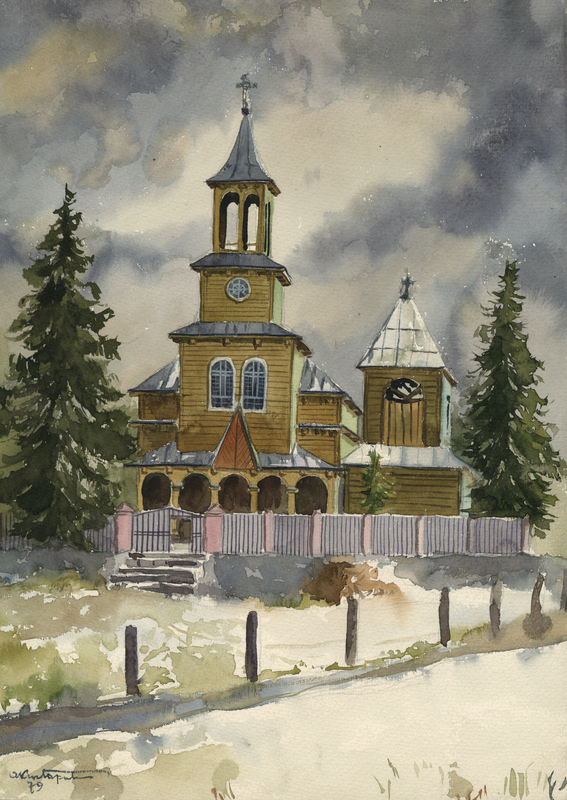
Kompozicijoje – Medininkų Švč. Trejybės ir Šv. Kazimiero bažnyčia.
Signuotas akvarele averso apatinėje dalyje kairėje: autoriaus parašu ir data: „79“, reverse pieštuku: „MEDININKAI / 1979. XII. 7.“.
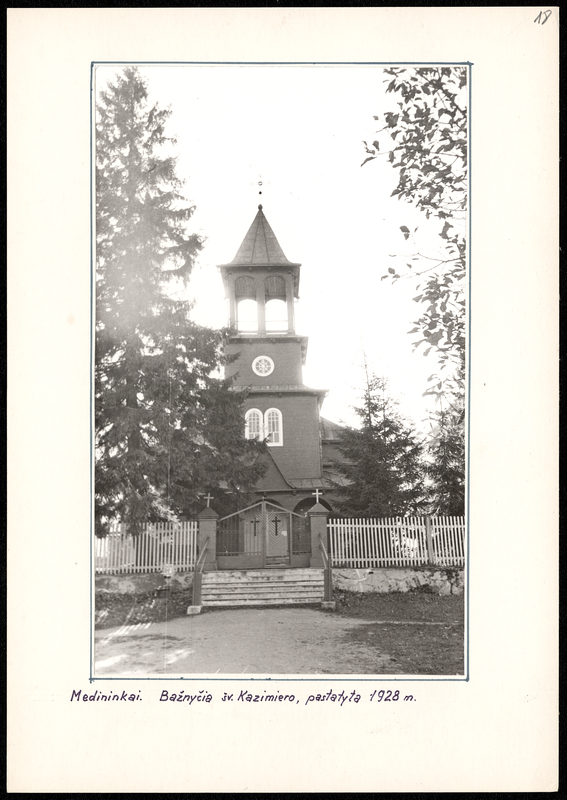
Medininkų Švč. Trejybės ir Šv. Kazimiero bažnyčia. Fotografijos aprašymas ant pasporto: „Medininkai. Bažnyčia šv. Kazimiero, pastatyta 1928 m.“