About the Church
The history of the Church of St George in Dubingiai is a story of long-term change and perseverance, reflecting the history not only of the building but also of the local community.
Ancient origins and a church under noble patronage.
The first Church of St George in Dubingiai was built before 1430, when the Grand Duke of Lithuania Vytautas the Great allocated funds for the project. The church became an important spiritual centre, supported by later rulers as well. The Grand Duke Casimir IV Jagiellon confirmed and increased the property granted to the church in 1449, and Povilas Kareiva, the starosta of Giedraičiai, further strengthened its material base.
In 1542 Povilas and Anastazija Giedraitis set up a special altar space and donated the Bijutiškis estate, thereby securing the church's financial stability. However, in the middle of the 16th century, around 1565, the church passed into the hands of the Evangelical Reformed Church, and the Catholics were forced to build a chapel in the cemetery.
Lawsuits and revivals.
Only after a long and complicated legal process did the Catholics begin to regain their rights in 1642. A new Catholic church rose in Dubingiai in 1677–1678, built on the initiative of the then owner K. Radvilaitė. Rebuilt in 1800, it also served as a parish school and was an important place of culture and education. In the 18th century a Confraternity of the Holy Rosary was established here, contributing to the strengthening of the local community.
Trials by fire.
Unfortunately, in 1954 the church was damaged by fire. Measures were quickly taken — an annex was added to the cemetery chapel and a temporary church was set up. But this too burned down in 1958. The church was then set up in a former almshouse. In the post-war period, the priest of Dubingiai Jonas Kunigėlis and the parish priest Jonas Žvinys made a significant contribution to preserving Lithuanian national identity.
A church for a new generation.
The cornerstone of the new Church of St George in Dubingiai was laid in October 2012, to a design by the architect Kęstutis Pempė. Construction, funded by the local community and by the family foundation of the businessman Aurelijus Rusteika, was completed at the end of 2014.
The new church is characterised by a concise, traditional cross-plan architecture. Simple Lithuanian materials were used — laminated timber, glass, and special roof tiles. Today the church is not only a place of religious rites but also a cultural heritage site, symbolising the historical continuity and vitality of the town of Dubingiai.
Despite all its trials, the Church of St George in Dubingiai remains an important spiritual and cultural centre, testifying to the strength of the local community and its loyalty to its history.
Ancient origins and a church under noble patronage.
The first Church of St George in Dubingiai was built before 1430, when the Grand Duke of Lithuania Vytautas the Great allocated funds for the project. The church became an important spiritual centre, supported by later rulers as well. The Grand Duke Casimir IV Jagiellon confirmed and increased the property granted to the church in 1449, and Povilas Kareiva, the starosta of Giedraičiai, further strengthened its material base.
In 1542 Povilas and Anastazija Giedraitis set up a special altar space and donated the Bijutiškis estate, thereby securing the church's financial stability. However, in the middle of the 16th century, around 1565, the church passed into the hands of the Evangelical Reformed Church, and the Catholics were forced to build a chapel in the cemetery.
Lawsuits and revivals.
Only after a long and complicated legal process did the Catholics begin to regain their rights in 1642. A new Catholic church rose in Dubingiai in 1677–1678, built on the initiative of the then owner K. Radvilaitė. Rebuilt in 1800, it also served as a parish school and was an important place of culture and education. In the 18th century a Confraternity of the Holy Rosary was established here, contributing to the strengthening of the local community.
Trials by fire.
Unfortunately, in 1954 the church was damaged by fire. Measures were quickly taken — an annex was added to the cemetery chapel and a temporary church was set up. But this too burned down in 1958. The church was then set up in a former almshouse. In the post-war period, the priest of Dubingiai Jonas Kunigėlis and the parish priest Jonas Žvinys made a significant contribution to preserving Lithuanian national identity.
A church for a new generation.
The cornerstone of the new Church of St George in Dubingiai was laid in October 2012, to a design by the architect Kęstutis Pempė. Construction, funded by the local community and by the family foundation of the businessman Aurelijus Rusteika, was completed at the end of 2014.
The new church is characterised by a concise, traditional cross-plan architecture. Simple Lithuanian materials were used — laminated timber, glass, and special roof tiles. Today the church is not only a place of religious rites but also a cultural heritage site, symbolising the historical continuity and vitality of the town of Dubingiai.
Despite all its trials, the Church of St George in Dubingiai remains an important spiritual and cultural centre, testifying to the strength of the local community and its loyalty to its history.
Gallery and Resources
Archive captions are shown in Lithuanian.
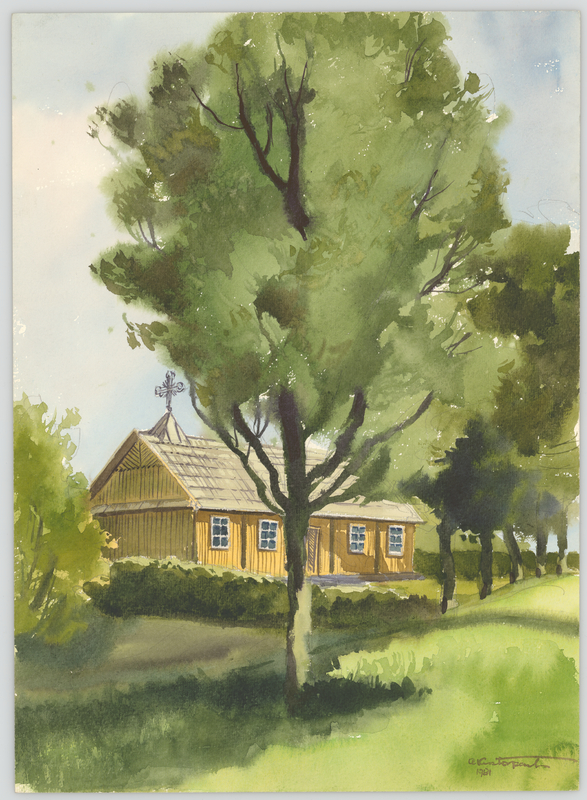
Dubingių Šv. Jurgio bažnyčia.
Signuotas akvarele averso apatinėje dalyje dešinėje, pieštuku reverso viršutinėje dalyje kairėje.