About the Church
The Church of St Bartholomew in Giedraičiai is one of the most impressive Classicist-style buildings in Lithuania, standing in the small town of Giedraičiai. Its history goes back to the 15th century and reflects both the religious and the political past of Lithuania.
The church was built in 1410, when the Grand Duke of Lithuania Vytautas the Great commissioned Mykolas Gintilavičius-Gentvilas to build it. This was a significant moment not only in the church's history but for the whole region. By 1445 the church had been provided with a benefice, later funded by the Giedraitis family. In 1510 the church was rebuilt, and its parish priest held extensive territory — the town's jurisdiction, eight villages, and as many as three lakes.
In the 17th century the church was attacked by Russian soldiers, who burned it down. Nevertheless, in 1676 a temporary church still stood here. At the beginning of the 18th century a Confraternity of the Holy Rosary was established in Giedraičiai, contributing to the development of the town's spiritual life. At the same time a parish school also operated, where young people could obtain a primary education.
In 1809 the present masonry church was built by the Bishop of Samogitia, Juozapas Arnulfas Giedraitis, together with his brother Martynas. This church holds special symbolic significance, since after the bishop's death in 1838 his heart was walled into the chancel. A portrait of the bishop hangs in the sacristy, recalling his contribution to the church's history.
In the 19th century the Polish language was used in the church, although sermons were also given in Lithuanian. When services in Lithuanian began to be held in 1903, a Lithuanian church choir was formed. However, the Lithuanian services encountered difficulties — in 1911 Poles disrupted them, and during the disturbances of 1912–1913 legal proceedings were even required.
Another dramatic moment in the church's history came in 1919, when on 24 August Poles disrupted the Lithuanian services, terrorised and took away the parish priest Kazimieras Liesevičius. During the Soviet occupation he was arrested and sentenced to ten years' imprisonment, returning to Lithuania only in 1955.
Architecturally, the Church of St Bartholomew in Giedraičiai is Classicist and towerless, with a portal, a triangular pediment and a broad entablature. Inside are three naves separated by piers. The churchyard wall is built of stone masonry, and a massive Classicist bell tower stands at the corner of the wall, built in the middle of the 19th century to a design by Karolis Gregotovičius. The bell tower is distinguished by an openwork upper tier made of timber construction.
This church is not only an architectural marvel but also an important witness to Lithuania's culture and history. Its walls preserve the stories, struggles and hopes of many generations.
The church was built in 1410, when the Grand Duke of Lithuania Vytautas the Great commissioned Mykolas Gintilavičius-Gentvilas to build it. This was a significant moment not only in the church's history but for the whole region. By 1445 the church had been provided with a benefice, later funded by the Giedraitis family. In 1510 the church was rebuilt, and its parish priest held extensive territory — the town's jurisdiction, eight villages, and as many as three lakes.
In the 17th century the church was attacked by Russian soldiers, who burned it down. Nevertheless, in 1676 a temporary church still stood here. At the beginning of the 18th century a Confraternity of the Holy Rosary was established in Giedraičiai, contributing to the development of the town's spiritual life. At the same time a parish school also operated, where young people could obtain a primary education.
In 1809 the present masonry church was built by the Bishop of Samogitia, Juozapas Arnulfas Giedraitis, together with his brother Martynas. This church holds special symbolic significance, since after the bishop's death in 1838 his heart was walled into the chancel. A portrait of the bishop hangs in the sacristy, recalling his contribution to the church's history.
In the 19th century the Polish language was used in the church, although sermons were also given in Lithuanian. When services in Lithuanian began to be held in 1903, a Lithuanian church choir was formed. However, the Lithuanian services encountered difficulties — in 1911 Poles disrupted them, and during the disturbances of 1912–1913 legal proceedings were even required.
Another dramatic moment in the church's history came in 1919, when on 24 August Poles disrupted the Lithuanian services, terrorised and took away the parish priest Kazimieras Liesevičius. During the Soviet occupation he was arrested and sentenced to ten years' imprisonment, returning to Lithuania only in 1955.
Architecturally, the Church of St Bartholomew in Giedraičiai is Classicist and towerless, with a portal, a triangular pediment and a broad entablature. Inside are three naves separated by piers. The churchyard wall is built of stone masonry, and a massive Classicist bell tower stands at the corner of the wall, built in the middle of the 19th century to a design by Karolis Gregotovičius. The bell tower is distinguished by an openwork upper tier made of timber construction.
This church is not only an architectural marvel but also an important witness to Lithuania's culture and history. Its walls preserve the stories, struggles and hopes of many generations.
Gallery and Resources
Archive captions are shown in Lithuanian.

Kompozicijoje – Giedraičių Šv. Baltramiejaus bažnyčia.
Signuotas akvarele averso apatinėje dalyje kairėje ir pieštuku reverso viršutinėje dalyje.
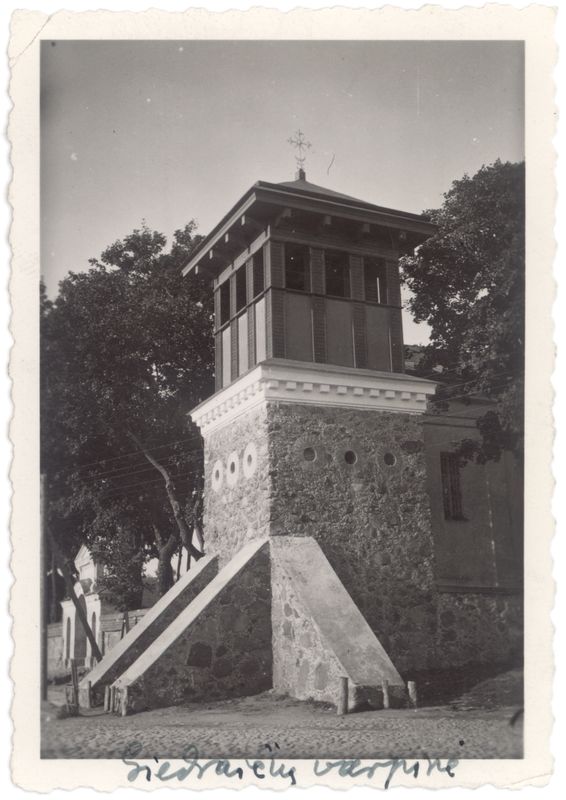
Architektūrinė kompozicija. Giedraičių (Molėtų r.) klasicistinė, tinkuoto mūro Šv. Baltramiejaus bažnyčia pastatyta 1809 m. Šventorių juosia akmenų mūro tvora, jos kampe stovi masyvi klasicistinė varpinė, pastatyta XIX a. vid. pagal Vilniaus universiteto profesoriaus K. Gregotovičiaus (1799–1848) projektą.
Aprašė Aldona Rudzevičienė