About the Church
The Church of the Nativity of the Blessed Virgin Mary in Labanoras is an expressive monument with a rich history, located in the town of Labanoras, in Švenčionys district. It is remarkable how this wooden house of God became a symbol of the whole community over the centuries.
The church of Labanoras was first mentioned as early as 1522 in the lists of the Diocese of Vilnius, which attests to its antiquity and long history. However, the first church became old and dilapidated over time and burned down at the end of the 18th century. A new church was built at the parishioners' expense by the Bishop of Vilnius, Masalskis, in 1768, but it too was destroyed by fire in 1798.
This, however, did not stop the local residents — in 1818–1820 the church was rebuilt at the parishioners' expense. It was not only a house of prayer but also a community centre, whose walls witnessed many events: from religious ceremonies to the interwar summer gatherings of the Pavasaris youth society.
The church was constantly changing, restored and maintained. In the summer of 2009 a major renovation was carried out that revived the church's appearance: the facades were repainted, the roof was replaced with authentic shingle cladding, and the turrets were covered with copper sheeting. Unfortunately, six months later, just before Christmas, tragedy struck the church — it burned down completely. Fortunately, the bell tower remained untouched.
This bell tower, dating from the 19th century, with its square plan and three tiers, reflects authentic folk architecture. A bronze bell, cast in 1805 by Johanas Samuelis Vėneris, which can be considered a true work of art, hung in it.
After the fire the community did not lose hope — reconstruction of the church began as early as 2010 and was successfully completed in 2011. The newly rebuilt church retained its Classicist style and became a modern yet authentic example of sacred architecture.
Today the Church of the Nativity of the Blessed Virgin Mary in Labanoras not only continues to serve as a house of prayer but also recalls the community's unity and strength in overcoming hardship. It is a place where past and present, religious practice and cultural heritage, come together.
The church of Labanoras was first mentioned as early as 1522 in the lists of the Diocese of Vilnius, which attests to its antiquity and long history. However, the first church became old and dilapidated over time and burned down at the end of the 18th century. A new church was built at the parishioners' expense by the Bishop of Vilnius, Masalskis, in 1768, but it too was destroyed by fire in 1798.
This, however, did not stop the local residents — in 1818–1820 the church was rebuilt at the parishioners' expense. It was not only a house of prayer but also a community centre, whose walls witnessed many events: from religious ceremonies to the interwar summer gatherings of the Pavasaris youth society.
The church was constantly changing, restored and maintained. In the summer of 2009 a major renovation was carried out that revived the church's appearance: the facades were repainted, the roof was replaced with authentic shingle cladding, and the turrets were covered with copper sheeting. Unfortunately, six months later, just before Christmas, tragedy struck the church — it burned down completely. Fortunately, the bell tower remained untouched.
This bell tower, dating from the 19th century, with its square plan and three tiers, reflects authentic folk architecture. A bronze bell, cast in 1805 by Johanas Samuelis Vėneris, which can be considered a true work of art, hung in it.
After the fire the community did not lose hope — reconstruction of the church began as early as 2010 and was successfully completed in 2011. The newly rebuilt church retained its Classicist style and became a modern yet authentic example of sacred architecture.
Today the Church of the Nativity of the Blessed Virgin Mary in Labanoras not only continues to serve as a house of prayer but also recalls the community's unity and strength in overcoming hardship. It is a place where past and present, religious practice and cultural heritage, come together.
Gallery and Resources
Archive captions are shown in Lithuanian.

Kompozicijoje – Labanoro Švč. Mergelės Marijos Gimimo bažnyčia.
Signuotas akvarele averso apatinėje dalyje kairėje, pieštuku reverso viršutinėje dalyje.
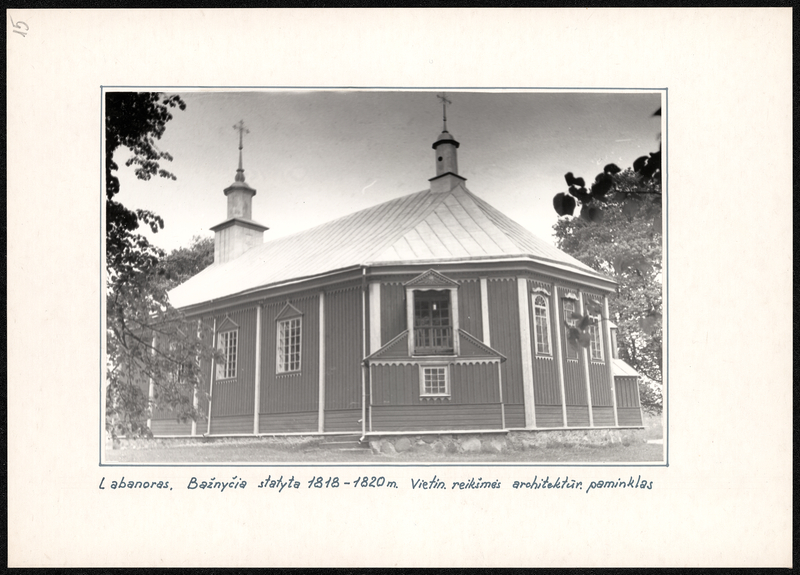
Labanoro Švč. Mergelės Marijos Gimimo bažnyčia. Fotografijos aprašymas ant pasporto: „Labanoras. Bažnyčia statyta 1818–1820 m. Vietin. reikšmės architektūr. paminklas“.