About the Church
Deltuva's Church of the Holy Trinity is a true gem of architecture and history, situated in the small town of Deltuva, in Ukmergė district. It is a place where the religious and cultural past of ancient Lithuania intertwines with the charm of folk architecture.
The history of the church spans almost six centuries. The first shrine was built by 1444, and the new parish church is already mentioned in 1463. This church was also mentioned by Pope Paul II in his bull of 1468. Interestingly, from the second half of the 16th century until 1627 it was taken over by the Evangelical Reformed Church.
It is worth noting that the present wooden church, standing since 1752, preserves a unique folk architectural style with Neoclassical features. Inside you will find three wooden altars, which complement the sacred space within its three-nave structure. The church is also notable for its pentagonal apse and its single tower, which gives it particular beauty.
The churchyard fence, made of stone masonry, has impressive wayside shrines for the Stations of the Cross, which further strengthen the shrine's spirituality. Next to the church stands a wooden bell tower, a fine example of folk craftsmanship.
From the end of the 18th century until the mid-19th century a parish school operated at the church, contributing to the education of the local community. At that time the priest Šimkevičius carried out major renovation works, which revived the shrine in 1872. In addition, from 1909 to 1914 a branch of the Lithuanian Catholic Temperance Society was actively operating here, promoting a sober way of life.
The church served not only as a place of worship but also as a community centre, connecting people through both spiritual and social ties. Today Deltuva's Church of the Holy Trinity remains an important historical monument, reminding us of Lithuania's rich past and people's efforts to preserve their cultural and spiritual heritage.
A visit to this church is a journey into the past, an invitation to feel the spirit of Lithuanian history and to admire the architectural beauty that has survived to this day.
The history of the church spans almost six centuries. The first shrine was built by 1444, and the new parish church is already mentioned in 1463. This church was also mentioned by Pope Paul II in his bull of 1468. Interestingly, from the second half of the 16th century until 1627 it was taken over by the Evangelical Reformed Church.
It is worth noting that the present wooden church, standing since 1752, preserves a unique folk architectural style with Neoclassical features. Inside you will find three wooden altars, which complement the sacred space within its three-nave structure. The church is also notable for its pentagonal apse and its single tower, which gives it particular beauty.
The churchyard fence, made of stone masonry, has impressive wayside shrines for the Stations of the Cross, which further strengthen the shrine's spirituality. Next to the church stands a wooden bell tower, a fine example of folk craftsmanship.
From the end of the 18th century until the mid-19th century a parish school operated at the church, contributing to the education of the local community. At that time the priest Šimkevičius carried out major renovation works, which revived the shrine in 1872. In addition, from 1909 to 1914 a branch of the Lithuanian Catholic Temperance Society was actively operating here, promoting a sober way of life.
The church served not only as a place of worship but also as a community centre, connecting people through both spiritual and social ties. Today Deltuva's Church of the Holy Trinity remains an important historical monument, reminding us of Lithuania's rich past and people's efforts to preserve their cultural and spiritual heritage.
A visit to this church is a journey into the past, an invitation to feel the spirit of Lithuanian history and to admire the architectural beauty that has survived to this day.
Gallery and Resources
Archive captions are shown in Lithuanian.

Bažnyčia, vieno bokšto, dengta dvišlaitės formos stogu, užfiksuota kartu su šventoriaus ir daržų tvoromis.
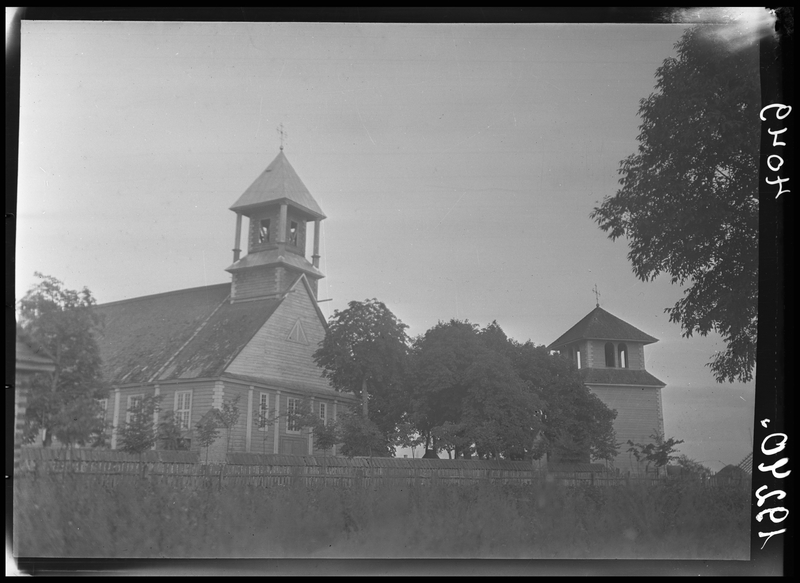
Bažnyčia vieno bokšto, dengta dvišlaitės formos stogu, ir dviejų tarpsnių varpinė užfiksuotos su jas juosiančia šventoriaus tvora.