About the Church
The Church of Sts Peter and Paul, Apostles, in Ukmergė, standing proudly in the town, is not only a religious site but also a magnificent architectural monument, reflecting the town's long history. This church, built in 1820, has undergone numerous changes and challenges throughout its existence.
The first church in Ukmergė was built as early as around 1387, showing how deep-rooted the town's Christian traditions are. The first parish priest was maintained from three valakai of land, granted by the Grand Duke of Lithuania Jogaila himself. This church did not survive, however — it was destroyed by Muscovite troops in 1655.
Later, by 1674, the church had been rebuilt, but misfortunes continued: the building erected in 1764 burned down in 1786. Even so, the parish did not give up — a temporary church was soon put up, until in 1800–1820 the present church was built through the efforts of the parish priest Motiejus Šneideravičius and the donations of parishioners.
This church gradually became an inseparable part of the Ukmergė townscape, although it suffered from various historical events. In 1842 the Russian authorities confiscated the church's lands, leaving only a plot in the town and the 18-hectare Mikailiškiai farmstead. Later, in 1875 and in 1901–1902, the church was repaired in order to preserve its beauty and functionality.
In 1931–1939, under the direction of the engineer Vaclovas Michnevičius and the parish priest Leonas Špokevičius, the church was rebuilt to meet the needs of the growing community. During this rebuilding it was enlarged, with the addition of a chancel and two sacristies, and a new façade with a portico was built at the end where the former apse had stood. This allowed Archbishop Juozapas Skvireckas to reconsecrate the church in 1935.
Architecturally, the church is an interesting blend of Neoclassical and Baroque styles. Its rectangular, towerless structure, with three aisles covered by barrel vaults, creates a sense of grandeur combined with harmony. The churchyard's stone masonry wall with pillared gates lends it additional solidity and old-world charm. There also stands a Classicist bell tower, whose lower section is of stone masonry and whose upper section is wooden.
The interior of the church is likewise striking in its beauty: the central altar, the pulpit and the organ create a special atmosphere in which religion, art and history merge. Every visitor here can sense a spiritual and cultural tradition spanning centuries.
The Church of Sts Peter and Paul, Apostles, in Ukmergė is not only a house of prayer but also a living witness to a long struggle for survival and devotion to its community and to God. A visit to this church allows one to touch the history of the town of Ukmergė and of Lithuania, sensing the spirit of past generations and their unbreakable resolve.
The first church in Ukmergė was built as early as around 1387, showing how deep-rooted the town's Christian traditions are. The first parish priest was maintained from three valakai of land, granted by the Grand Duke of Lithuania Jogaila himself. This church did not survive, however — it was destroyed by Muscovite troops in 1655.
Later, by 1674, the church had been rebuilt, but misfortunes continued: the building erected in 1764 burned down in 1786. Even so, the parish did not give up — a temporary church was soon put up, until in 1800–1820 the present church was built through the efforts of the parish priest Motiejus Šneideravičius and the donations of parishioners.
This church gradually became an inseparable part of the Ukmergė townscape, although it suffered from various historical events. In 1842 the Russian authorities confiscated the church's lands, leaving only a plot in the town and the 18-hectare Mikailiškiai farmstead. Later, in 1875 and in 1901–1902, the church was repaired in order to preserve its beauty and functionality.
In 1931–1939, under the direction of the engineer Vaclovas Michnevičius and the parish priest Leonas Špokevičius, the church was rebuilt to meet the needs of the growing community. During this rebuilding it was enlarged, with the addition of a chancel and two sacristies, and a new façade with a portico was built at the end where the former apse had stood. This allowed Archbishop Juozapas Skvireckas to reconsecrate the church in 1935.
Architecturally, the church is an interesting blend of Neoclassical and Baroque styles. Its rectangular, towerless structure, with three aisles covered by barrel vaults, creates a sense of grandeur combined with harmony. The churchyard's stone masonry wall with pillared gates lends it additional solidity and old-world charm. There also stands a Classicist bell tower, whose lower section is of stone masonry and whose upper section is wooden.
The interior of the church is likewise striking in its beauty: the central altar, the pulpit and the organ create a special atmosphere in which religion, art and history merge. Every visitor here can sense a spiritual and cultural tradition spanning centuries.
The Church of Sts Peter and Paul, Apostles, in Ukmergė is not only a house of prayer but also a living witness to a long struggle for survival and devotion to its community and to God. A visit to this church allows one to touch the history of the town of Ukmergė and of Lithuania, sensing the spirit of past generations and their unbreakable resolve.
Gallery and Resources
Archive captions are shown in Lithuanian.

Vilkmergė (dab. Ukmergė). Vaizdas į Šv. apaštalų Petro ir Povilo bažnyčią. Akmens mūro stačiakampio plano šventovė pastatyta 1800–1818 m. Stilius mišrus – klasicizmo ir romantizmo. Varpinė pastatyta 1836 m. pagal architekto Karolio Gregotavičiaus projektą.
Įrašas lenkų kalba virš fotografijos albumo lape: „Kościół w Wiłkomierzu“.
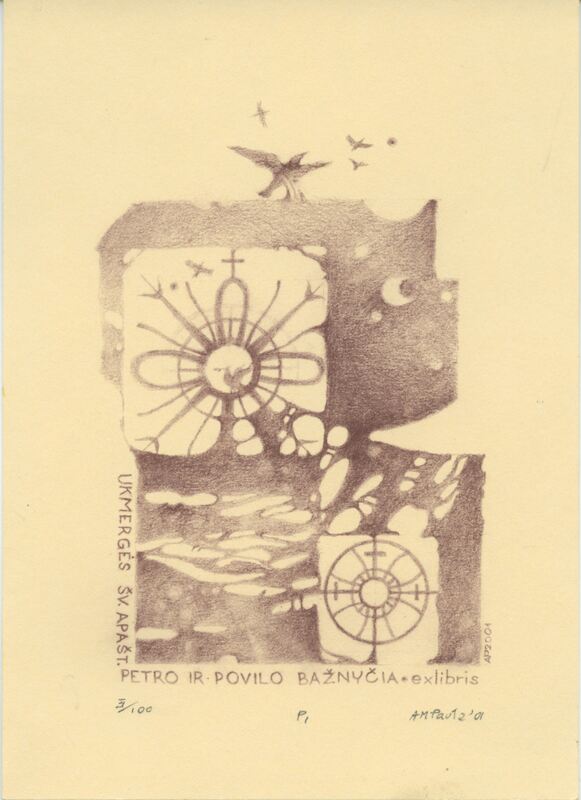
Autorė Aušra Marija Paulauskienė (Kėdainiai). „Ukmergės Šv. apaštalų Petro ir Povilo bažnyčia“. Stilizuotame stačiakampyje, apatinėje dešinėje ir viršutinėje kairėje dalyse, pavaizduota po saulutę – kryžių. Virš stačiakampio matyti kylantys paukščių siluetai. Šviesiai persikinės spalvos popieriaus ir rusvos spalvų derinys.