About the Church
The church's history goes back to the 18th century, when Januška-Januškevičius built the first wooden chapel in Milašaičiai in 1786. Almost six decades later this modest house of prayer was renewed — a new wooden chapel was built in 1855, which in 1867 became a filial church of the Betygala parish and received its first priest. Later, in 1903–1905, the church was repaired and its walls reinforced, ensuring the longevity of the building.
Architecturally, the Church of the Crucified Jesus in Milašaičiai reflects the features of vernacular architecture. It is a rectangular-plan building with two small turrets. This simple but charming design conveys the aesthetic of its time and the skill of local craftsmen. The churchyard contains a cemetery, which as it were extends the sacred space and recalls the past generations who lived and prayed here.
Looking at the church's interior, many interesting details can be seen: from the organ loft to the organ bellows — everything breathes historical heritage and respect for liturgical requirements. The cross on the turret crowns this wooden masterpiece, as it were, lending it still more sanctity.
Although the church is neither large nor lavish, its importance to the local community and its architectural beauty make it exceptional. It is a place where history, faith and the rhythm of community life intertwine, where every stone and piece of wood tells its own story.
A visit to the Church of the Crucified Jesus in Milašaičiai can be not only a spiritual experience but also an excellent opportunity to get to know Lithuania's vernacular architectural heritage and history.
Gallery and Resources
Archive captions are shown in Lithuanian.
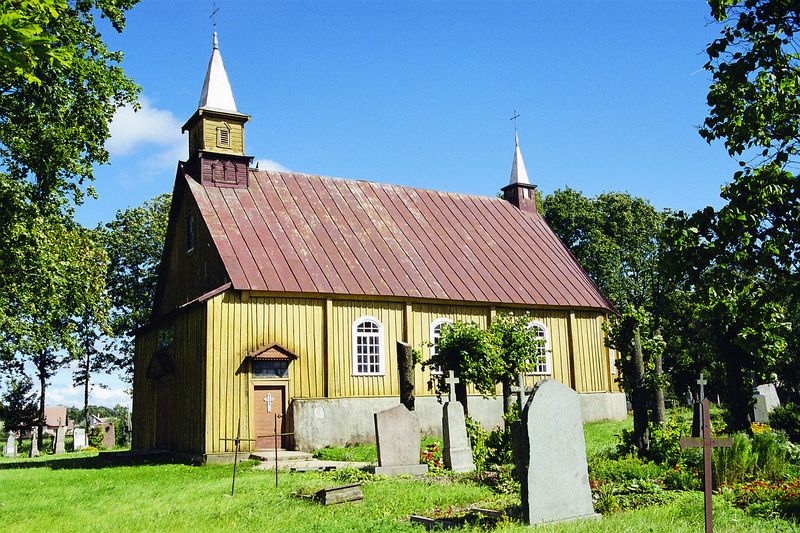
Spalvota, horizontalaus formato nuotrauka. Milašaičių Nukryžiuotojo Jėzaus bažnyčia, Bažnyčios g. 2, Milašaičių k., Ariogalos sen., Raseinių r. sav. Vaizdas iš pietvakarių pusės. Fotografas Jonas Šimkus, Kretinga, 2001 m.
Bažnyčia medinė, turi liaudies architektūros bruožų, stačiakampio plano, su bokštu kraigo priekyje ir bokšteliu virš trisienės apsidės. Aplinkui kapinės, kurias juosia aukšti medžiai ir akmenų tvora.
1786 m. dvarininkas Januška-Januškevičius Milašaičių kapinėse pastatė pirmąją medinę koplyčią. Jos vietoje 1855 m. pastatyta dabartinė koplyčia, kuriai 1867 m. suteiktos Betygalos parapijos filijinės bažnyčios teisės ir paskirtas kunigas kuratas. 1903–1905 m. ji remontuota, suveržtos sienos.
Priklauso Motiejaus Valančiaus vyskupavimo laikotarpiu (1850–1875) pastatytoms ar restauruotoms bažnyčioms.
Aprašymą parengė Algirdas Čėsna, 2014-06-05.