About the Church
Its history begins in the 16th century, when in 1525 the holdings of the Vilkija parish priest are recorded. At that time the parish was beginning to take shape, and in 1542 the church was granted considerable lands and an annual tribute of 80 gold coins. However, the condition of the church and the abilities of the parish priest were questionable: in 1579 the roof was leaking, the registers were not being kept, and the cemetery was unfenced. The parish was served by Fr J. Laskovskis, who barely managed in Latin and had little understanding of his duties.
In the mid-18th century the church burned down several times and was rebuilt. After the first wooden church burned down, a new one was built in 1751. At the beginning of the 19th century the town plan already marked a church with a small tower and a chapel. In 1892 the shrine again burned down in flames.
At the beginning of the 20th century it was decided to build a new masonry church in a different location, on a hill, so that it would become the town's main landmark and point the way to heaven. Construction began in 1901 under the parish priest Butkus, who, despite objections from parishioners, bought up plots of land and laid massive foundations. His work was continued by K. Bučnys, and the construction of the church was finally completed by the parish priest Stanislovas Bačkis. He found ways to finance the construction, set up brickworks, and organised the work himself, involving local residents.
Construction was completed in 1908, and on 21 September the new St George's Church was solemnly blessed. This was a huge event, attended by around 10,000 people. An organ, made by the renowned Lithuanian craftsman Jonas Garalevičius, lent the church a special aura of sanctity.
During the First World War, S. Bačkis's resourcefulness helped to save the church from destruction. He got the Russian soldiers to "forget" their order to demolish it, and later informed the German army that there were no Russians in the town, thereby avoiding shelling.
The church is notable for its Gothic Revival architecture. It has a Latin-cross plan, with a twin-towered facade and a many-sided apse. Inside there are three naves, and the altar is adorned with relics of saints. The churchyard is decorated with a wooden wayside shrine-pillar by the folk artist J. Mikutaitis, erected in 1960, and a stone with a bas-relief of President Valdas Adamkus, unveiled in 2014.
Vilkija St George's Church is not only a place of religious practice but also a cultural heritage site, recalling a complex and colourful past and testifying to the strength and faith of the local community.
Gallery and Resources
Archive captions are shown in Lithuanian.
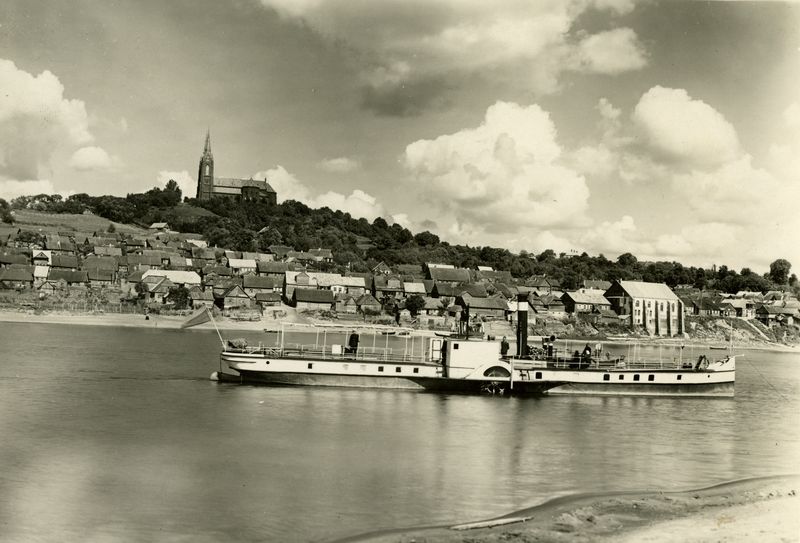
Garlaivis Nemune ties Vilkija. Nuotrauka aprėminta baltais kraštais.
Miestelio panoramoje matyti pagrindiniai jos akcentai: stambi mūrinė sinagoga upės pakrantėje (nuotraukos dešinėje) ir mūrinė dvibokštė Šv. Jurgio bažnyčia kalvos viršuje. Iki pat XX a. vid. Vilkija buvo beveik ištisai medinis miestelis, mūro pastatų centre pagausėjo po 1938 m. siautėjusio gaisro.
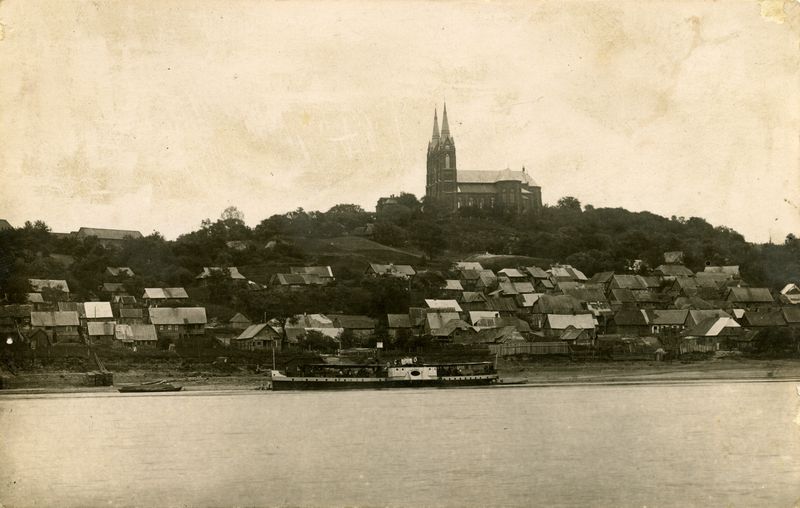
Vilkija. Vaizdas nuo kairiojo Nemuno kranto. Nuotraukoje ant kalno matyti Vilkijos Šv. Jurgio bažnyčia. Prieplaukoje apačioje – garlaivis „Balanda". Nuotraukos nugaros pusėje yra spausdintos linijos įrašams.
Naujos mūrinės bažnyčios statyba Vilkijoje pradėjo visiškai naują miestelio raidos etapą. 1892 m. siautėjęs gaisras sunaikino senąją medinę bažnyčią. Tuometinė Vilkija buvo išsidėsčiusi žemutinėje Nemuno slėnio terasoje ir pašlaitėje, o bažnyčia stovėjo istoriniame miestelio centre – svarbiausių gatvių sankryžoje šalia turgaus aikštės. Po gaisro miestelis buvo atstatytas ant senų pamatų, pakito tik bažnyčios vieta – atsisakius senojo šventoriaus, statyboms pasirinkta vieta ant kalno šalia tuometinės miestelio ir Vilkijos kaimo ribos. Kaimas ilgą laiką trukdė miesteliui plėstis į šiaurę, tačiau 1908–1910 m. jis imtas skirstyti vienkiemiais. Šalia bažnyčios pradėjo kurtis naujas miestelio centras su turgaus aikšte. Senasis centras apačioje ilgainiui prarado savo reikšmę, o senoji turgaus aikštė buvo užstatyta. Bažnyčia iki šiol yra pagrindinis miesto panoramos akcentas ir ryški dominantė ilgoje Nemuno slėnio atkarpoje.