About the Church
The church of St John the Baptist at Vajasiškis is one of those hidden corners of Lithuania where history, culture and architecture intertwine. This wooden shrine, in the settlement of Vajasiškis, Zarasai district, near Lake Alksnas, has now been standing for more than a century and a half.
The first church in this area was built around 1795, when Vajasiškis belonged to the Salakas manor holding of the Bishop of Vilnius. From then on services were held here, although the parish had not yet been formally established. Fr Liudvikas Jokūbauskas, who arrived in 1862, resolved to build a new church, and it was consecrated as early as 1863. This date marks the beginning of the present wooden church.
The church's history is not short of important events and personalities. In 1902 a house for church servants was built, and Fr Jonas Deveikis took care of the presbytery's construction in 1911. Thanks to him the church was also repaired and additional land was bought for the parish. On the initiative of parish priest Antanas Bačkis a parish house with a hall was built in 1935, becoming a gathering place for the community. Even during wartime the parish continued to grow – an almshouse was built here in 1943.
The church at Vajasiškis was renowned for its parish feasts, especially the feasts of St John and St Anne, which attracted pilgrims from the whole region. These were not only religious but also social events, strengthening the bonds of the community.
Architecturally the church is distinctive for its cross-plan form and its two-tower design. Its churchyard is surrounded by a stone-masonry wall, within which stands a wooden bell tower holding four bells. These elements give the church an authentic rural charm, characteristic of many of Lithuania's wooden churches.
An interesting detail is that the bell tower of the church at Vajasiškis is an 18th-century structure, preserved to this day. The sound of the bells, echoing across the surroundings, creates a special atmosphere and recalls the old traditions and long history of this place.
Thus, the church of St John the Baptist at Vajasiškis is not only a religious but also a cultural monument, bearing witness to a rich past and the living spirit of the community.
The first church in this area was built around 1795, when Vajasiškis belonged to the Salakas manor holding of the Bishop of Vilnius. From then on services were held here, although the parish had not yet been formally established. Fr Liudvikas Jokūbauskas, who arrived in 1862, resolved to build a new church, and it was consecrated as early as 1863. This date marks the beginning of the present wooden church.
The church's history is not short of important events and personalities. In 1902 a house for church servants was built, and Fr Jonas Deveikis took care of the presbytery's construction in 1911. Thanks to him the church was also repaired and additional land was bought for the parish. On the initiative of parish priest Antanas Bačkis a parish house with a hall was built in 1935, becoming a gathering place for the community. Even during wartime the parish continued to grow – an almshouse was built here in 1943.
The church at Vajasiškis was renowned for its parish feasts, especially the feasts of St John and St Anne, which attracted pilgrims from the whole region. These were not only religious but also social events, strengthening the bonds of the community.
Architecturally the church is distinctive for its cross-plan form and its two-tower design. Its churchyard is surrounded by a stone-masonry wall, within which stands a wooden bell tower holding four bells. These elements give the church an authentic rural charm, characteristic of many of Lithuania's wooden churches.
An interesting detail is that the bell tower of the church at Vajasiškis is an 18th-century structure, preserved to this day. The sound of the bells, echoing across the surroundings, creates a special atmosphere and recalls the old traditions and long history of this place.
Thus, the church of St John the Baptist at Vajasiškis is not only a religious but also a cultural monument, bearing witness to a rich past and the living spirit of the community.
Gallery and Resources
Archive captions are shown in Lithuanian.
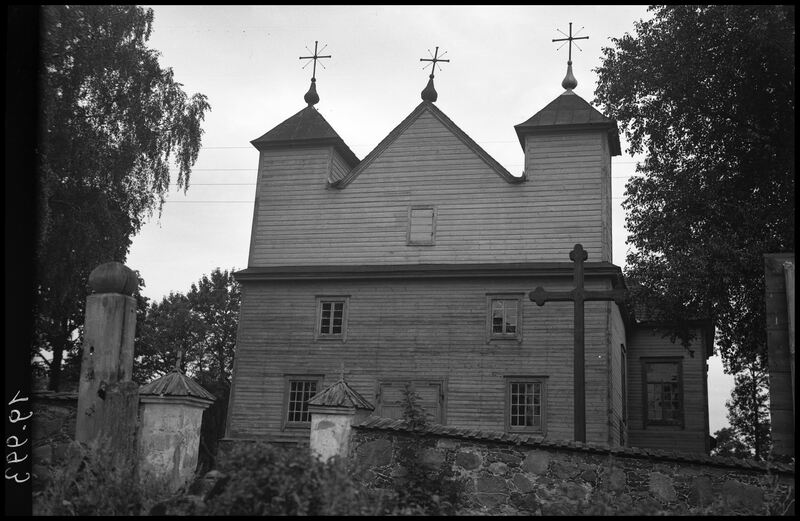
Bažnyčia, medinė, dvibokštė, nufotografuota iš pagrindinio fasado pusės.
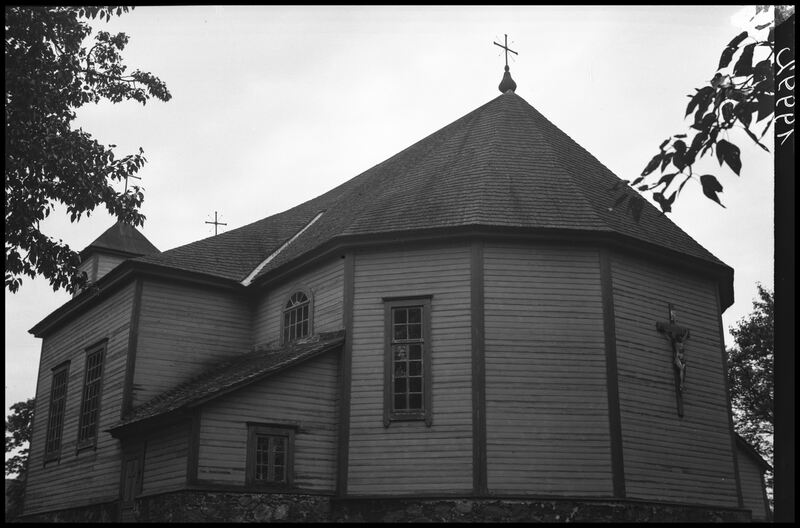
Bažnyčia, medinė, dvibokštė, nufotografuota iš apsidės pusės.