About the Church
The church's history begins as early as the late 17th century. The Strutinskis family, renowned for their generosity and religious devotion, conceived the idea of building a new monastery in 1732; construction continued until 1760. Finally, in 1763, a new church was consecrated, opening its doors to the parish's faithful.
The Discalced Carmelites settled here around 1700, hospitably received by Jonas Mykolas Strutinskis, the stolnik of Ukmergė county. The friars' activity was of great significance to the local community – they founded a parish school, which contributed to the development of education in the region. Unfortunately, after the failed uprising of 1831, the Russian authorities closed the church and monastery, and the liturgical items were distributed to other parishes.
Although an Orthodox church was established in the former church premises in the late 18th century, a women's Orthodox convent with a school that trained primary-school teachers was founded in the monastery in the late 19th century. During the First World War the German army turned the church into a car garage, severely damaging it. Only in 1918 was the church returned to the Catholics, and parish priest Stanislovas Stakelė undertook its renovation.
Despite various hardships and persecutions, including bombing during the Second World War, the church remained important to the local community. After the war, parish priest Pranciškus Strakšas and later other clergy saw to the restoration and decoration of the church. Particularly worth mentioning is the priest Jonas Buba, who was not deterred by repression and imprisonment, and who, after returning to Lithuania, continued to serve the faithful.
Architecturally, the Church of the Finding of the Holy Cross at Antalieptė is a fine example of the Baroque style: it is single-naved, with two facade towers. The chancel is narrower and lower than the main nave, and behind it stands a lower chapel with a small tower. The churchyard wall is tall and made of masonry, lending the whole complex a sense of solidity and grandeur.
Today the church at Antalieptė and the surrounding monastery complex are not only a place of religious rites but also a living history, testifying to the many changes and trials this place has experienced over the centuries.
Gallery and Resources
Archive captions are shown in Lithuanian.

Laisvo, kiek eskizinės manieros piešinio litografijoje vaizduojama barokinė dvibokštė Antalieptės Šv. Kryžiaus Atradimo bažnyčia. Ji stovi Antalieptės miestelyje, Šventosios dešiniajame krante, prie Dusetų – Daugailių kelio. Senoji Antalieptės bažnyčia pastatyta iki 1685 (nuo tų metų pradėtos rašyti metrikų knygos). Naujos bažnyčios ir basųjų karmelitų vienuolyno fundatoriai buvo Strutinskai. 1732–1734 buvo pastatytas vienuolynas, 1732–1760 – bažnyčia ( ji pašventinta 1763). Vienuoliai čia buvo įkūrę parapinę mokyklą.
Aprašė Regina Urbonienė
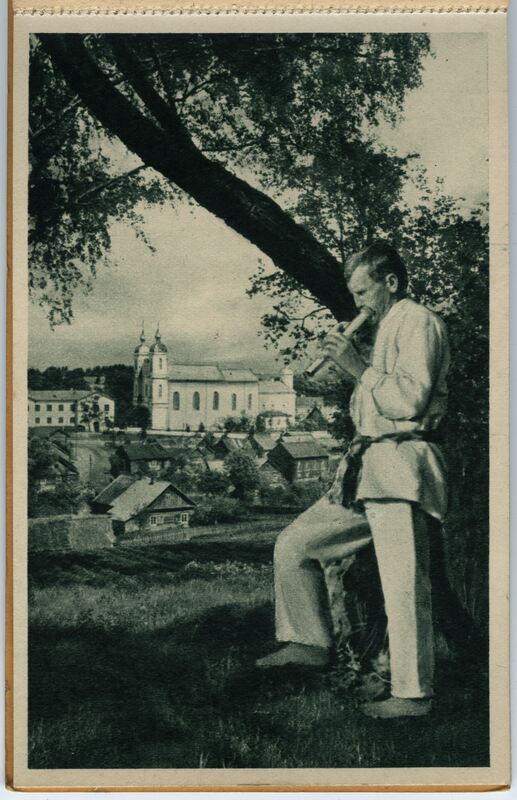
Vertikalus, nespalvotas atvirukas yra iš plėšomo, ketvirtosios serijos, fotoatvirukų albumo „Lietuvos vaizdai“.
Averse: Antalieptės miestelio (Zarasų r.) panoraminis vaizdas. Miestelio puošmena – iki 1685 m. pastatyta Antalieptės Šv. Kryžiaus atradimo bažnyčia. Pirmame plane užfiksuotas stovintis prie medžio ir grojantis dūdele piemuo. Reverse: vieta laiškui ir adresui. Pagaminimo duomenys.