About the Church
The town of Gruzdžiai, in Šiauliai district, is proud of its historical and architectural landmarks. One of them is the Church of the Holy Trinity in Gruzdžiai, whose history and architecture leave no one indifferent.
This church stands in the town's central square, and its origins go back to the 17th century. It began as a house of prayer for the Evangelical Reformed community, built by Kristupas Gruzdys in 1636. However, just a few decades later, in 1653, the church passed to the Catholics. Carefully maintained and cared for, a new Catholic church was built around 1670, to which 2 valakai of land were donated in 1672.
The church's history is connected with the famous Lithuanian princely family of Radvila. In 1759 Prince Radvila built a wooden church on the Gruzdžiai hillfort (where the cemetery is today), which became an important community centre. The village of Šiupyliai also belonged to the church. In the early 19th century a parish school operated here, where teaching was also carried out in Lithuanian from 1820.
In 1842 a parish centre was established in Gruzdžiai, and a few years later, in 1849, the church was rebuilt. Unfortunately, the church burned down in a fire in the town on 8 September 1891.
In 1892 the architect Ustinas Golinevičius designed a new masonry church, but the authorities did not allow it to be built for a long time. It was only in 1896 that a design for a two-towered church by the architect Karl Eduard Strandmann was approved. Construction work continued until 1904, supervised by the architect Nikolaj Andrejev. The main sponsors were the parishioners, the parish priest Lionginas Rakštys and the curate Juozapas Skorupskas. The church was completed in 1901, and it was consecrated in 1920 by Bishop Pranciškus Karevičius.
Architecturally the Church of the Holy Trinity in Gruzdžiai is Gothic Revival, of cruciform plan, with two towers and an apse. Inside it has three vaulted naves. The churchyard wall is of masonry, with niches, along which chapels of the Stations of the Cross are set. A masonry chapel also stands in the churchyard.
The church is not only a religious but also a cultural and architectural monument, testifying to the rich history of the town of Gruzdžiai. This building is an integral part of the local community, joining past and present into one harmonious whole.
This church stands in the town's central square, and its origins go back to the 17th century. It began as a house of prayer for the Evangelical Reformed community, built by Kristupas Gruzdys in 1636. However, just a few decades later, in 1653, the church passed to the Catholics. Carefully maintained and cared for, a new Catholic church was built around 1670, to which 2 valakai of land were donated in 1672.
The church's history is connected with the famous Lithuanian princely family of Radvila. In 1759 Prince Radvila built a wooden church on the Gruzdžiai hillfort (where the cemetery is today), which became an important community centre. The village of Šiupyliai also belonged to the church. In the early 19th century a parish school operated here, where teaching was also carried out in Lithuanian from 1820.
In 1842 a parish centre was established in Gruzdžiai, and a few years later, in 1849, the church was rebuilt. Unfortunately, the church burned down in a fire in the town on 8 September 1891.
In 1892 the architect Ustinas Golinevičius designed a new masonry church, but the authorities did not allow it to be built for a long time. It was only in 1896 that a design for a two-towered church by the architect Karl Eduard Strandmann was approved. Construction work continued until 1904, supervised by the architect Nikolaj Andrejev. The main sponsors were the parishioners, the parish priest Lionginas Rakštys and the curate Juozapas Skorupskas. The church was completed in 1901, and it was consecrated in 1920 by Bishop Pranciškus Karevičius.
Architecturally the Church of the Holy Trinity in Gruzdžiai is Gothic Revival, of cruciform plan, with two towers and an apse. Inside it has three vaulted naves. The churchyard wall is of masonry, with niches, along which chapels of the Stations of the Cross are set. A masonry chapel also stands in the churchyard.
The church is not only a religious but also a cultural and architectural monument, testifying to the rich history of the town of Gruzdžiai. This building is an integral part of the local community, joining past and present into one harmonious whole.
Gallery and Resources
Archive captions are shown in Lithuanian.
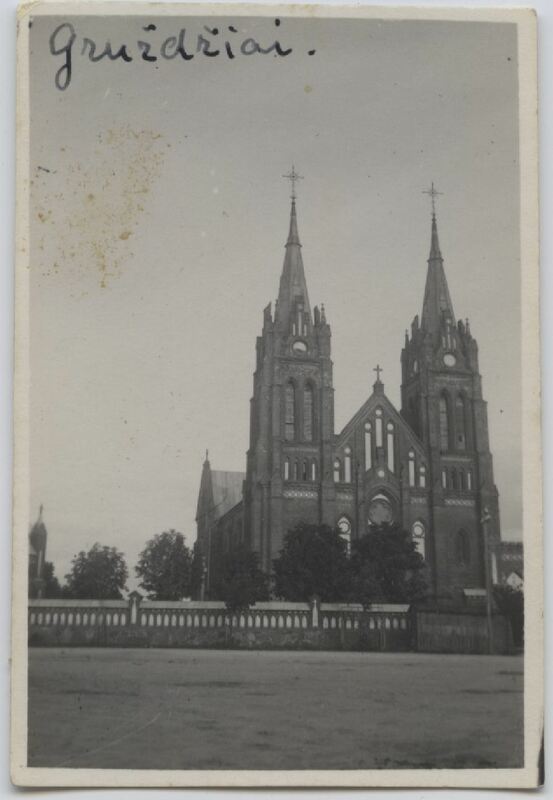
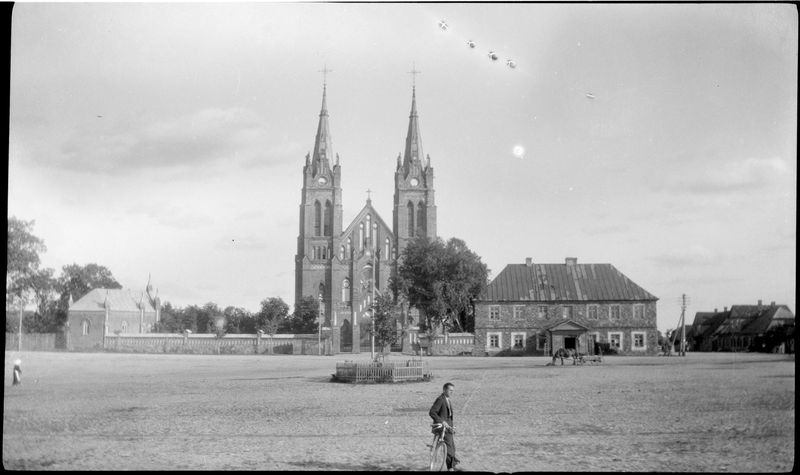
Negatyve užfiksuotas Gruzdžių Švč. Trejybės bažnyčia, stovinti Gruzdžių miestelio centrinėje aikštėje.
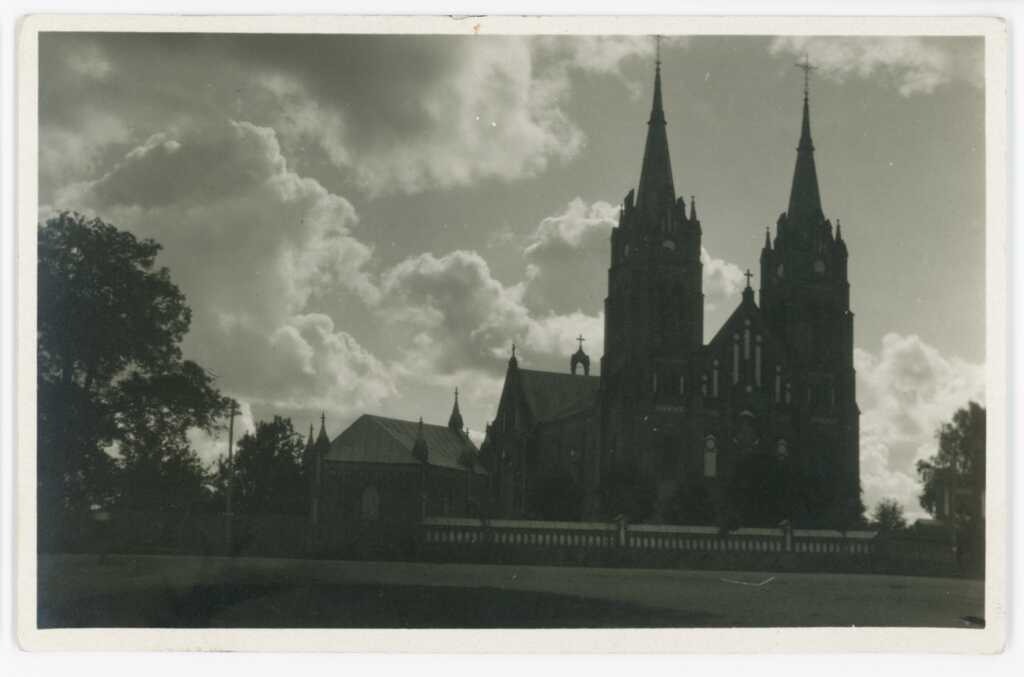
Gruzdžių miestelio bažnyčia.