About the Church
The Church of St Philip and St James the Apostles in Rudiškiai is a true gem among Lithuania's wooden sacred buildings, standing in the village of Rudiškiai, Joniškis district. The church, past which the Joniškis–Gruzdžiai road runs, has a rich and interesting history and distinctive architecture.
The first chapel on this site was built as early as 1671. Later, in 1770, it was replaced by a new wooden chapel, for which Pope Pius VI granted the parish feast of St Philip and St James on 6 September 1786. The village's religious community grew, so in 1836 a resident priest was appointed here, and by the mid-19th century a parish school was operating.
The present wooden church, which we see today, was built in 1868, largely at parishioners' expense. The church's organ, made around 1870, has six registers and was built by the Latvian Karlas Hermanas.
The church stands out for its architecture – it is a rectangular-plan, hall-type, single-nave building with three small towers. These towers are square, not projecting, with pyramidal roofs and bulbous helms, and the church itself combines vernacular architecture forms with elements of Neo-Gothic and Neo-Baroque. The chancel has three walls, with a four-sided apse extension serving as the sacristy. Vertical board cladding, Neo-Gothic windows with lancet arches and a coved ceiling all give the church a distinctive atmosphere.
The interior is no less impressive – five wooden Baroque altars, stylised organ lofts with openwork carving, and raised galleries at the rear of the nave. Here one can find numerous valuable works of art and liturgical items: a bronze bell from 1865, a 19th-century ornamented iron cross, the painting "St Casimir", and the wooden sculptures "Archangel Michael" and "the Blessed Virgin Mary".
The church at Rudiškiai is not only a place of religion but a treasury of cultural heritage, reflecting the community spirit and artistic expression that have endured for decades. It is a place where time seems to stand still, letting one sense deep-rooted traditions and admire authentic Lithuanian architecture.
The first chapel on this site was built as early as 1671. Later, in 1770, it was replaced by a new wooden chapel, for which Pope Pius VI granted the parish feast of St Philip and St James on 6 September 1786. The village's religious community grew, so in 1836 a resident priest was appointed here, and by the mid-19th century a parish school was operating.
The present wooden church, which we see today, was built in 1868, largely at parishioners' expense. The church's organ, made around 1870, has six registers and was built by the Latvian Karlas Hermanas.
The church stands out for its architecture – it is a rectangular-plan, hall-type, single-nave building with three small towers. These towers are square, not projecting, with pyramidal roofs and bulbous helms, and the church itself combines vernacular architecture forms with elements of Neo-Gothic and Neo-Baroque. The chancel has three walls, with a four-sided apse extension serving as the sacristy. Vertical board cladding, Neo-Gothic windows with lancet arches and a coved ceiling all give the church a distinctive atmosphere.
The interior is no less impressive – five wooden Baroque altars, stylised organ lofts with openwork carving, and raised galleries at the rear of the nave. Here one can find numerous valuable works of art and liturgical items: a bronze bell from 1865, a 19th-century ornamented iron cross, the painting "St Casimir", and the wooden sculptures "Archangel Michael" and "the Blessed Virgin Mary".
The church at Rudiškiai is not only a place of religion but a treasury of cultural heritage, reflecting the community spirit and artistic expression that have endured for decades. It is a place where time seems to stand still, letting one sense deep-rooted traditions and admire authentic Lithuanian architecture.
Gallery and Resources
Archive captions are shown in Lithuanian.

Fotografijoje užfiksuotas medinė Šv. Apaštalų Pilypo ir Jokūbo bažnyčia Rudiškių kaime (Gruzdžių vls.).
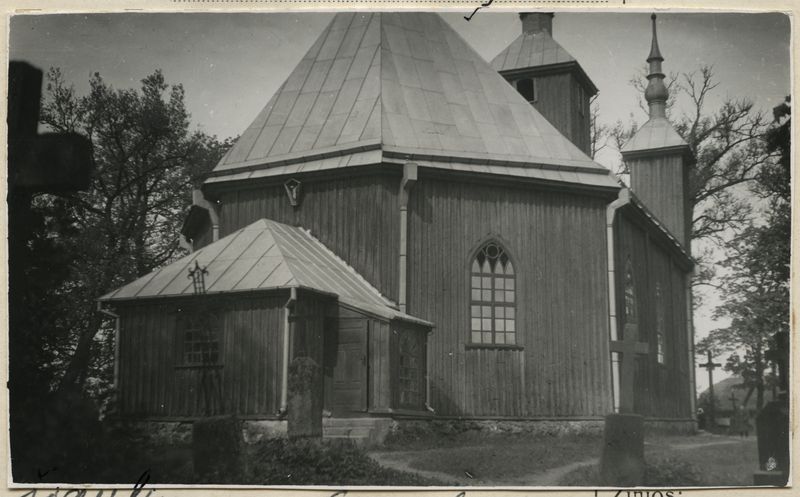
Fotografijoje užfiksuotas medinė Šv. Apaštalų Pilypo ir Jokūbo bažnyčia Rudiškių kaime (Gruzdžių vls.).

Rudiškių bažnyčia.