About the Church
The Pievėnai Church of Christ Crucified is not only a building for religious purposes, but also a cultural and architectural monument with deep historical roots. This wooden church, situated in the village of Pievėnai, in Mažeikiai district, in the Diocese of Telšiai, was built at the end of the 18th century, specifically in 1788, on the initiative of the elder of Tirkšliai, Feliksas Važinskis.
The church stands out for its vernacular architecture. Its shape recalls a traditional dwelling house, and the rectangular-plan building is adorned with a small tower. Inside are three altars, which give the interior a special sacredness. Beside the church stands a two-storey bell tower: its lower part is built of stone masonry, while the upper part is clad in upright boards. The church's churchyard is enclosed by a stone masonry wall, and nearby, in the cemetery, one can find a cross with a small chapel and a statue of St Roch, which was restored in 1954.
One of the unique features of the Pievėnai church is the theatrical vigil of the "velykžydžiai" (Easter Jews) and guard soldiers during Easter. This is the only custom of its kind in Europe, whose authenticity was restored in 2005 according to interwar-period iconography. This tradition attracts a great many visitors and worshippers seeking to experience the spirit of times past.
In the church's churchyard there once grew an impressive lime tree, which reached a height of 19 metres and a diameter of 2.6 metres. It was declared a natural monument of local significance in 1986. Unfortunately, after storms one of its two trunks broke off, and the remaining trunk was later removed as well. Today a small chapel stands on that spot, testifying to the grandeur of the past and the power of nature.
The Pievėnai Church of Christ Crucified is not only a house of prayer but also an important cultural heritage site, preserving both architectural and ethnographic riches. A visit here allows one not only to touch religious history but also to feel the spirit of the Lithuanian countryside.
The church stands out for its vernacular architecture. Its shape recalls a traditional dwelling house, and the rectangular-plan building is adorned with a small tower. Inside are three altars, which give the interior a special sacredness. Beside the church stands a two-storey bell tower: its lower part is built of stone masonry, while the upper part is clad in upright boards. The church's churchyard is enclosed by a stone masonry wall, and nearby, in the cemetery, one can find a cross with a small chapel and a statue of St Roch, which was restored in 1954.
One of the unique features of the Pievėnai church is the theatrical vigil of the "velykžydžiai" (Easter Jews) and guard soldiers during Easter. This is the only custom of its kind in Europe, whose authenticity was restored in 2005 according to interwar-period iconography. This tradition attracts a great many visitors and worshippers seeking to experience the spirit of times past.
In the church's churchyard there once grew an impressive lime tree, which reached a height of 19 metres and a diameter of 2.6 metres. It was declared a natural monument of local significance in 1986. Unfortunately, after storms one of its two trunks broke off, and the remaining trunk was later removed as well. Today a small chapel stands on that spot, testifying to the grandeur of the past and the power of nature.
The Pievėnai Church of Christ Crucified is not only a house of prayer but also an important cultural heritage site, preserving both architectural and ethnographic riches. A visit here allows one not only to touch religious history but also to feel the spirit of the Lithuanian countryside.
Gallery and Resources
Archive captions are shown in Lithuanian.
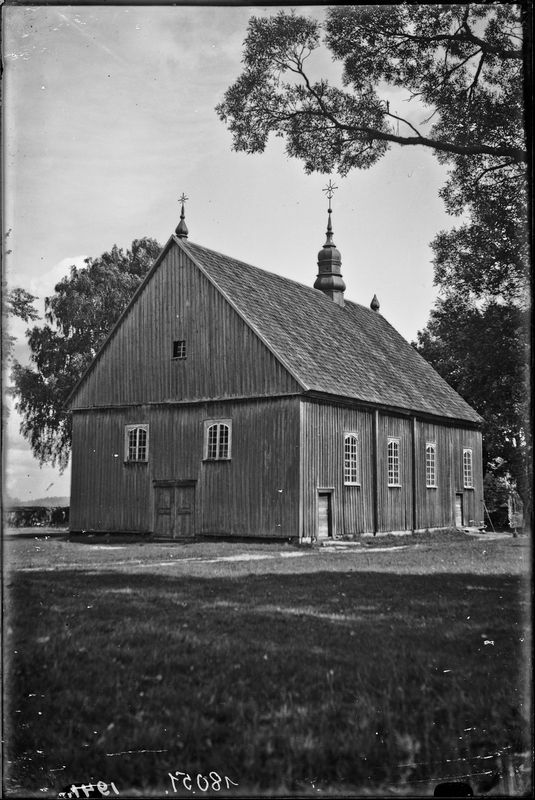
Stiklo negatyve fotografas įamžino medinę bažnyčią trijų ketvirčių rakursu. Religinio pastato fasadai apkalti stačiomis lentomis. Šoninėje sienoje keturi langai ir dvejos vienvėrės įėjimo durys, o galinėje – du langai ir dvivėrės durys. Pastato stogas dvišlaitis, dengtas skiedromis. Virš kraigo trys smailės su geležiniais kryžiais.