About the Church
The Church of the Holy Trinity at Linkmenys is an impressive church with a rich history, standing in the village of Linkmenys, a mere 12 kilometres west of Ignalina. Although the church in its present form was built in 1887, its history begins much earlier.
The first mention of the church goes back to the reign of Grand Duke Casimir Jagiellon of Lithuania, when a parish was established at Linkmenys between 1440 and 1492. Interestingly, as early as 1501 Alexander Jagiellon granted the right of patronage over the church to Bishop Albertas I Taboras of Vilnius, strictly stipulating that services were to be held in Lithuanian. This is a significant fact, reflecting the importance of language at the time and the Lithuanians' efforts to preserve their identity.
Even so, the first wooden church fell into decay in the 17th century, and so a new one was built in 1645. Later, in 1720, Count Tiškevičius funded the building of yet another wooden church. Each of these churches was important to the local people, not only as a house of prayer but also as a centre of social life. In the 18th century a parish school even operated here, and by 1820 several surrounding villages belonged to the church.
In the middle of the 19th century the church had three wooden altars and an almshouse, where the poor were cared for. In 1882, however, plans began for a new masonry church, to a design by the military engineer Cherkasov. The church was built in 1887 and still stands on the same site today. It is in the Historicist style, dominated by Neo-Romanesque elements.
The church has a rectangular plan, is of basilica type, and has a single tower. Its interior is striking for its beauty: decorative altars, a chancel balustrade, a pulpit, a statue of the Mother of God, the original organ, paintings in gilded frames, and ornamented glass windows. All of this lends the church particular charm and warmth.
In the churchyard one can find the graves of the priest Jeronimas Janulionis and the priest Ignas Montvila. The latter was a fighter for the Lithuanian cause during the Polish occupation.
The Church of the Holy Trinity at Linkmenys is not merely a monument of architecture; it is a living witness to the history of Lithuanian culture and spiritual life, linking past and present and inviting every visitor to feel the spirit of history.
The first mention of the church goes back to the reign of Grand Duke Casimir Jagiellon of Lithuania, when a parish was established at Linkmenys between 1440 and 1492. Interestingly, as early as 1501 Alexander Jagiellon granted the right of patronage over the church to Bishop Albertas I Taboras of Vilnius, strictly stipulating that services were to be held in Lithuanian. This is a significant fact, reflecting the importance of language at the time and the Lithuanians' efforts to preserve their identity.
Even so, the first wooden church fell into decay in the 17th century, and so a new one was built in 1645. Later, in 1720, Count Tiškevičius funded the building of yet another wooden church. Each of these churches was important to the local people, not only as a house of prayer but also as a centre of social life. In the 18th century a parish school even operated here, and by 1820 several surrounding villages belonged to the church.
In the middle of the 19th century the church had three wooden altars and an almshouse, where the poor were cared for. In 1882, however, plans began for a new masonry church, to a design by the military engineer Cherkasov. The church was built in 1887 and still stands on the same site today. It is in the Historicist style, dominated by Neo-Romanesque elements.
The church has a rectangular plan, is of basilica type, and has a single tower. Its interior is striking for its beauty: decorative altars, a chancel balustrade, a pulpit, a statue of the Mother of God, the original organ, paintings in gilded frames, and ornamented glass windows. All of this lends the church particular charm and warmth.
In the churchyard one can find the graves of the priest Jeronimas Janulionis and the priest Ignas Montvila. The latter was a fighter for the Lithuanian cause during the Polish occupation.
The Church of the Holy Trinity at Linkmenys is not merely a monument of architecture; it is a living witness to the history of Lithuanian culture and spiritual life, linking past and present and inviting every visitor to feel the spirit of history.
Gallery and Resources
Archive captions are shown in Lithuanian.
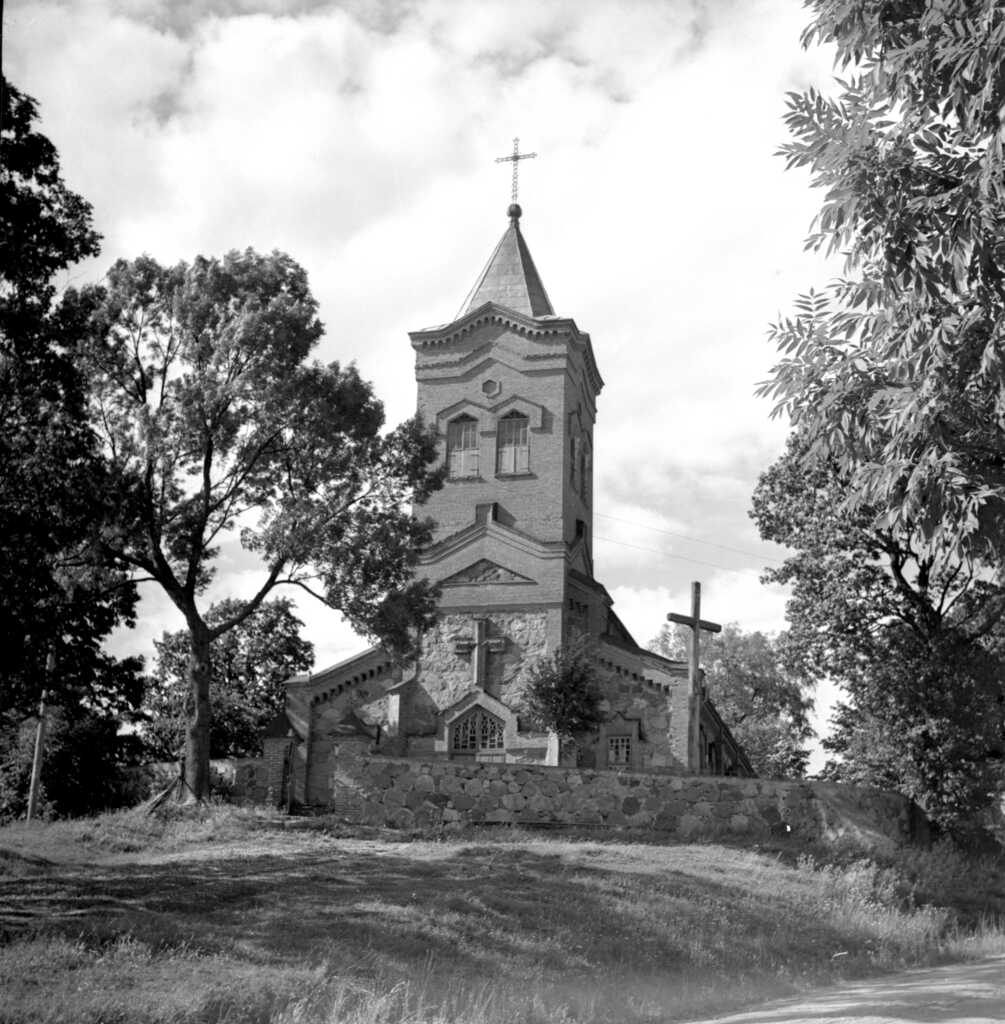
Linkmenų Švč. Trejybės bažnyčios pagrindinis fasadas.