About the Church
The All Saints' Church in Švenčionys is a genuine architectural and historical gem, concealing many interesting stories. Standing in Švenčionys, the church is an inseparable part of the town, and its history reaches back to the times of the Grand Duke of Lithuania Vytautas.
The first church was built as early as 1514, showing how long this religious building has served the local community. Later, in 1636, a new church was built, which was rebuilt again in 1743. However, due to age and poor condition, services were banned there in 1817, and they were temporarily moved to the presbytery. A year later, in 1818, the church was rebuilt.
Interestingly, over its long existence the church became a witness to major events. For example, on 10 April 1831 the insurgent Anupras Labutis, who had fought against the forces of the Russian tsarist authorities, died in Švenčionys. His body was buried in the church's churchyard, where more than one local resident found eternal rest.
The church was renovated more than once. In 1853 it was renovated, and in 1869 sermons began to be given not only in Polish but also in Russian. In 1889 a masonry church was designed, but the governor-general of the time did not permit its construction because the exterior was too ornate. Only after 1892 was the design simplified and approved.
Construction began in 1895, and the church was completed and consecrated in 1900 by Bishop Steponas Aleksandras Žvėravičius. Incidentally, in 1914 the parish house was also built of masonry materials, giving the whole complex even greater stability and durability.
Inside the church you will find three aisles separated by piers, and the twin-towered structure and side sacristies lend it further grandeur. A stone masonry wall encloses the churchyard, giving the whole complex a sense of solidity.
No less important were the people who worked here. The priest Ignotas Šopara, who served as curate from 1894 to 1897, encouraged parishioners to sing in Lithuanian and speak their native language. Another priest, Placidas Šarkauskas, organised the transport and distribution of banned books. Jonas Burba, who served as parish priest from 1903 to 1909, organised Lithuanian evenings and promoted the idea of temperance. Such active work helped strengthen Lithuanian identity and national feeling.
The All Saints' Church in Švenčionys is not only a religious monument but also a monument of culture and history, recalling the region's complex and rich past. It is a place where various eras, personalities and events that shaped the present face of Švenčionys converge.
The first church was built as early as 1514, showing how long this religious building has served the local community. Later, in 1636, a new church was built, which was rebuilt again in 1743. However, due to age and poor condition, services were banned there in 1817, and they were temporarily moved to the presbytery. A year later, in 1818, the church was rebuilt.
Interestingly, over its long existence the church became a witness to major events. For example, on 10 April 1831 the insurgent Anupras Labutis, who had fought against the forces of the Russian tsarist authorities, died in Švenčionys. His body was buried in the church's churchyard, where more than one local resident found eternal rest.
The church was renovated more than once. In 1853 it was renovated, and in 1869 sermons began to be given not only in Polish but also in Russian. In 1889 a masonry church was designed, but the governor-general of the time did not permit its construction because the exterior was too ornate. Only after 1892 was the design simplified and approved.
Construction began in 1895, and the church was completed and consecrated in 1900 by Bishop Steponas Aleksandras Žvėravičius. Incidentally, in 1914 the parish house was also built of masonry materials, giving the whole complex even greater stability and durability.
Inside the church you will find three aisles separated by piers, and the twin-towered structure and side sacristies lend it further grandeur. A stone masonry wall encloses the churchyard, giving the whole complex a sense of solidity.
No less important were the people who worked here. The priest Ignotas Šopara, who served as curate from 1894 to 1897, encouraged parishioners to sing in Lithuanian and speak their native language. Another priest, Placidas Šarkauskas, organised the transport and distribution of banned books. Jonas Burba, who served as parish priest from 1903 to 1909, organised Lithuanian evenings and promoted the idea of temperance. Such active work helped strengthen Lithuanian identity and national feeling.
The All Saints' Church in Švenčionys is not only a religious monument but also a monument of culture and history, recalling the region's complex and rich past. It is a place where various eras, personalities and events that shaped the present face of Švenčionys converge.
Gallery and Resources
Archive captions are shown in Lithuanian.

Atvirukas, nespalvotas. Pavaizduota Švenčionių Visų Šventųjų bažnyčia. Kitoje atviruko pusėje yra užrašas ranka: „Švenčionys“, spausdinta leidybinė informacija vokiečių kalba.
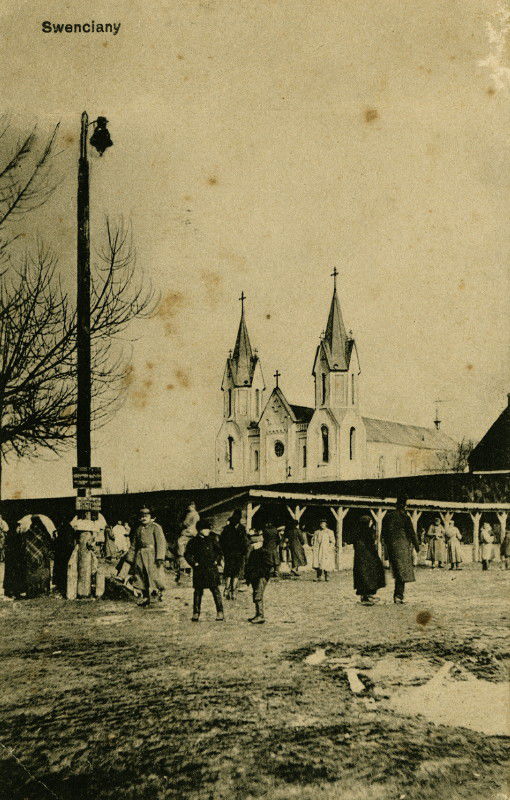
Antrame plane Visų Šventųjų bažnyčia.