About the Church
Alytus St Louis Church is one of those places where history and architecture merge into a unique object of cultural value. The church stands in Alytus, on the right bank of the Nemunas, and is a fine example of the Classicist era.
The church's history goes back to the 16th century, when the Marshal of Lithuania and Voivode of Trakai, Jonas Zaberezinskis, had the first church in this town built by 1520. As early as 1524 a parish was established, which for many years drew Catholics both from the town centre and from other parts of Alytus. Interestingly, under the founding charter the church's vicar was required to know the Lithuanian language – highlighting the importance of Lithuanian culture even in the medieval period.
In 1658 the church was rebuilt after being ravaged. Later, in 1763, a new wooden church was built, and in 1773 a parish school was founded. Unfortunately, in 1810 the town was struck by a huge fire, which also destroyed this church.
But the strength of the parish community did not allow it to remain without a house of prayer for long. In 1818–1820 the parish priest Liudvikas Kaminskas, together with the parishioners, built the present church, which still stands today. At that time the village of Skraičionys also belonged to the presbytery.
The church endured many trials, especially in the 20th century. In 1930 the parish priest Konstantinas Paulavičius extended and renovated it, added a small tower, and had the churchyard fence built of stone. Tragedy struck on 24 June 1941, when the Nazis shot the parish priest K. Paulavičius and the vicar Vincentas Mazurkevičius. They were buried in the churchyard, where a Rūpintojėlis (a figure of the Sorrowful Christ) now stands.
During the Second World War the church and its tower were damaged, but through the efforts of the priest Leonas Jakubauskas they were rebuilt around 1957. The church has a rectangular plan, with a low, massive tower, which gives it a particular sense of monumentality. The churchyard fence is also made of stone masonry, and buried within it is Bronislovas Novelskis (1905–1991), who served here as priest from 1956 until his death.
Alytus St Louis Church is not only a spiritual centre but also a significant part of the region's cultural heritage. Its walls attest not only to architectural changes but also to the history of a living community, whose strength and faith have kept this church's light from going out through the ages.
The church's history goes back to the 16th century, when the Marshal of Lithuania and Voivode of Trakai, Jonas Zaberezinskis, had the first church in this town built by 1520. As early as 1524 a parish was established, which for many years drew Catholics both from the town centre and from other parts of Alytus. Interestingly, under the founding charter the church's vicar was required to know the Lithuanian language – highlighting the importance of Lithuanian culture even in the medieval period.
In 1658 the church was rebuilt after being ravaged. Later, in 1763, a new wooden church was built, and in 1773 a parish school was founded. Unfortunately, in 1810 the town was struck by a huge fire, which also destroyed this church.
But the strength of the parish community did not allow it to remain without a house of prayer for long. In 1818–1820 the parish priest Liudvikas Kaminskas, together with the parishioners, built the present church, which still stands today. At that time the village of Skraičionys also belonged to the presbytery.
The church endured many trials, especially in the 20th century. In 1930 the parish priest Konstantinas Paulavičius extended and renovated it, added a small tower, and had the churchyard fence built of stone. Tragedy struck on 24 June 1941, when the Nazis shot the parish priest K. Paulavičius and the vicar Vincentas Mazurkevičius. They were buried in the churchyard, where a Rūpintojėlis (a figure of the Sorrowful Christ) now stands.
During the Second World War the church and its tower were damaged, but through the efforts of the priest Leonas Jakubauskas they were rebuilt around 1957. The church has a rectangular plan, with a low, massive tower, which gives it a particular sense of monumentality. The churchyard fence is also made of stone masonry, and buried within it is Bronislovas Novelskis (1905–1991), who served here as priest from 1956 until his death.
Alytus St Louis Church is not only a spiritual centre but also a significant part of the region's cultural heritage. Its walls attest not only to architectural changes but also to the history of a living community, whose strength and faith have kept this church's light from going out through the ages.
Gallery and Resources
Archive captions are shown in Lithuanian.
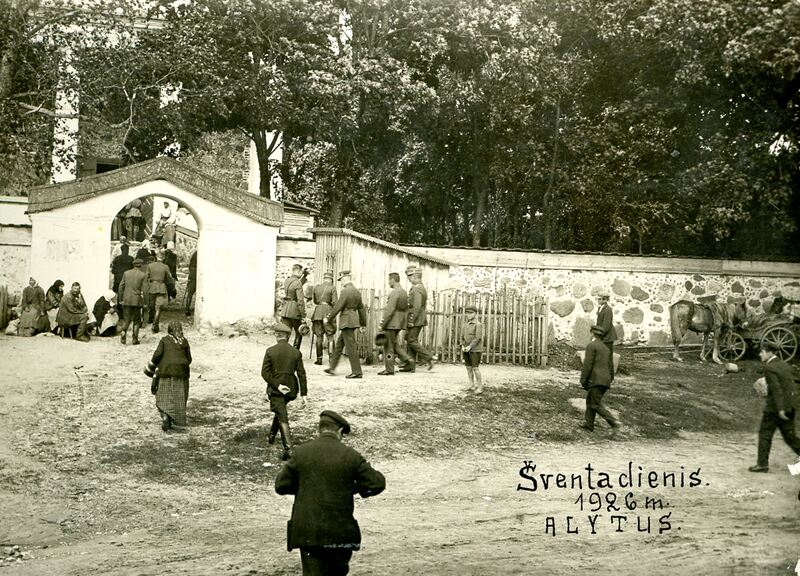
Į Alytaus Šv. Liudviko bažnyčią einantys kariai ir civiliai. Kairėje matosi bažnyčios vartai ir bažnyčios vaizdas pro medžius.
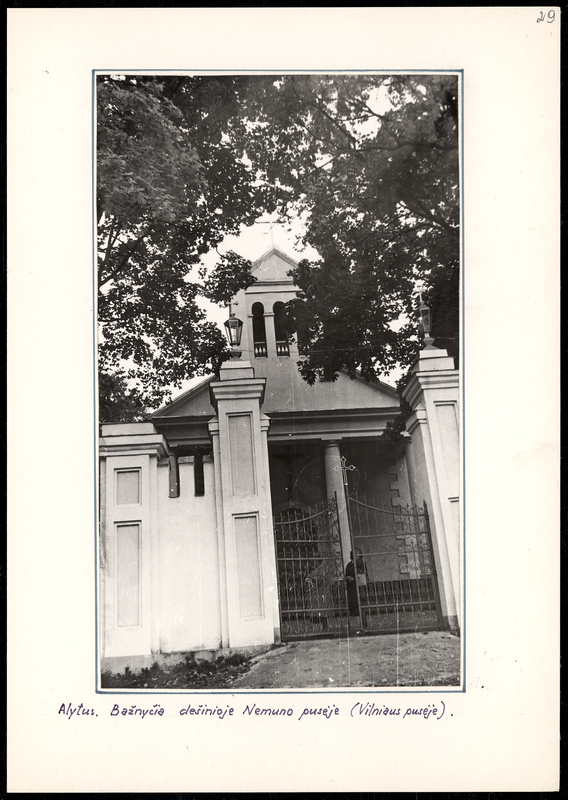
Alytaus Šv. Liudviko bažnyčia. Fotografijos aprašymas ant pasporto: „Alytus. Bažnyčia dešinioje Nemuno pusėje (Vilniaus pusėje).“