About the Church
The Church of the Blessed Virgin Mary, Queen of Angels, in Kruonis is one of those Lithuanian shrines that attracts both history enthusiasts and religious pilgrims with its rich history and impressive architecture.
The church stands in the small town of Kruonis, in Kaišiadorys district, and its history goes back as far as 1472, when Kazimieras Jogailaitis built the first wooden church here. However, the present building of the shrine has even deeper roots. Until 1626 an Orthodox church stood here, built by Bohdanas Oginskis, a colonel of the Grand Duchy of Lithuania and Chamberlain of Trakai. This building was later handed over to the Catholics and adapted for their needs.
This was not the only transformation the church underwent during its long existence. In 1866 the old wooden church was closed and demolished. In its place, a new wooden church was built in 1907, in which the Catholic parish was re-established. During this period the church became an important centre of local culture: a branch of the Lithuanian Catholic Temperance Society operated here, a choir was formed, and public events and performances were organised.
In the early 20th century the Orthodox church of Kruonis passed finally into Catholic hands. Although a masonry church was planned, in the end a simpler solution was chosen – to build a new wooden church, the material of which was later used to build a parish hall and almshouse.
Architecturally, the church of Kruonis is notable for its Renaissance features. The main building has a rectangular plan with a five-sided apse and two towers. Inside can be found 17th-century tombstones of purple marble, dedicated to Bohdanas Oginskis and his son Samuelis Levas Oginskis. These monuments represent the Renaissance style and the transition to Baroque.
This is a place where history, culture and religion intertwine, giving visitors a unique opportunity to sense the spirit of the past and admire works of architecture and art. Despite all the changes and challenges, this church has remained an important spiritual and cultural centre for the community of Kruonis.
The church stands in the small town of Kruonis, in Kaišiadorys district, and its history goes back as far as 1472, when Kazimieras Jogailaitis built the first wooden church here. However, the present building of the shrine has even deeper roots. Until 1626 an Orthodox church stood here, built by Bohdanas Oginskis, a colonel of the Grand Duchy of Lithuania and Chamberlain of Trakai. This building was later handed over to the Catholics and adapted for their needs.
This was not the only transformation the church underwent during its long existence. In 1866 the old wooden church was closed and demolished. In its place, a new wooden church was built in 1907, in which the Catholic parish was re-established. During this period the church became an important centre of local culture: a branch of the Lithuanian Catholic Temperance Society operated here, a choir was formed, and public events and performances were organised.
In the early 20th century the Orthodox church of Kruonis passed finally into Catholic hands. Although a masonry church was planned, in the end a simpler solution was chosen – to build a new wooden church, the material of which was later used to build a parish hall and almshouse.
Architecturally, the church of Kruonis is notable for its Renaissance features. The main building has a rectangular plan with a five-sided apse and two towers. Inside can be found 17th-century tombstones of purple marble, dedicated to Bohdanas Oginskis and his son Samuelis Levas Oginskis. These monuments represent the Renaissance style and the transition to Baroque.
This is a place where history, culture and religion intertwine, giving visitors a unique opportunity to sense the spirit of the past and admire works of architecture and art. Despite all the changes and challenges, this church has remained an important spiritual and cultural centre for the community of Kruonis.
Gallery and Resources
Archive captions are shown in Lithuanian.
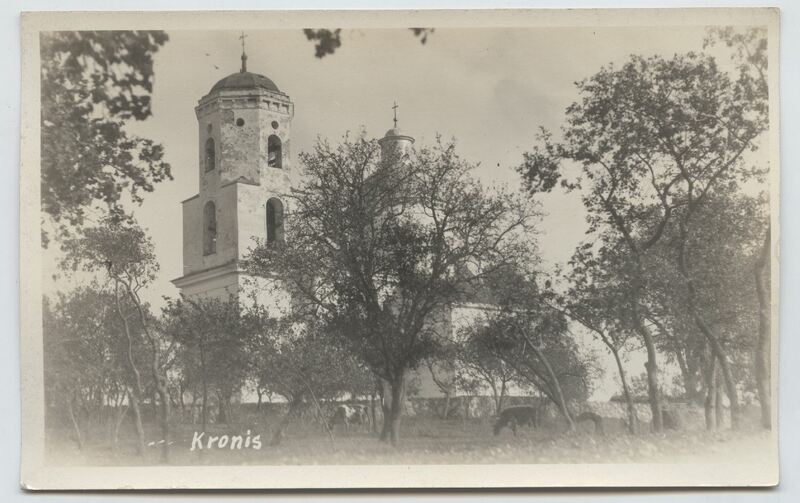
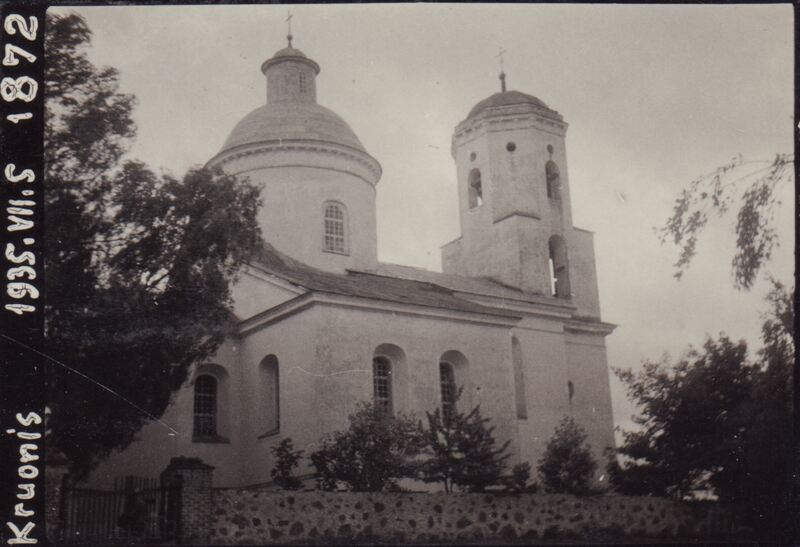
Bažnyčios vaizdas iš toliau. Bažnyčia pastatyta 1610 m., 1764 m.atstatyta ar perstatyta, ir 1836 m. perstatyta. Fotografas Stanislovas Kolupaila.