About the Church
The Church of the Assumption of the Blessed Virgin Mary in Darsūniškis is one of the most important and impressive historic sites in Darsūniškis, which lies on the right bank of the Nemunas. This church not only astonishes with its architectural beauty, but also has a long and rich history, which begins as far back as the 15th century.
It is believed that the first church in Darsūniškis was built in 1418. In 1473 it was granted households, and in 1492 it was given the right to receive part of the income from the manor of Jieznas and to build an inn. This church suffered many misfortunes: it burned down in 1655, but a new one was already built by 1694. In the 18th century the parish also functioned as a centre of education, with a parish school operating here.
In 1702 the Swedish army burned down the presbytery and the almshouse. A later church was built in 1780, but it too did not survive – it burned down in 1818. The current masonry church was built in 1848–1855. In the late 19th century parish priest Jotautas held services in Lithuanian, paying great attention to national identity and the preservation of the language.
The church also suffered during the Second World War. In 1944 artillery shells damaged the church: the ceiling collapsed, the walls cracked, and the wooden parts burned. Nevertheless, parish priest J. Kanoverskis, together with the parishioners, rebuilt it by 1950, restoring its former splendour.
Architecturally, the church of Darsūniškis is Classicist, with Baroque features. It has a rectangular plan and is towerless, with a three-aisled interior separated by piers. The church's vaults are shallow, and the churchyard is enclosed by a stone masonry wall, into which a bell tower is incorporated.
This architectural monument is undoubtedly significant not only in religious terms but also culturally and historically, demonstrating the resilience of the local people and their devotion to their traditions and faith.
It is believed that the first church in Darsūniškis was built in 1418. In 1473 it was granted households, and in 1492 it was given the right to receive part of the income from the manor of Jieznas and to build an inn. This church suffered many misfortunes: it burned down in 1655, but a new one was already built by 1694. In the 18th century the parish also functioned as a centre of education, with a parish school operating here.
In 1702 the Swedish army burned down the presbytery and the almshouse. A later church was built in 1780, but it too did not survive – it burned down in 1818. The current masonry church was built in 1848–1855. In the late 19th century parish priest Jotautas held services in Lithuanian, paying great attention to national identity and the preservation of the language.
The church also suffered during the Second World War. In 1944 artillery shells damaged the church: the ceiling collapsed, the walls cracked, and the wooden parts burned. Nevertheless, parish priest J. Kanoverskis, together with the parishioners, rebuilt it by 1950, restoring its former splendour.
Architecturally, the church of Darsūniškis is Classicist, with Baroque features. It has a rectangular plan and is towerless, with a three-aisled interior separated by piers. The church's vaults are shallow, and the churchyard is enclosed by a stone masonry wall, into which a bell tower is incorporated.
This architectural monument is undoubtedly significant not only in religious terms but also culturally and historically, demonstrating the resilience of the local people and their devotion to their traditions and faith.
Gallery and Resources
Archive captions are shown in Lithuanian.
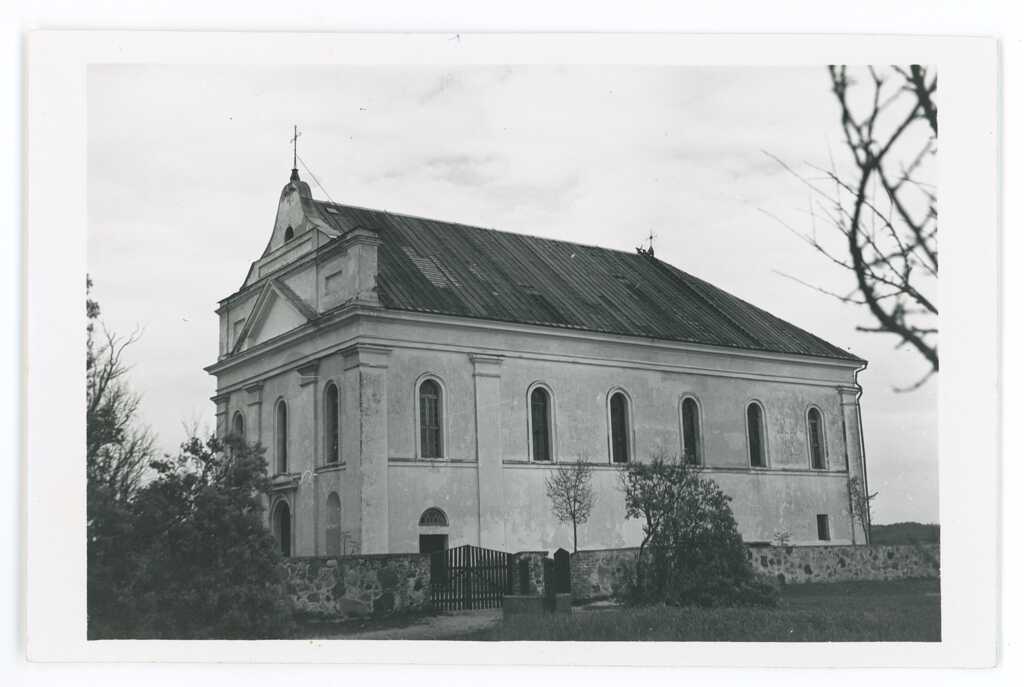
Darsūniškio Švč. Mergelės Marijos Ėmimo į dangų bažnyčia.