About the Church
The Church of Sts Peter and Paul, Apostles, in Lyduvėnai is not only a religious but also a historical and architectural monument, situated in a picturesque spot by the River Dratvens, on the right bank of this tributary of the Dubysa.
The church's history goes back to the second half of the 16th century, when it passed to the Evangelical Reformed church. Catholics were not long in returning, however: a Catholic church is already recorded here in 1613. In the early 18th century construction of a new masonry church began, but when the owner of the Lyduvėnai manor died the work was halted and resumed only in 1755. The church finally rose in 1761, thanks in large part to the Stanevičiai family, who as early as 1754 had donated land for the project.
Over the long years the church saw many changes. In the 19th century a parish school operated here, and its parish priest Antanas Opulskis was exiled to Siberia during the uprising of 1863, where he died. In the early 20th century the architect Nikolajus Andrejevas designed a new tower for the church, although it was not built entirely to the design and was only approved as satisfactory a few years later, in 1911. In 1914 a school of the "Saulė" Society was established at the church. During the Second World War the church was damaged, but was later rebuilt, though the tower remained lower than before.
Architecturally, the church of Lyduvėnai is distinguished by late Baroque features. It has a rectangular plan and a single-tower structure with a semicircular apse. The churchyard is enclosed by a masonry wall, and within its grounds is a cemetery that lends the site additional historical context.
When visiting Lyduvėnai, it is worth seeing not only the church itself but also walking through the surrounding landscape, sensing the atmosphere of centuries past and coming into touch with Lithuania's rich history.
The church's history goes back to the second half of the 16th century, when it passed to the Evangelical Reformed church. Catholics were not long in returning, however: a Catholic church is already recorded here in 1613. In the early 18th century construction of a new masonry church began, but when the owner of the Lyduvėnai manor died the work was halted and resumed only in 1755. The church finally rose in 1761, thanks in large part to the Stanevičiai family, who as early as 1754 had donated land for the project.
Over the long years the church saw many changes. In the 19th century a parish school operated here, and its parish priest Antanas Opulskis was exiled to Siberia during the uprising of 1863, where he died. In the early 20th century the architect Nikolajus Andrejevas designed a new tower for the church, although it was not built entirely to the design and was only approved as satisfactory a few years later, in 1911. In 1914 a school of the "Saulė" Society was established at the church. During the Second World War the church was damaged, but was later rebuilt, though the tower remained lower than before.
Architecturally, the church of Lyduvėnai is distinguished by late Baroque features. It has a rectangular plan and a single-tower structure with a semicircular apse. The churchyard is enclosed by a masonry wall, and within its grounds is a cemetery that lends the site additional historical context.
When visiting Lyduvėnai, it is worth seeing not only the church itself but also walking through the surrounding landscape, sensing the atmosphere of centuries past and coming into touch with Lithuania's rich history.
Gallery and Resources
Archive captions are shown in Lithuanian.
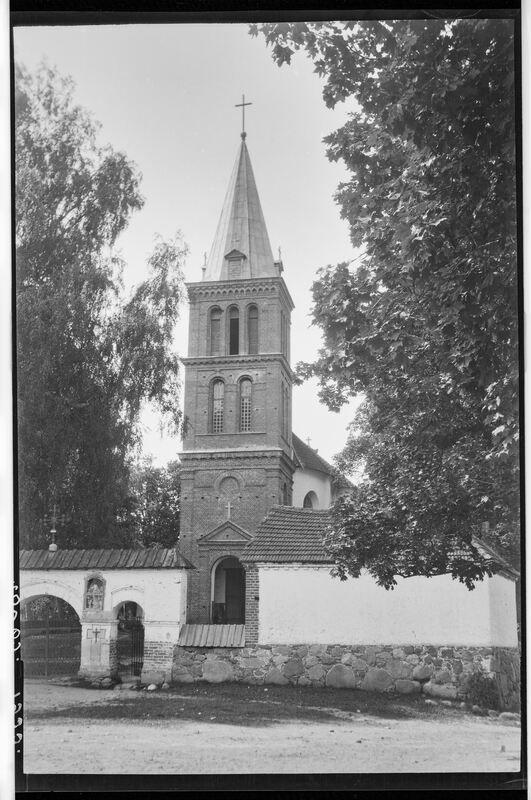
Bažnyčia, mūrinė, vienbokštė, nufotografuota kartu su šventoriaus vartais ir tvora.