About the Church
The Church of St Anthony of Padua in Žaiginys is an impressive wooden shrine standing in the small town of Žaiginys, on the left bank of the River Sandrava. Built in 1917, this church is a fine example of how a religious building can preserve its authenticity while adapting to the demands of its time.
The first church in Žaiginys was mentioned as early as 1664. It was a wooden building with two altars. In 1762 the Nagurskiai family invited Franciscans to Žaiginys and granted them a sizeable area of land and several villages. The Franciscans quickly set to work, building a monastery in 1764 and a new church in 1770. In the same year a chapel was built in Legečiai. By 1820 another wooden monastery had been built. Unfortunately, the Russian authorities closed the monastery in 1832, and it soon burned down. The local community did not give up, however — a presbytery was built on the foundations of the old monastery, and in 1836 a priest again took up residence at the church.
One of the greatest tragedies occurred on 4 May 1915, when the church burned down. A temporary chapel was set up in the Žaiginys manor, until in 1916–1917, under the care of the priest Leonas Skabeika, a new wooden church was built. At the same time the presbytery and farm buildings were rebuilt, and parish premises were built in 1931.
During and after the Second World War the church also went through difficulties. A kindergarten was set up in the presbytery, but the church itself remained active and continued to serve the local community.
Architecturally, the Church of St Anthony of Padua in Žaiginys is unique. In shape it resembles a dwelling house, is towerless, and has a three-sided apse. Inside there are three aisles separated by slender columns, and three altars. The churchyard's stone masonry fence with pillared gates gives the shrine a distinctive atmosphere. Within the churchyard stands a wooden bell tower, which completes the church's architectural ensemble.
This church not only testifies to the religious and cultural history of the small town of Žaiginys, but also shows the strong determination of the local community to preserve its spiritual heritage despite various trials.
The first church in Žaiginys was mentioned as early as 1664. It was a wooden building with two altars. In 1762 the Nagurskiai family invited Franciscans to Žaiginys and granted them a sizeable area of land and several villages. The Franciscans quickly set to work, building a monastery in 1764 and a new church in 1770. In the same year a chapel was built in Legečiai. By 1820 another wooden monastery had been built. Unfortunately, the Russian authorities closed the monastery in 1832, and it soon burned down. The local community did not give up, however — a presbytery was built on the foundations of the old monastery, and in 1836 a priest again took up residence at the church.
One of the greatest tragedies occurred on 4 May 1915, when the church burned down. A temporary chapel was set up in the Žaiginys manor, until in 1916–1917, under the care of the priest Leonas Skabeika, a new wooden church was built. At the same time the presbytery and farm buildings were rebuilt, and parish premises were built in 1931.
During and after the Second World War the church also went through difficulties. A kindergarten was set up in the presbytery, but the church itself remained active and continued to serve the local community.
Architecturally, the Church of St Anthony of Padua in Žaiginys is unique. In shape it resembles a dwelling house, is towerless, and has a three-sided apse. Inside there are three aisles separated by slender columns, and three altars. The churchyard's stone masonry fence with pillared gates gives the shrine a distinctive atmosphere. Within the churchyard stands a wooden bell tower, which completes the church's architectural ensemble.
This church not only testifies to the religious and cultural history of the small town of Žaiginys, but also shows the strong determination of the local community to preserve its spiritual heritage despite various trials.
Gallery and Resources
Archive captions are shown in Lithuanian.
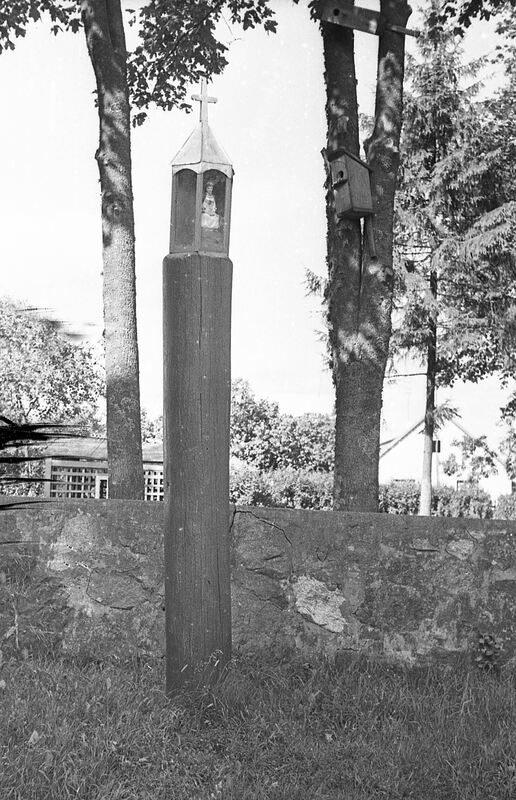
Koplytstulpis Žaiginio Šv. Antano Paduviečio bažnyčios šventoriuje. Medinė bažnyčia pastatyta 1917 m.