About the Church
The Basilica of the Nativity of the Blessed Virgin Mary in Šiluva is a unique gem of Lithuanian sacred architecture, set in the small town of Šiluva. The church is a fine example of the late Baroque style and unquestionably one of the most important Catholic shrines in Lithuania.
The church's history begins as early as the 15th century, when in 1457 the nobleman Petras Simonas Gedgaudas founded the first wooden church in Šiluva. It is worth noting that this act was not only religious but also political, aimed at strengthening Christianity in the region. The church was endowed with as many as 146 valakai of land, testifying to its importance and influence over the local community.
In the 17th century Šiluva became the scene of a merciless conflict between religious groups. Catholics and Evangelical Reformed believers fought over the land and ownership rights to the church. The struggle did not go without armed clashes, and a particularly painful date was 1669, when a serious confrontation took place between the two sides. The conflict was finally resolved only by a court ruling of 1622, which returned their rightful lands to the Catholics.
The Basilica of Šiluva is renowned for its miraculous image of the Blessed Virgin Mary, found on the high altar. It is said that around 1608 the Blessed Virgin Mary appeared in Šiluva with the infant in her arms. This was a highly significant event that drew the attention of numerous pilgrims and spurred a religious revival in the region. The image was restored and adorned with a silver riza in 1674.
The basilica also has a rich architectural heritage. Construction of the masonry church began in 1760 and was completed in 1775, under the direction of Tadas Bukota. The interior is decorated with ornamentation by T. Podgaiskis, while the exterior features red brick masonry with white plastered accents. The basilica contains the Chapel of Our Lady, Health of the Sick, where prayers are offered for the health of the sick. In the town cemetery stands another important chapel — the Chapel of the Apparition of the Blessed Virgin Mary, built in 1924.
The importance and significance of the basilica is also attested by the fact that it was visited by Pope John Paul II in 1993, and in 2008 the complex was granted the status of a cultural monument. This shows that the site is a place of historical as well as religious value.
Although over its long history the basilica has endured many trials, including a fire in 1892 that destroyed the towers and roof, it has always been rebuilt and restored. Today it remains one of the most important symbols of religion and culture in Lithuania, drawing pilgrims and history enthusiasts alike from every corner of the world.
The church's history begins as early as the 15th century, when in 1457 the nobleman Petras Simonas Gedgaudas founded the first wooden church in Šiluva. It is worth noting that this act was not only religious but also political, aimed at strengthening Christianity in the region. The church was endowed with as many as 146 valakai of land, testifying to its importance and influence over the local community.
In the 17th century Šiluva became the scene of a merciless conflict between religious groups. Catholics and Evangelical Reformed believers fought over the land and ownership rights to the church. The struggle did not go without armed clashes, and a particularly painful date was 1669, when a serious confrontation took place between the two sides. The conflict was finally resolved only by a court ruling of 1622, which returned their rightful lands to the Catholics.
The Basilica of Šiluva is renowned for its miraculous image of the Blessed Virgin Mary, found on the high altar. It is said that around 1608 the Blessed Virgin Mary appeared in Šiluva with the infant in her arms. This was a highly significant event that drew the attention of numerous pilgrims and spurred a religious revival in the region. The image was restored and adorned with a silver riza in 1674.
The basilica also has a rich architectural heritage. Construction of the masonry church began in 1760 and was completed in 1775, under the direction of Tadas Bukota. The interior is decorated with ornamentation by T. Podgaiskis, while the exterior features red brick masonry with white plastered accents. The basilica contains the Chapel of Our Lady, Health of the Sick, where prayers are offered for the health of the sick. In the town cemetery stands another important chapel — the Chapel of the Apparition of the Blessed Virgin Mary, built in 1924.
The importance and significance of the basilica is also attested by the fact that it was visited by Pope John Paul II in 1993, and in 2008 the complex was granted the status of a cultural monument. This shows that the site is a place of historical as well as religious value.
Although over its long history the basilica has endured many trials, including a fire in 1892 that destroyed the towers and roof, it has always been rebuilt and restored. Today it remains one of the most important symbols of religion and culture in Lithuania, drawing pilgrims and history enthusiasts alike from every corner of the world.
Gallery and Resources
Archive captions are shown in Lithuanian.

Šiluvos miestelio vaizdas žiūrint nuo Lyduvėnų pusės. Vaizde matosi mediniai pastatai, Švč. Mergelės Marijos apsireiškimo koplyčia ir Švč. Mergelės Marijos gimimo bazilika.
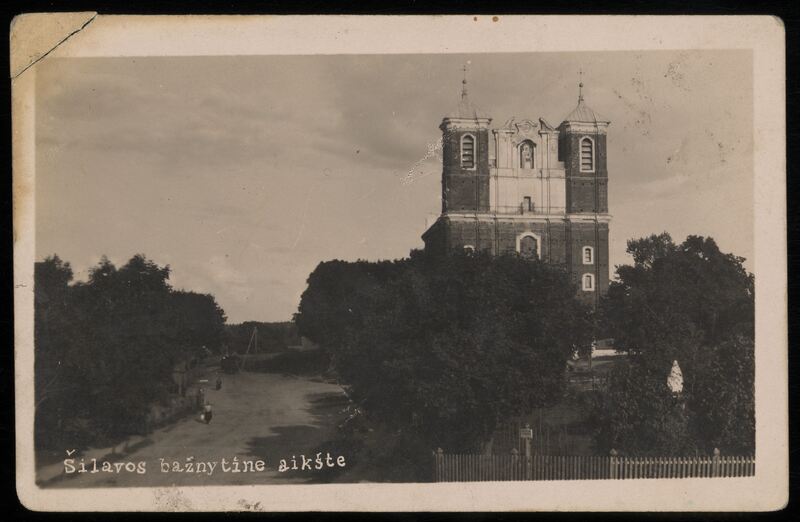
Šiluvos Švč. Mergelės Marijos Gimimo bazilika ir aikštė.