About the Church
The Church of St Martin, Bishop, in Šimkaičiai is a subtle and history-rich shrine, standing in the picturesque town of Šimkaičiai. This wooden church, built in 1932, is a fine example of a combination of Gothic Revival and vernacular architecture. Its history goes back as far as the 18th century, when the first chapel was built in 1771.
After the First World War, as the community's needs grew, thoughts turned to a new church. Having returned from the war, local farmers Jonas Simanavičius and Šaulys, a native of Vadžgirys, donated plots of land, on which the present church then rose. The initiator and organiser of the construction work was parish priest Stanislovas Kemzūra, who also led the first Mass on the opening day – the second day of Christmas, 1932.
The church's interior and exterior are no less impressive than its history. It draws attention with its large facade tower, covered with galvanised sheet metal, as well as its Latin-cross plan and a churchyard enclosed by a wooden fence. Inside the church are three altars, painted pictures of the "Stations", and paintings of the Sacred Heart of Jesus and of St Martin, Bishop and Confessor.
During the Second World War the church suffered considerable damage – it was pitted with bullets and shrapnel, and the surrounding buildings burned down. Despite this, the community successfully rebuilt the shrine. In 1995, on the initiative of the local forester Adolfas Šiugžda, a new oak cross was erected, replacing the old one, put up in 1939.
It is interesting that the parish has long been known for the feast of St John the Baptist, which draws the faithful from the whole region. This feast not only strengthens the spirit of the local community but also upholds deep Christian traditions.
It is extremely important to mention the church's architectural details too: 17 crosses on the roof, a decorative balustrade, stairs to the choir loft, and a small bell in one of the towers. All of this creates a unique atmosphere, further enhanced by richly decorated interior details.
The Church of St Martin, Bishop, in Šimkaičiai is not only a house of prayer but also a cultural and historical monument, recalling many important events and people who helped it become what it is today.
After the First World War, as the community's needs grew, thoughts turned to a new church. Having returned from the war, local farmers Jonas Simanavičius and Šaulys, a native of Vadžgirys, donated plots of land, on which the present church then rose. The initiator and organiser of the construction work was parish priest Stanislovas Kemzūra, who also led the first Mass on the opening day – the second day of Christmas, 1932.
The church's interior and exterior are no less impressive than its history. It draws attention with its large facade tower, covered with galvanised sheet metal, as well as its Latin-cross plan and a churchyard enclosed by a wooden fence. Inside the church are three altars, painted pictures of the "Stations", and paintings of the Sacred Heart of Jesus and of St Martin, Bishop and Confessor.
During the Second World War the church suffered considerable damage – it was pitted with bullets and shrapnel, and the surrounding buildings burned down. Despite this, the community successfully rebuilt the shrine. In 1995, on the initiative of the local forester Adolfas Šiugžda, a new oak cross was erected, replacing the old one, put up in 1939.
It is interesting that the parish has long been known for the feast of St John the Baptist, which draws the faithful from the whole region. This feast not only strengthens the spirit of the local community but also upholds deep Christian traditions.
It is extremely important to mention the church's architectural details too: 17 crosses on the roof, a decorative balustrade, stairs to the choir loft, and a small bell in one of the towers. All of this creates a unique atmosphere, further enhanced by richly decorated interior details.
The Church of St Martin, Bishop, in Šimkaičiai is not only a house of prayer but also a cultural and historical monument, recalling many important events and people who helped it become what it is today.
Gallery and Resources
Archive captions are shown in Lithuanian.
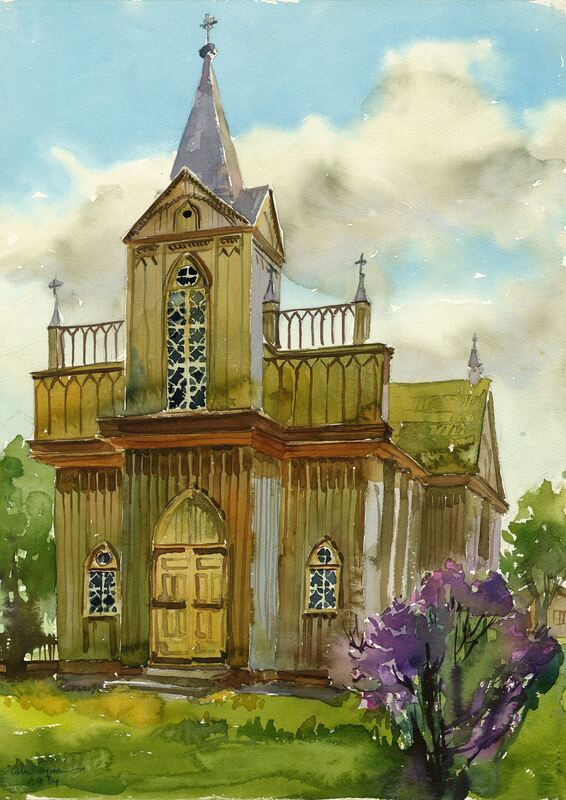
Kompozicijoje – Šimkaičių Šv. vyskupo Martyno bažnyčia.
Signuotas averso apatinėje dalyje kairėje.