About the Church
The Church of St John Nepomucene at Vadaktėliai stands in the small village of Vadaktėliai, just 7 kilometres south of Naujamiestis, on the right bank of the Nevėžis. Although built in 1910, this wooden church has deep historical roots and architectural features combining Neo-Gothic and vernacular elements.
The church's history begins as far back as the 18th century, when documents of 1773 mention that the chapel at Vadaktėliai was being repaired. It is thought that its founder was the Duke of Courland, Peter Biron. The high altar, one of the most important elements of the church's interior, was made between 1773 and 1880. The priest Aleksandras Beresnevičius consecrated this chapel in 1881, by which time it had already been repaired thanks to Izabelė and Ivonas Kopanskis.
One of the most notable curates of this church was the priest Juozas Tumas-Vaižgantas, who served here from 1902 to 1905. During his time the church was especially active in cultural life. Later, in 1910, on the initiative of the priest Aleksandras Garnevičius, towers were added to the church and a major renovation was carried out. This reconstruction gave the church its present two-tower appearance.
In 1930 the church at Vadaktėliai became the centre of the parish. After the Second World War the parish priest Gediminas Ignas Blynas revived the community's spiritual life – he formed a parish choir and took care of the catechesis of children. In 1956 the parish priest Alfonsas Kadžius, having returned from Siberia, painted the church himself, thereby contributing to its preservation.
The church's architectural aspects are also of interest. It has a rectangular plan with a three-sided apse and two main towers as well as one smaller turret. Inside can be seen a bell cast in 1725, a late-18th-century portrait of Duke P. Biron, a font, and works by the sculptor V. Svirskis — “St Peter” and “St Paul”. The churchyard is surrounded by a hedge, and the cemetery within it lends the place a sense of peace and antiquity.
This church not only serves as a place of religious rites but is also an important cultural and historical asset in the Panevėžys region. It is a place where the shadows of the past merge with the present, allowing visitors to feel the passage of time and the weight of history.
The church's history begins as far back as the 18th century, when documents of 1773 mention that the chapel at Vadaktėliai was being repaired. It is thought that its founder was the Duke of Courland, Peter Biron. The high altar, one of the most important elements of the church's interior, was made between 1773 and 1880. The priest Aleksandras Beresnevičius consecrated this chapel in 1881, by which time it had already been repaired thanks to Izabelė and Ivonas Kopanskis.
One of the most notable curates of this church was the priest Juozas Tumas-Vaižgantas, who served here from 1902 to 1905. During his time the church was especially active in cultural life. Later, in 1910, on the initiative of the priest Aleksandras Garnevičius, towers were added to the church and a major renovation was carried out. This reconstruction gave the church its present two-tower appearance.
In 1930 the church at Vadaktėliai became the centre of the parish. After the Second World War the parish priest Gediminas Ignas Blynas revived the community's spiritual life – he formed a parish choir and took care of the catechesis of children. In 1956 the parish priest Alfonsas Kadžius, having returned from Siberia, painted the church himself, thereby contributing to its preservation.
The church's architectural aspects are also of interest. It has a rectangular plan with a three-sided apse and two main towers as well as one smaller turret. Inside can be seen a bell cast in 1725, a late-18th-century portrait of Duke P. Biron, a font, and works by the sculptor V. Svirskis — “St Peter” and “St Paul”. The churchyard is surrounded by a hedge, and the cemetery within it lends the place a sense of peace and antiquity.
This church not only serves as a place of religious rites but is also an important cultural and historical asset in the Panevėžys region. It is a place where the shadows of the past merge with the present, allowing visitors to feel the passage of time and the weight of history.
Gallery and Resources
Archive captions are shown in Lithuanian.
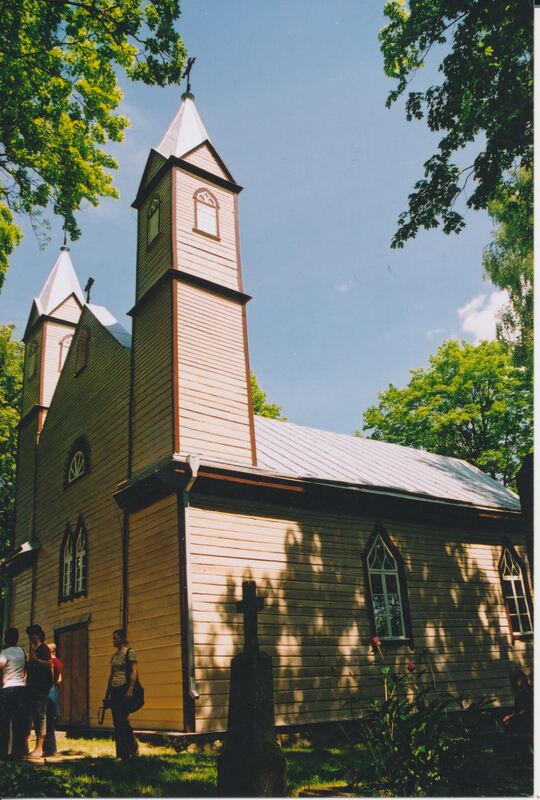
Nuotraukoje Vadaktėlių bažnytėlė, kurioje 1902-1905m. kunigavo Vaižgantas.
Juozas Tumas-Vaižgantas (1869 m. rugsėjo 20 d. Maleišiuose, Svėdasų valsčius – 1933 m. balandžio 29 d. Kaune) – Lietuvos rašytojas, spaudos darbuotojas, literatūros istorikas, kritikas, visuomenės veikėjas, pedagogas, kunigas.