About the Church
The Church of St Bartholomew the Apostle in Raudėnai is a splendid example of wooden sacred architecture, situated in the village of Raudėnai, just 10 kilometres south-east of Tryškiai and 1 kilometre north of the road linking Šiauliai and Palanga. This church not only charms with its architecture but also has a long and rich history.
A chapel was first built on this site as far back as 1550. More than half a century later, in 1611, the manor administrator Baltramiejus Berdovskis built a wooden church here, which became an important centre for the local community. The church was rebuilt in 1739, and by 1805 it already had 1.5 valakai of land.
In the early 19th century a parish school operated by the church, contributing to the education and cultural life of local residents. The present wooden church was built in 1881, through the efforts of the priest Antanas Stankevičius. In 1882 church furnishings and paintings were transferred to the new church from the old one.
The church of St Bartholomew in Raudėnai is distinguished by its cruciform-plan architecture and single-tower structure, crowned with a turret. The church has as many as six altars inside, testifying to a rich religious heritage and aesthetic beauty. The churchyard wall, built of stone masonry, adds further historical and architectural value to the site.
It is worth noting that the church was repainted in 2015, refreshing its appearance and further emphasising its historical significance.
The Church of St Bartholomew the Apostle in Raudėnai is a fine example of how small Lithuanian settlements can have deep religious and cultural traditions, preserved and cherished over the centuries. Every visit to this church is like a journey into the past, where one can feel the spirit of former times and understand the faith and daily life of our ancestors.
A chapel was first built on this site as far back as 1550. More than half a century later, in 1611, the manor administrator Baltramiejus Berdovskis built a wooden church here, which became an important centre for the local community. The church was rebuilt in 1739, and by 1805 it already had 1.5 valakai of land.
In the early 19th century a parish school operated by the church, contributing to the education and cultural life of local residents. The present wooden church was built in 1881, through the efforts of the priest Antanas Stankevičius. In 1882 church furnishings and paintings were transferred to the new church from the old one.
The church of St Bartholomew in Raudėnai is distinguished by its cruciform-plan architecture and single-tower structure, crowned with a turret. The church has as many as six altars inside, testifying to a rich religious heritage and aesthetic beauty. The churchyard wall, built of stone masonry, adds further historical and architectural value to the site.
It is worth noting that the church was repainted in 2015, refreshing its appearance and further emphasising its historical significance.
The Church of St Bartholomew the Apostle in Raudėnai is a fine example of how small Lithuanian settlements can have deep religious and cultural traditions, preserved and cherished over the centuries. Every visit to this church is like a journey into the past, where one can feel the spirit of former times and understand the faith and daily life of our ancestors.
Gallery and Resources
Archive captions are shown in Lithuanian.
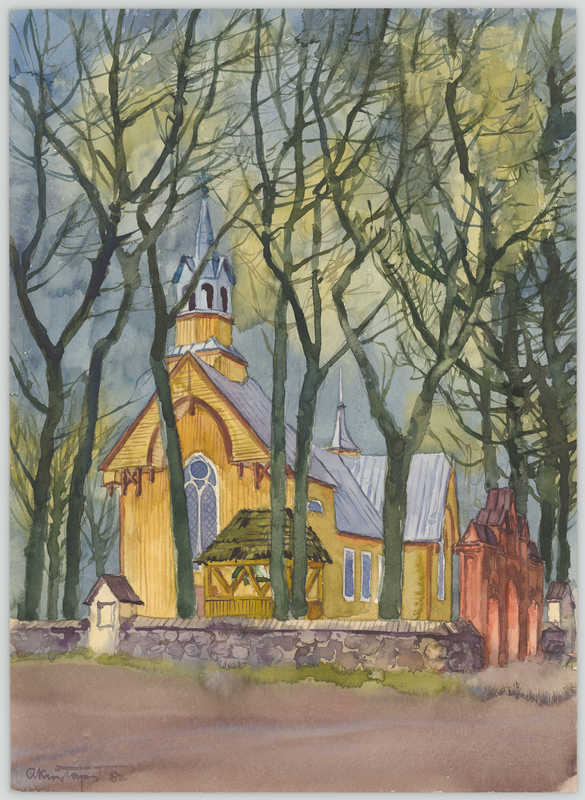
Raudėnų Šv. apaštalo Baltramiejaus bažnyčia.
Signuotas akvarele averso apatinėje dalyje kairėje, pieštuku reverso viršutinėje dalyje kairėje.