About the Church
The history of the Church of St Lawrence at Stačiūnai begins as early as the mid-17th century, when the first chapel was built on this site in 1668. Unfortunately it did not survive for long – it collapsed in 1729, but was soon rebuilt. A few decades later, in 1765, a new chapel was erected.
Interestingly, it was only in 1779 that the first permanent priest was assigned to Stačiūnai, and the chapel became a filial church. Already the following year parish registers began to be kept, recording moments of parish life. In 1781 the church was granted one valakas of land, testifying to its importance for the local community.
In 1811 the present wooden Church of St Lawrence at Stačiūnai was built. It is a building in vernacular architectural forms, with a rectangular plan, a turret and a semicircular apse, which still catches the eye today with its simplicity and harmony with nature. The churchyard fence is built of stone masonry, and a wooden bell tower stands within its grounds. The church's churchyard also holds the grave of the priest and historian Petras Veblaitis, who is buried in the Stačiūnai cemetery.
Let us not forget that the Vismantai chapel also operates within the parish, additionally serving the faithful of the surrounding area.
This church is not only a religious centre but also a piece of cultural heritage, reflecting the region's traditions and history. With its unique architectural style and long history, it bears witness to the faith and sense of community of local residents over many years.
Interestingly, it was only in 1779 that the first permanent priest was assigned to Stačiūnai, and the chapel became a filial church. Already the following year parish registers began to be kept, recording moments of parish life. In 1781 the church was granted one valakas of land, testifying to its importance for the local community.
In 1811 the present wooden Church of St Lawrence at Stačiūnai was built. It is a building in vernacular architectural forms, with a rectangular plan, a turret and a semicircular apse, which still catches the eye today with its simplicity and harmony with nature. The churchyard fence is built of stone masonry, and a wooden bell tower stands within its grounds. The church's churchyard also holds the grave of the priest and historian Petras Veblaitis, who is buried in the Stačiūnai cemetery.
Let us not forget that the Vismantai chapel also operates within the parish, additionally serving the faithful of the surrounding area.
This church is not only a religious centre but also a piece of cultural heritage, reflecting the region's traditions and history. With its unique architectural style and long history, it bears witness to the faith and sense of community of local residents over many years.
Gallery and Resources
Archive captions are shown in Lithuanian.
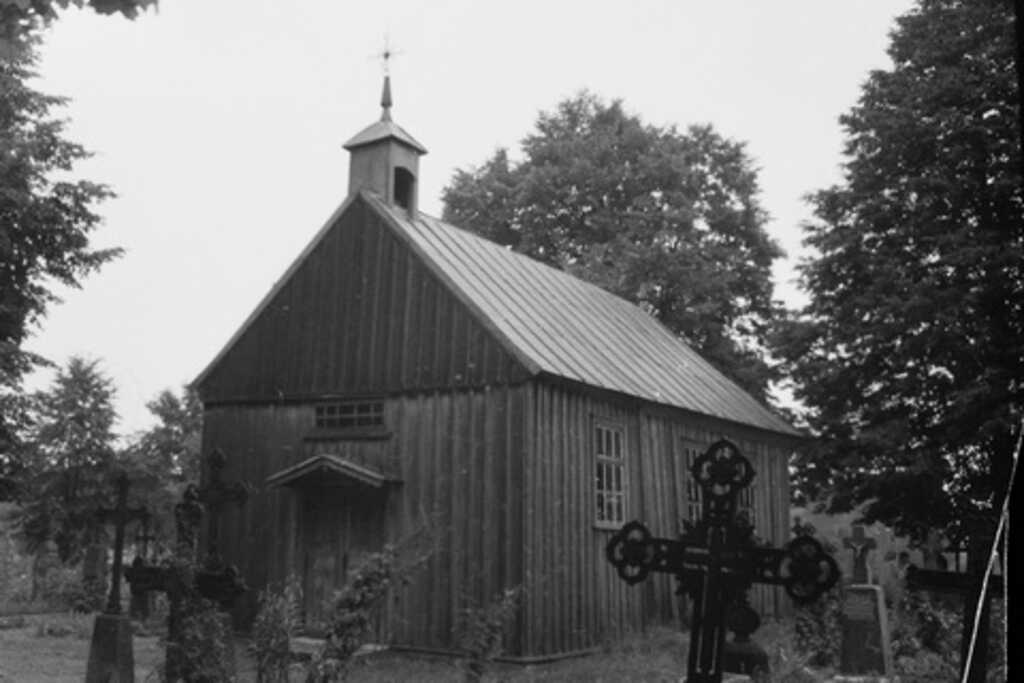
Stačiūnų Šv. Lauryno bažnyčios fasadas.