About the Church
The Laukuva Church of the Finding of the Holy Cross is a distinctive architectural monument, standing in Samogitia, in the town of Laukuva. It belongs to the Diocese of Telšiai and the Šilalė Deanery. The present masonry church was built in 1856, of stone and brick masonry. Its style reflects the features of Historicist architecture, and the design was prepared by the architect Timofeyev.
The church's history goes back to 1624, when Jonas Talaitis built the first wooden church and founded the parish. Over time the church was rebuilt several times and changed location: a church built in Ivoniškis in 1689 stood until 1863, when it was demolished after the uprising. Construction of the present masonry church began after the previous church burned down in 1829. The building work was initiated by the parish priest Matas Narkevičius, the manor lord Vladas Tallat-Kelpša and other parishioners. The church's cornerstone was blessed by Bishop Motiejus Valančius, and the construction work was carried out by the master builder Kalėda. The church was finally consecrated in 1893 by Bishop Mečislovas Paliulionis.
The Laukuva church has not only a rich history but also distinctive architecture. The rectangular-plan, two-towered church is surrounded by a stone masonry wall. Works of art survive inside the church, including Art Deco-style painting and national motifs on the walls and ceiling. One of the main decorative features, in the vault of the chancel, is a scene depicting Christ preaching from a boat. Also surviving are 19th-century painted consecration crosses with episcopal attributes.
During the First World War the Germans took away two of the church's bells, but the church survived and has been continuously maintained and restored. Major restoration work was completed in 2022, revealing many old artistic details.
Also buried in the churchyard is the renowned translator of the Holy Scriptures into Lithuanian, Monsignor Antanas Rubšys, a further reminder of the church's importance not only as a religious but also a cultural site.
Together with the nearby chapels in Dvarviečiai, Laukuva and Šiauduva, the church forms a unified religious complex, whose history and architecture attract visitors and worshippers from every corner of Lithuania.
The church's history goes back to 1624, when Jonas Talaitis built the first wooden church and founded the parish. Over time the church was rebuilt several times and changed location: a church built in Ivoniškis in 1689 stood until 1863, when it was demolished after the uprising. Construction of the present masonry church began after the previous church burned down in 1829. The building work was initiated by the parish priest Matas Narkevičius, the manor lord Vladas Tallat-Kelpša and other parishioners. The church's cornerstone was blessed by Bishop Motiejus Valančius, and the construction work was carried out by the master builder Kalėda. The church was finally consecrated in 1893 by Bishop Mečislovas Paliulionis.
The Laukuva church has not only a rich history but also distinctive architecture. The rectangular-plan, two-towered church is surrounded by a stone masonry wall. Works of art survive inside the church, including Art Deco-style painting and national motifs on the walls and ceiling. One of the main decorative features, in the vault of the chancel, is a scene depicting Christ preaching from a boat. Also surviving are 19th-century painted consecration crosses with episcopal attributes.
During the First World War the Germans took away two of the church's bells, but the church survived and has been continuously maintained and restored. Major restoration work was completed in 2022, revealing many old artistic details.
Also buried in the churchyard is the renowned translator of the Holy Scriptures into Lithuanian, Monsignor Antanas Rubšys, a further reminder of the church's importance not only as a religious but also a cultural site.
Together with the nearby chapels in Dvarviečiai, Laukuva and Šiauduva, the church forms a unified religious complex, whose history and architecture attract visitors and worshippers from every corner of Lithuania.
Gallery and Resources
Archive captions are shown in Lithuanian.
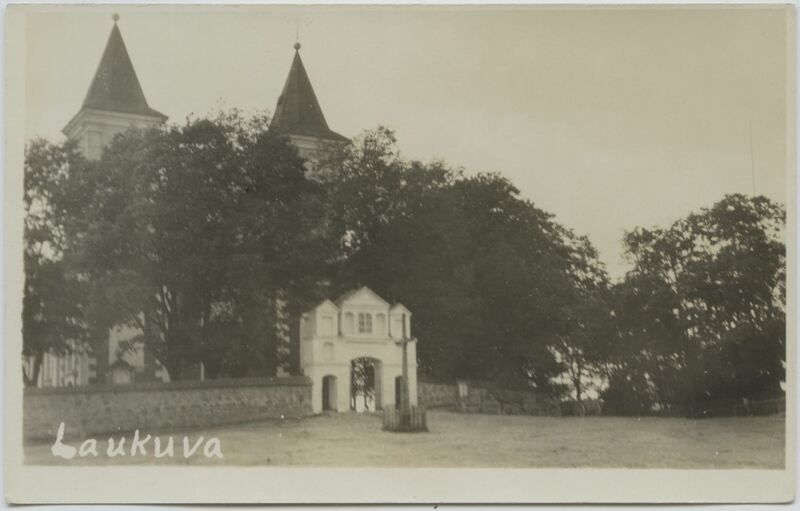
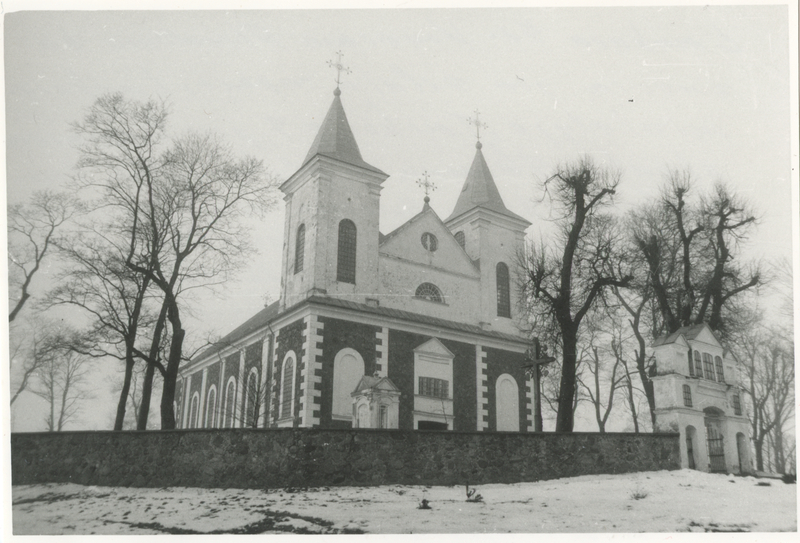
NEGATYVAS. Aut. A. Beresnevičius. Plungė, 1994 m. Fotojuosta. 3,5×3,5.
Laukuvos Šv. Kryžiaus Atradimo bažnyčia.