About the Church
The church's history goes back to the 17th century. The first church in Pikeliai was ravaged in 1625 during an attack by the Protestant Melchior Bilevičius. However, it was already rebuilt by 1636, as attested by an inscription found there: "Anno Dom. 1636 K. Pr. Aejtowicz". The present church has a single nave, with two side aisles added later, and as many as seven ornate altars.
The beauty and decoration of the altars are marked by the particular influence of their founders – they were sponsored by Mykolas Važinskis, treasurer of the Grand Duchy of Lithuania, as well as by the noble families of the Sapiegos, the Gadonai and the Stirpeikos. In these altars local Samogitian woodcarving is beautifully combined with work by masters of European standing, which is why this church is considered one of the most beautiful wooden churches in Lithuania.
Over the course of its history, the church has been renewed and repaired more than once. In 1756 it was given two valakai of land, and in 1857 permission was granted to add a second sacristy. After repairs in 1880 it still continued its important mission in the community. However, during the Second World War, in 1944, the church suffered damage – its tower was toppled and the wooden bell tower burned down. Despite these setbacks, the church survived and was restored in 2021, recovering not only its outer beauty but also its functionality.
The Pikeliai Church of the Holy Trinity is a site of historical as well as architectural significance – the well-known Lithuanian army general Povilas Plechavičius was baptised here.
Architecturally, the church has a rectangular plan, no tower, a tall roof and a three-sided apse. Its main tower was destroyed during the war but has now been rebuilt. Inside there are seven altars, each shining with its own unique artistic style.
A visit to the Pikeliai Church of the Holy Trinity allows one to feel not only the religious spirit but also to become acquainted with the rich history of Lithuanian culture and art. It is a place where the past merges with the present, where every detail tells its own unique story, drawing visitors into an extraordinary journey through time.
Gallery and Resources
Archive captions are shown in Lithuanian.
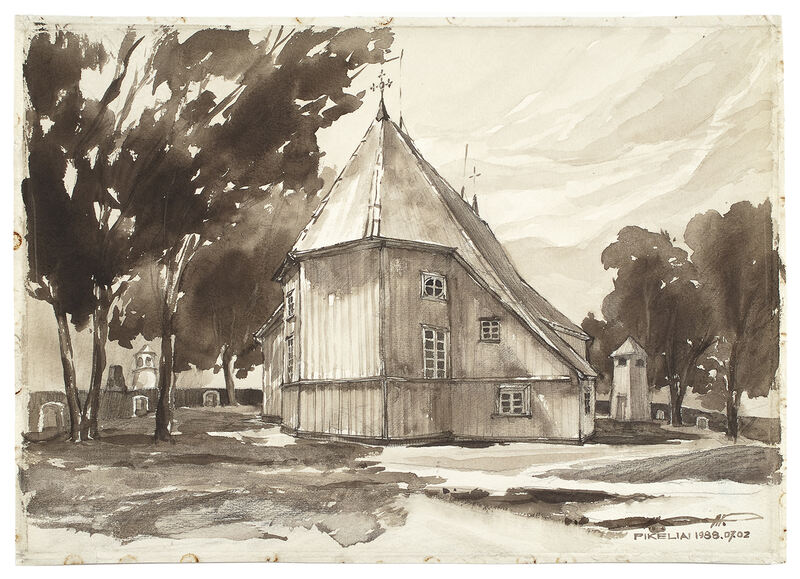
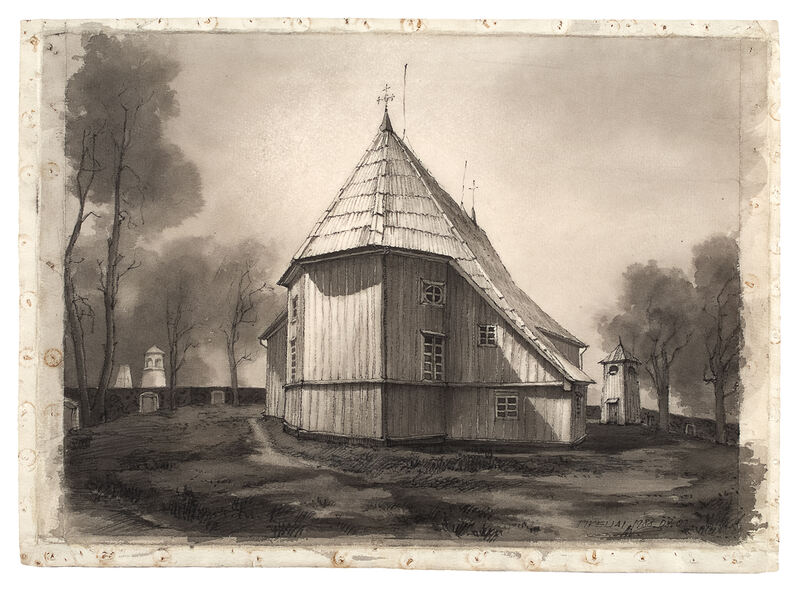
Dabartinė Pikelių Švč. Trejybės bažnyčia pastatyta 1752 m. Antrojo pasaulinio karo pabaigoje, 1944 m., artilerijos sviedinys nugriovė bažnyčios bokštą ir sunaikino senąją varpinę. Arūno Paslaičio piešinyje šventovė be bokštų, o prie šventoriaus tvoros matoma nedidelė medinė varpinė buvo naujai pastatyta pokario metais. Dabar Pikelių bažnyčia jau atgavusi senąją, kelis šimtmečius turėtą, išvaizdą: 2021 m. atstatytas senasis bokštas ir abu šoniniai bokšteliai. Vaizdo kairėje pusėje matomas 1827 m. pastatytas apvalus koplytstulpis 1710 m. maro aukoms atminti.
Dabartinė Pikelių Švč. Trejybės bažnyčia pastatyta 1752 m. Antrojo pasaulinio karo pabaigoje, 1944 m., artilerijos sviedinys nugriovė bažnyčios bokštą ir sunaikino senąją varpinę. Arūno Paslaičio piešinyje šventovė be bokštų, o prie šventoriaus tvoros matoma nedidelė medinė varpinė buvo naujai pastatyta pokario metais. Dabar Pikelių bažnyčia jau atgavusi senąją, kelis šimtmečius turėtą, išvaizdą: 2021 m. atstatytas senasis bokštas ir abu šoniniai bokšteliai. Vaizdo kairėje pusėje matomas 1827 m. pastatytas apvalus koplytstulpis 1710 m. maro aukoms atminti.