About the Church
The first church in Ukrinai was built in 1776, when the landowner Wawrzyniec Piłsudski generously donated a plot of land for its construction. It is thought that Piłsudski himself initiated the building of the first wooden church, whose high altar was consecrated as early as 1784. Later, in 1803, the nobility of Ukrinai and Bukantė built a new church, which had three altars and a five-sided pulpit with statues of the Evangelists. Unfortunately, this church burned down in 1852.
Despite the tragedy of the fire, the community did not give up. In 1857 the present wooden church was built at the parishioners' expense, its architecture echoing the forms of the earlier church. The church was extended in 1913 and renovated several times over the years – the last major restoration work was carried out in 2019.
This church is notable for its unique style. It has a rectangular plan and a single nave, with an organ loft above the narthex, two small towers and a three-sided apse. Three altars adorn the interior. The central altar is especially valuable for its sculpture of the Crucified Christ and its painting of St Anthony of Padua, which is adorned with votive offerings – symbols of special prayers. The left altar depicts St Francis of Assisi, and the right one a painting of the Immaculate Conception of the Blessed Virgin Mary.
The interior of the church is also decorated with various sculptures and relief Stations of the Cross. Here one can see images of Sts Peter and Paul, St Elizabeth of Hungary, the Archangel Michael and many other saints. Also worthy of particular attention is the painting of St Theophilus, created after his canonisation in 1930.
The churchyard has a stone-masonry wall and a two-storey bell tower, in which two bells hang. The bell tower is notable for its composite structure: the lower storey is of masonry, the upper one of wood. Next to the church is a cemetery, where several stone crosses carved by Steponas Gailevičius survive, with inscriptions testifying to the long history of this place.
The church's organ is also worth attention. It was built in the first half of the 19th century and, although currently in a dilapidated state, it offers a glimpse into the old craft of musical-instrument making. In the church loft, decoration from an even older organ is preserved, reflecting the musical heritage of that period.
The Ukrinai Church of St Anthony of Padua is not only a place of worship but also a cultural heritage monument, in which history, art and spiritual experience intertwine. It is a place where one can feel the passage of time and admire the unique beauty of Lithuanian vernacular architecture.
Gallery and Resources
Archive captions are shown in Lithuanian.
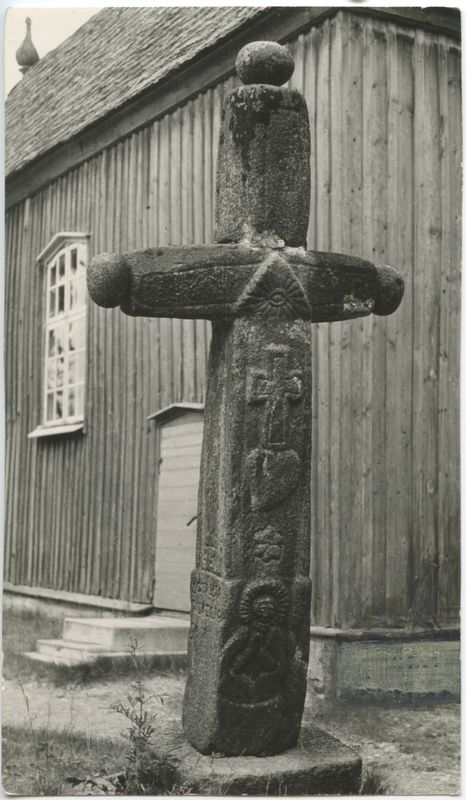
Fotografijoje užfiksuotas antkapinis paminklas-kryžius, iškaltas iš vieno akmens. Kryžmų galuose apvalūs rutuliai, kryžmos centre Dievo Apvaizdos simbolis, žemiau ant stiebo kryžiaus, širdies, dobilo lapo ir cokolinėje stiebo dalyje - Švč. Mergelės Marijos Sopulingosios reljefai. Kryžius pastatytas ant buv girnų akmens, aptašyto į apytikrį kvadratą. Cokolio šone iš kairės iškaltas užrašas. Antrame plane matosi Ukrinų Šv. Antano Paduviečio bažnyčia pastatyt 1857 m. Fotografijos reverse įrašai pieštuku, nurodantys vietovę ir keli spaustuvininkų pasižymėjimai bei leidyklos Mintis antspaudas, o ant jo mėlynu rašalu užrašyta "Statybos I-tas, Architektūros klausimai III".
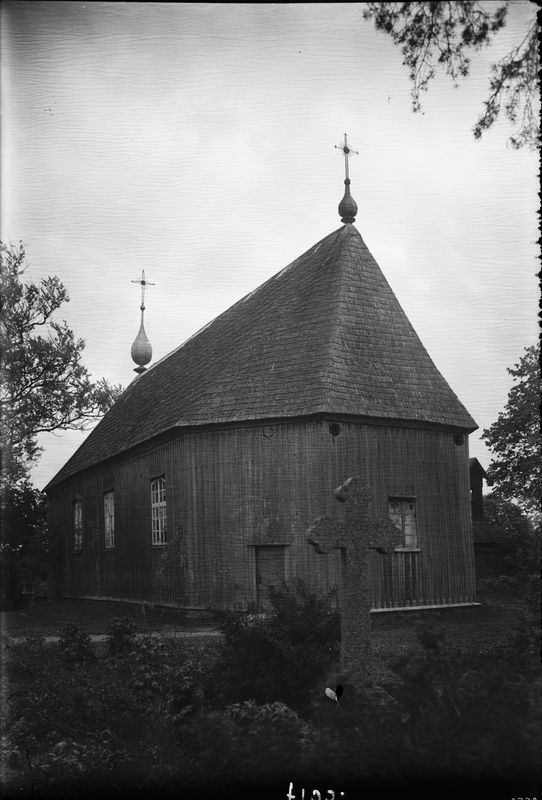
Ukrinų Šv. Antano Paduviečio bažnyčia trijų ketvirčių rakursu iš apsidės pusės nuo kapinių. Pirmame fotografinės kompozicijos plane – betoninis kryžius su profiliuotais trilapio motyvo vertikalės ir kryžmos galais. Medinės bažnytėlės šoninės sienos ir apsidės stačių lentelių apkalo. Šoninėje sienoje trys dvidešimties dalių langai, apsidėje vienas aštuonių dalių langas ir vienvėrės durys. Sakralinio pastato pagrindinio tūrio stogas status, dvišlaitis, virš apsidės trišlaitis, abiejuose kraigo galuose – po kriaušės formos smailę su geležinio kryžiaus viršūne.