About the Church
The Church of the Assumption of the Blessed Virgin Mary at Sintautai rises in the small town of Sintautai, about 8 km south-west of Šakiai. The first chapel here was built in 1641 by Albertas Radvila, lord of Veliuona; the church that arose after the 1788 fire was consecrated in 1800 by the Bishop of Vygriai, Mykolas Pranciškus Karpavičius. The parish priest from 1855 to 1863, Antanas Tatarė, considerably embellished it, but was exiled to Penza for supporting the 1863 uprising and never returned to Lithuania.
After a fire destroyed the old church in 1907, a masonry church began to be built: the cornerstone was blessed in 1913, and the first services in the new church were celebrated on 8 December 1922. On 13 August 1944 German artillery set fire to the church and badly damaged it; under Soviet rule it was confiscated, and it was rebuilt and reconsecrated only on 26 August 1995.
It is a Romanesque Revival church of white plastered masonry with two towers 48.7 m high, a three-aisled pseudo-basilica interior, and altars of modernised Romanesque Revival forms. The interior is adorned with stained-glass windows and the wooden sculpture "Atmintis" (Memory), symbolising the church's resurrection.
After a fire destroyed the old church in 1907, a masonry church began to be built: the cornerstone was blessed in 1913, and the first services in the new church were celebrated on 8 December 1922. On 13 August 1944 German artillery set fire to the church and badly damaged it; under Soviet rule it was confiscated, and it was rebuilt and reconsecrated only on 26 August 1995.
It is a Romanesque Revival church of white plastered masonry with two towers 48.7 m high, a three-aisled pseudo-basilica interior, and altars of modernised Romanesque Revival forms. The interior is adorned with stained-glass windows and the wooden sculpture "Atmintis" (Memory), symbolising the church's resurrection.
Gallery and Resources
Archive captions are shown in Lithuanian.
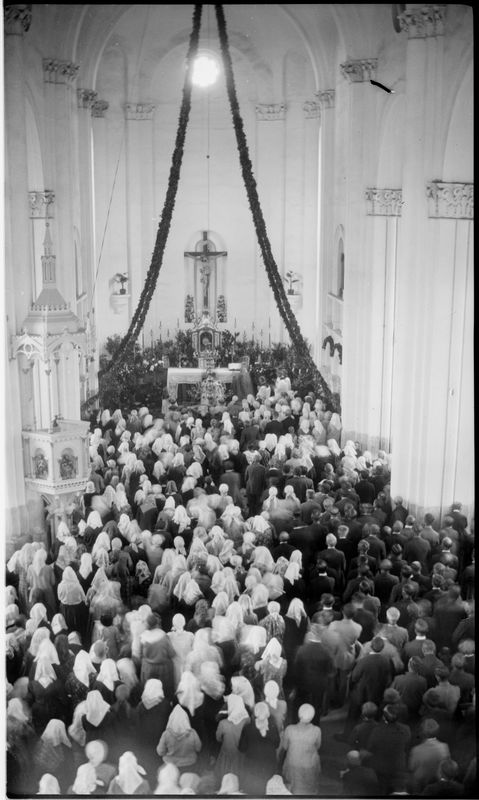
Pamaldos Sintautų Švč. Mergelės Marijos Ėmimo į dangų bažnyčioje.
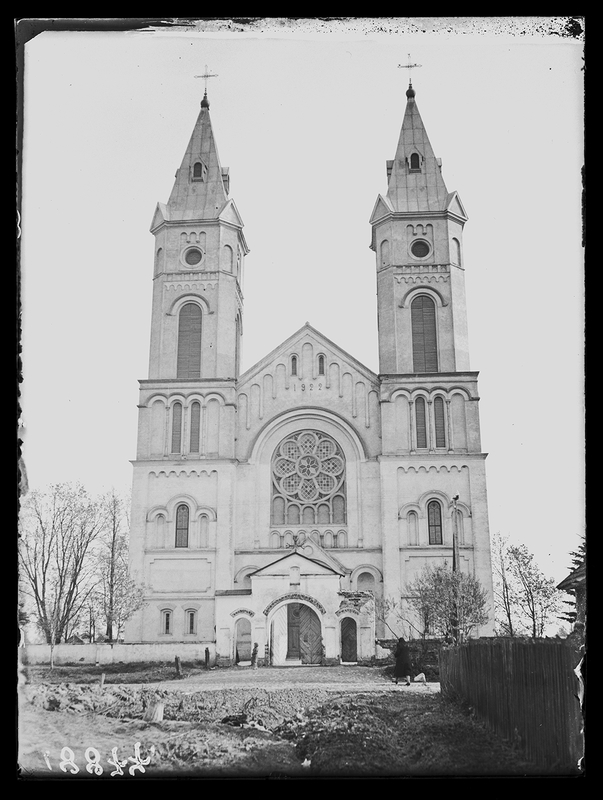
Mūrinė bažnyčia su dviem bokštais ir puošniu portalu viršuje, besibaigiančiu trikampiu frontonu, nufotografuota iš priekinio fasado pusės. Fasado centre, arkos formos nišoje, – nišelių arkada ir apskritas choro langas-rožė.