About the Church
The Church of the Holy Trinity in Tverečius is a distinctive shrine standing in the small town of Tverečius, in Ignalina district, near the state border between Lithuania and Belarus. Both its architecture and its history reflect a range of periods and cultural changes.
The first church in Tverečius was built as early as 1501. It was a small wooden church, home to the Canons Regular of Penance. Later, in the 17th century, the nobles Petras Pacas and his wife contributed to the church's upkeep by assigning it villages and manor farms. In 1662 Mikalojus Pacas, Voivode of Trakai, built a new church and monastery, which became important centres of religion and education. At the end of the 18th century a parish school even operated here, but in 1812 the church was plundered by the French, who stole its liturgical items.
The Russian authorities closed the monastery in 1832, and in 1862 a new wooden building was erected in place of the church that had burned down. In the second half of the 19th century the parish priest Jonas Burba worked to organise Lithuanian-language services, even though the tsarist authorities obstructed the building of masonry churches. Despite the obstacles, in 1906 the present masonry Gothic Revival church was built to a design by the engineer B. Kokijevskis-Kozėla, its construction supported by the parishioners and the parish priest Antanas Slapšys-Slapšinskas.
During the First World War the church suffered considerable damage – its towers were wrecked, and they were rebuilt by 1925. In 1928, by order of Archbishop Romuald Jałbrzykowski, services at the Tverečius church began to be held only in Polish. The organist Leonas Bielinis, who worked here from 1932, collected local folklore and folk songs, thereby helping to preserve the culture.
The church's architecture is highly striking – a Gothic Revival building on a rectangular plan with two towers and a lower apse. The interior is basilica-form, divided into three aisles separated by piers and vaulted. A stone masonry fence further reinforces the beauty and solidity of the churchyard.
For long decades the Church of the Holy Trinity in Tverečius has remained not only a house of faith but also a centre of cultural activity. The history and architecture of this shrine testify to a strong community and its ability to preserve its values even in the hardest of times.
The first church in Tverečius was built as early as 1501. It was a small wooden church, home to the Canons Regular of Penance. Later, in the 17th century, the nobles Petras Pacas and his wife contributed to the church's upkeep by assigning it villages and manor farms. In 1662 Mikalojus Pacas, Voivode of Trakai, built a new church and monastery, which became important centres of religion and education. At the end of the 18th century a parish school even operated here, but in 1812 the church was plundered by the French, who stole its liturgical items.
The Russian authorities closed the monastery in 1832, and in 1862 a new wooden building was erected in place of the church that had burned down. In the second half of the 19th century the parish priest Jonas Burba worked to organise Lithuanian-language services, even though the tsarist authorities obstructed the building of masonry churches. Despite the obstacles, in 1906 the present masonry Gothic Revival church was built to a design by the engineer B. Kokijevskis-Kozėla, its construction supported by the parishioners and the parish priest Antanas Slapšys-Slapšinskas.
During the First World War the church suffered considerable damage – its towers were wrecked, and they were rebuilt by 1925. In 1928, by order of Archbishop Romuald Jałbrzykowski, services at the Tverečius church began to be held only in Polish. The organist Leonas Bielinis, who worked here from 1932, collected local folklore and folk songs, thereby helping to preserve the culture.
The church's architecture is highly striking – a Gothic Revival building on a rectangular plan with two towers and a lower apse. The interior is basilica-form, divided into three aisles separated by piers and vaulted. A stone masonry fence further reinforces the beauty and solidity of the churchyard.
For long decades the Church of the Holy Trinity in Tverečius has remained not only a house of faith but also a centre of cultural activity. The history and architecture of this shrine testify to a strong community and its ability to preserve its values even in the hardest of times.
Gallery and Resources
Archive captions are shown in Lithuanian.
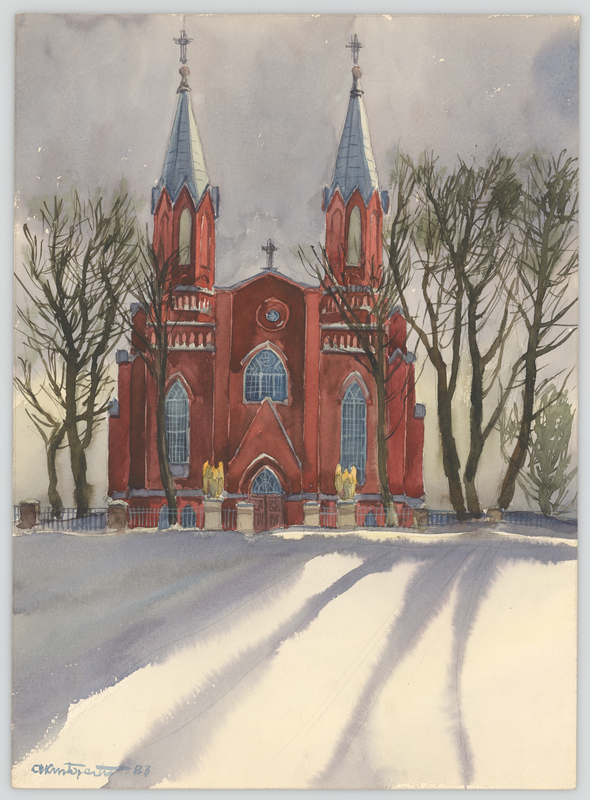
Kompozicijoje – Tverečiaus Švč. Trejybės bažnyčia.
Signuotas akvarele averso apatinėje dalyje kairėje ir pieštuku revreso viršutinėje dalyje.
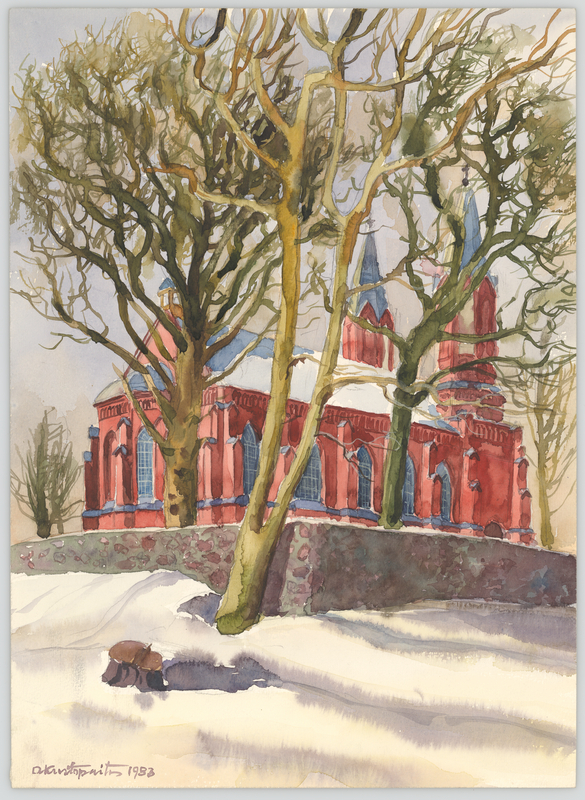
Kompozicijoje – Tverečiaus Švč. Trejybės bažnyčia.
Signuotas akvarele averso apatinėje dalyje kairėje ir pieštuku revreso viršutinėje dalyje kairėje.