About the Church
The church of St Michael the Archangel in Varėna is not only an important religious site but also a place of historical and architectural interest. This wooden church, standing in the south of the town of Varėna, is one of those places that draws local people and visitors alike thanks to its unique history and distinctive design.
The church's history begins as far back as the end of the 19th century, when an Orthodox church was built here in 1897. However, after the First World War, as political circumstances changed, this Orthodox church was converted into a Catholic church in 1919 and consecrated in 1920 as the church of St Michael the Archangel of Varėna. At that time services were held only in Polish, which caused considerable disagreement with Lithuanian-speaking parishioners. These conflicts sometimes turned into outright unrest, until it was finally decided that there would be no services at all – a situation that continued until the beginning of 1924.
In 1929 the parish was officially established, and four years later, in 1933, the church was rebuilt and enlarged, giving it its present appearance. It is worth noting that in 1936 the branches and reading rooms of the St Casimir Society were closed, reflecting the political and social tensions of the time. In 1967, through the efforts of the parish priest Kazimieras Gailius, the church was repaired, in order to preserve this important cultural and religious site.
Architecturally, the church of St Michael the Archangel in Varėna is characterised by features of folk architecture. It is cross-shaped in plan, with a single tower, a three-sided apse and a porch. The churchyard wall, made of wooden posts, also contributes to the church's traditional appearance.
This church is not only a house of prayer but also a place where different periods of history and architectural styles come together. It stands as a living testimony to difficult times, and equally to people's determination to preserve their faith and culture. So, when visiting Varėna, be sure to visit the church of St Michael the Archangel – it will surely leave a lasting impression.
The church's history begins as far back as the end of the 19th century, when an Orthodox church was built here in 1897. However, after the First World War, as political circumstances changed, this Orthodox church was converted into a Catholic church in 1919 and consecrated in 1920 as the church of St Michael the Archangel of Varėna. At that time services were held only in Polish, which caused considerable disagreement with Lithuanian-speaking parishioners. These conflicts sometimes turned into outright unrest, until it was finally decided that there would be no services at all – a situation that continued until the beginning of 1924.
In 1929 the parish was officially established, and four years later, in 1933, the church was rebuilt and enlarged, giving it its present appearance. It is worth noting that in 1936 the branches and reading rooms of the St Casimir Society were closed, reflecting the political and social tensions of the time. In 1967, through the efforts of the parish priest Kazimieras Gailius, the church was repaired, in order to preserve this important cultural and religious site.
Architecturally, the church of St Michael the Archangel in Varėna is characterised by features of folk architecture. It is cross-shaped in plan, with a single tower, a three-sided apse and a porch. The churchyard wall, made of wooden posts, also contributes to the church's traditional appearance.
This church is not only a house of prayer but also a place where different periods of history and architectural styles come together. It stands as a living testimony to difficult times, and equally to people's determination to preserve their faith and culture. So, when visiting Varėna, be sure to visit the church of St Michael the Archangel – it will surely leave a lasting impression.
Gallery and Resources
Archive captions are shown in Lithuanian.
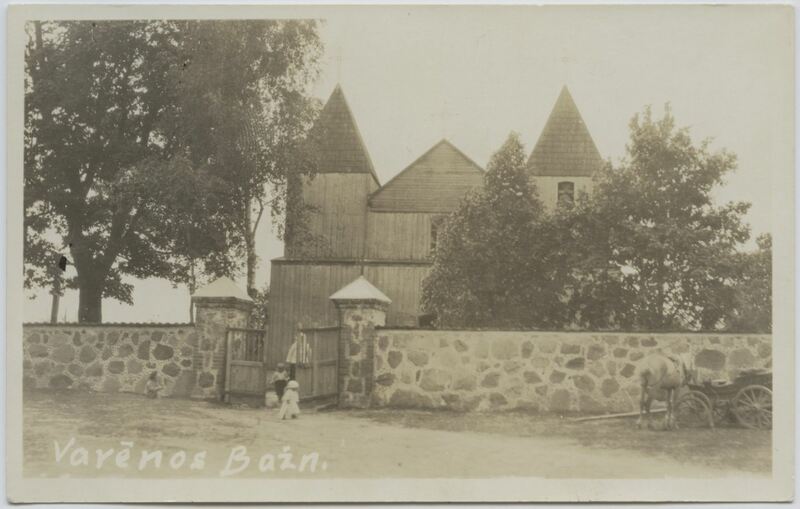
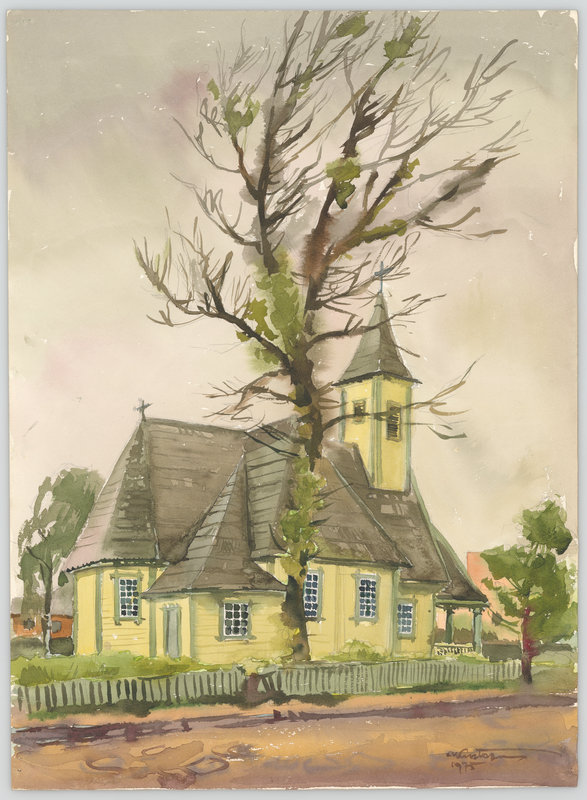
Kompozicijoje – Varėnos Šv. arkangelo Mykolo bažnyčia.
Signuotas akvarele averso apatinėje dalyje dešinėje ir pieštuku revreso viršutinėje dalyje kairėje.