About the Church
The church of Our Lady, Perpetual Protectress, in Rudnia is a special place whose history spans almost the entire 20th century and is closely bound up with changing political and cultural circumstances.
This wooden church stands in the village of Rudnia, 17 km south-east of Varėna. Built in 1910 through the efforts of Father St. Mincevičius, the church at once became an important religious and cultural centre for the local people. It was built in the historicist style, which blends beautifully with the surrounding forests and the natural beauty of the landscape.
The church's history is especially vivid during the interwar years, when Lithuania faced various political threats. Under the Polish occupation Lithuanian activities were strictly restricted. Yet even in these hard times the Lithuanian community found ways to keep its language and traditions alive. From 1927 the church was permitted to sing in Lithuanian every second Sunday, although before that this right had not existed.
A particularly dramatic event took place at Christmas 1933, when police broke into the church and started a brawl. In this incident 7 worshippers were injured and 4 people were arrested. This shows how tense the situation was at the time and how important a role the church played as guardian of national identity.
Despite all the challenges, the church remained the constant centre of parish life. Thanks to the parish priest Napoleonas Norkūnas, who served from 1962 to 1970, the building was repainted, giving it a new splendour. Finally, in 2014 the church was restored, ensuring its survival for future generations.
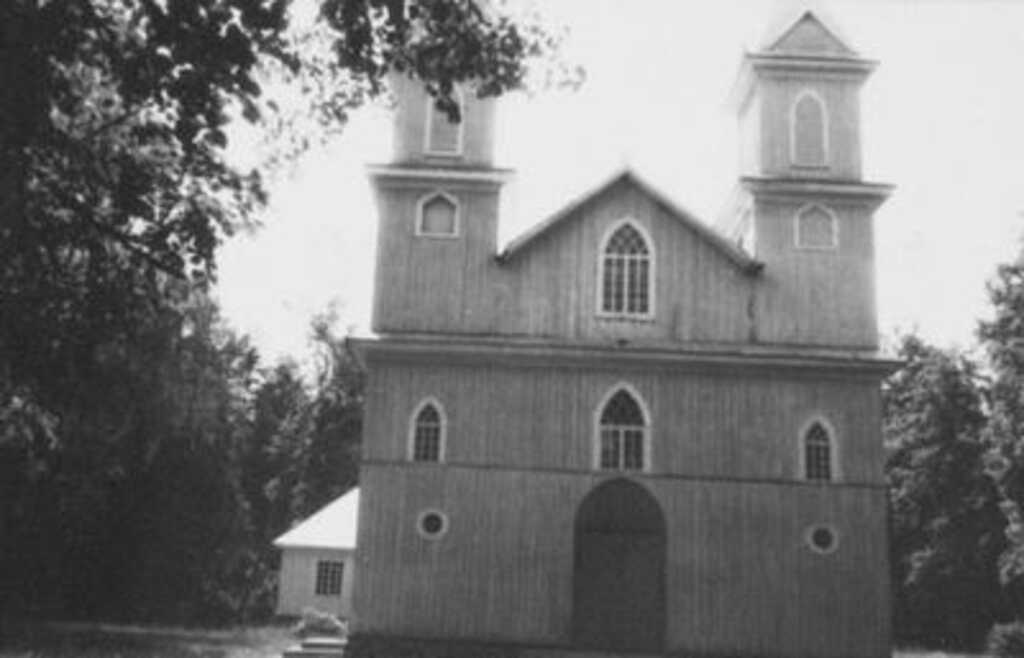
Architecturally, the church in Rudnia is unique. Its rectangular plan, two-tower structure and single-nave space with a porch and a multi-sided apse make it distinctive. The towers and façades are clad in wooden boards, and the roof is covered with sheet metal, giving the building strength and durability.
Today, more than a century after the church's founding, it remains important not only as a place of worship but also as cultural heritage, testifying to the strong spirit of the local community and its resistance in the face of historical trials.
This wooden church stands in the village of Rudnia, 17 km south-east of Varėna. Built in 1910 through the efforts of Father St. Mincevičius, the church at once became an important religious and cultural centre for the local people. It was built in the historicist style, which blends beautifully with the surrounding forests and the natural beauty of the landscape.
The church's history is especially vivid during the interwar years, when Lithuania faced various political threats. Under the Polish occupation Lithuanian activities were strictly restricted. Yet even in these hard times the Lithuanian community found ways to keep its language and traditions alive. From 1927 the church was permitted to sing in Lithuanian every second Sunday, although before that this right had not existed.
A particularly dramatic event took place at Christmas 1933, when police broke into the church and started a brawl. In this incident 7 worshippers were injured and 4 people were arrested. This shows how tense the situation was at the time and how important a role the church played as guardian of national identity.
Despite all the challenges, the church remained the constant centre of parish life. Thanks to the parish priest Napoleonas Norkūnas, who served from 1962 to 1970, the building was repainted, giving it a new splendour. Finally, in 2014 the church was restored, ensuring its survival for future generations.
Architecturally, the church in Rudnia is unique. Its rectangular plan, two-tower structure and single-nave space with a porch and a multi-sided apse make it distinctive. The towers and façades are clad in wooden boards, and the roof is covered with sheet metal, giving the building strength and durability.
Today, more than a century after the church's founding, it remains important not only as a place of worship but also as cultural heritage, testifying to the strong spirit of the local community and its resistance in the face of historical trials.
Gallery and Resources
Archive captions are shown in Lithuanian.
Rudnios bažnyčia.