About the Church
The church's history began in 1989, when the parish of Elektrėnai was established. Before that, the faithful of Elektrėnai had to travel to the neighbouring towns of Vievis, Kietaviškės or Semeliškės. The initiative to establish a parish in Elektrėnai received broad community support – in a short time around 2,000 signatures were gathered requesting permission to build a church. The first parish priest was Jonas Sabaliauskas, who began holding Mass in various temporary premises.
In 1990 construction of the church began to a design by the architect H. K. Šilgalis. Already that summer, the Bishop of Kaišiadorys, Juozapas Matulaitis, blessed the cornerstone of the future church. After six years of intensive work, on 28 July 1996, the church was solemnly consecrated, with the Apostolic Nuncio to Lithuania, Archbishop Justo Mullor García, in attendance.
Although the church is modern and innovative, its design also incorporates traditional Christian symbols and meanings. On the outside, a semicircular arched portal with rectangular crosses symbolises the seventh century of Christianity in Lithuania. Inside, a cylindrical vault, supported by orderless columns and stylised triangular pendentives, gives the interior a sense of space and spirituality.
One of the most important elements of the church is the sculptures of "The Risen Christ" and "Our Lady, Queen of Martyrs", created by the renowned Lithuanian artist Stanislovas Kuzma. Also attracting particular attention are the Stations of the Cross, created by the artist Nijolė Vilutytė, which took as much as seven years of work. This work is regarded as one of the most significant pieces of contemporary Lithuanian sacred art.
Despite difficulties encountered, such as a storm in 1997 that destroyed two of the church's pylons, the church was successfully rebuilt and continues to adorn the skyline of the town of Elektrėnai. The church's uniqueness and beauty attract not only the faithful but also lovers of art and architecture.
This church is not only a place of religious observance but also a cultural centre, where sacred music concerts and penitential evenings take place. Elektrėnai Church of Our Lady, Queen of Martyrs vividly reflects the possibilities of contemporary Lithuanian sacred architecture and the synthesis of artistic and spiritual life.
Gallery and Resources
Archive captions are shown in Lithuanian.
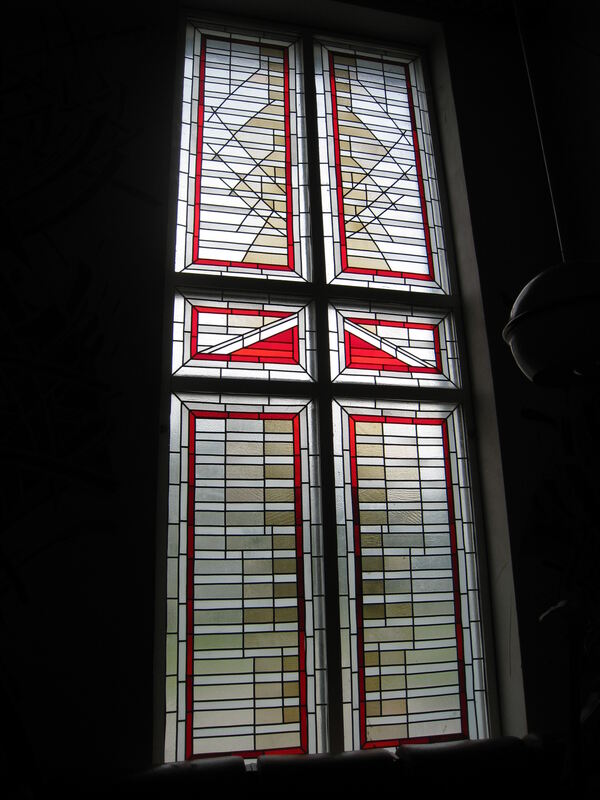
Pirma specialiai miestui projektuota arch. J.Matulevičiaus centrinė “Elektrėnų vaistinė” šalia ligoninės.
1990 metai, pakilimo banga sukurti individualaus stiliaus, savitą vaistinės interjerą - ne prekybos centrą, o išskirtinę erdvę, jaukią aplinką, pasitinkančią žmogų sveikatos, gydymo palaikymui.
Langas suskirstytas į šešias dalis , aprėmintomis visu perimetru stipria raudono stiklo juosta. Geometrinis simbolinis ornamentinis sprendimas . Iš apačios kylantis takas, centre mažojoje lango dalyje trikampiai ženklai, pereinantys kaip nuoroda į viršuje krentančių šakų linijų struktūrą .Vitražai - stiklinės simbolinės “užuolaidos”. Pauzė tarp baltų sgrafito plokštumų sienose. Interjero stilius - sgrafitų ir vitražų visumos sintezė.
Architekto J. Matulevičiaus buvo sugalvota ir suprojektuota vaistinės visa interjero visuma - lyg pirmas modernus bendras funkcinis sprendimas su meno kūrinių įjungimu Elektrėnų vaistinėje. Kaip įvadas mano tęstiniam kūrybiniame darbe Elektrėnuose. 1992-1998 į naujai iškilusią arch. H.Šilgalio modernią , vieną pirmųjų Lietuvoje Elektrėnų Švč. Mergelės Marijos Kankinių Karalienės bažnyčią , tęstinį projektą užsitęsusį iki 2020 metų!
Elektrėnų vaistinėje (architektas Jonas Matulevičius).