About the Church
Vievis St Anne Church is a real gem, standing on the northern shore of Lake Vievis. Its history is rich and colourful, spanning several centuries and a great many dramatic events.
The first church, mentioned in written sources, was built by 1550. In the 17th century, by the decision of Bogdanas Oginskis, the Catholic church was handed over to the Orthodox. At that time two Orthodox churches stood in Vievis, but after 1625, when B. Oginskis died, they were closed down, as his children returned to Catholicism.
In 1688 a new church was built in Vievis, but it burned down in 1794. Soon afterwards, in 1796, a wooden church was built in its place, which also did not last long – in 1812 it too fell victim to fire.
In 1816–1821 Gabrielius Oginskis built yet another Catholic church. Unfortunately, this one too was not long-lasting – it was struck by lightning and burned in 1907. After that a design for a masonry church was drawn up, and construction began in 1908, but was halted because of the First World War.
After the war, from 1925 to 1931, construction was continued under the engineer Vaclovas Michnevičius. The parish priest of this period was Juozapas Mincevičius, who, together with the parishioners, actively saw to the rebuilding of the church. Finally, in 1931, the church was completed and consecrated.
During the Second World War, in 1944, the presbytery burned down, and in Soviet times, from 1959 to 1979, the curia of the Diocese of Kaišiadorys operated in Vievis. In 1980 the church was robbed, but this did not stop it from remaining an important religious and cultural centre.
Architecturally, Vievis St Anne Church is a fine example of the Neo-Baroque style with Classicism elements. It is built of whitish brick and has the structure of a Latin-cross-plan basilica with two tall facade towers. Inside, the church has three aisles, covered by cross vaults. A masonry fence with ornate metal gates, designed by the architect M. Vaidakavičius, runs around the churchyard.
Several eminent individuals are buried in the churchyard: the priest J. Mincevičius, the vicars P. Budrauskas and Č. Kavaliauskas (a theologian and translator of the Bible), and the priest-altarist R. Šalčiūnas.
Vievis St Anne Church is not merely a place of religious observance – it is a living witness to history, recalling various eras and the complex twists of Lithuania's past.
The first church, mentioned in written sources, was built by 1550. In the 17th century, by the decision of Bogdanas Oginskis, the Catholic church was handed over to the Orthodox. At that time two Orthodox churches stood in Vievis, but after 1625, when B. Oginskis died, they were closed down, as his children returned to Catholicism.
In 1688 a new church was built in Vievis, but it burned down in 1794. Soon afterwards, in 1796, a wooden church was built in its place, which also did not last long – in 1812 it too fell victim to fire.
In 1816–1821 Gabrielius Oginskis built yet another Catholic church. Unfortunately, this one too was not long-lasting – it was struck by lightning and burned in 1907. After that a design for a masonry church was drawn up, and construction began in 1908, but was halted because of the First World War.
After the war, from 1925 to 1931, construction was continued under the engineer Vaclovas Michnevičius. The parish priest of this period was Juozapas Mincevičius, who, together with the parishioners, actively saw to the rebuilding of the church. Finally, in 1931, the church was completed and consecrated.
During the Second World War, in 1944, the presbytery burned down, and in Soviet times, from 1959 to 1979, the curia of the Diocese of Kaišiadorys operated in Vievis. In 1980 the church was robbed, but this did not stop it from remaining an important religious and cultural centre.
Architecturally, Vievis St Anne Church is a fine example of the Neo-Baroque style with Classicism elements. It is built of whitish brick and has the structure of a Latin-cross-plan basilica with two tall facade towers. Inside, the church has three aisles, covered by cross vaults. A masonry fence with ornate metal gates, designed by the architect M. Vaidakavičius, runs around the churchyard.
Several eminent individuals are buried in the churchyard: the priest J. Mincevičius, the vicars P. Budrauskas and Č. Kavaliauskas (a theologian and translator of the Bible), and the priest-altarist R. Šalčiūnas.
Vievis St Anne Church is not merely a place of religious observance – it is a living witness to history, recalling various eras and the complex twists of Lithuania's past.
Gallery and Resources
Archive captions are shown in Lithuanian.
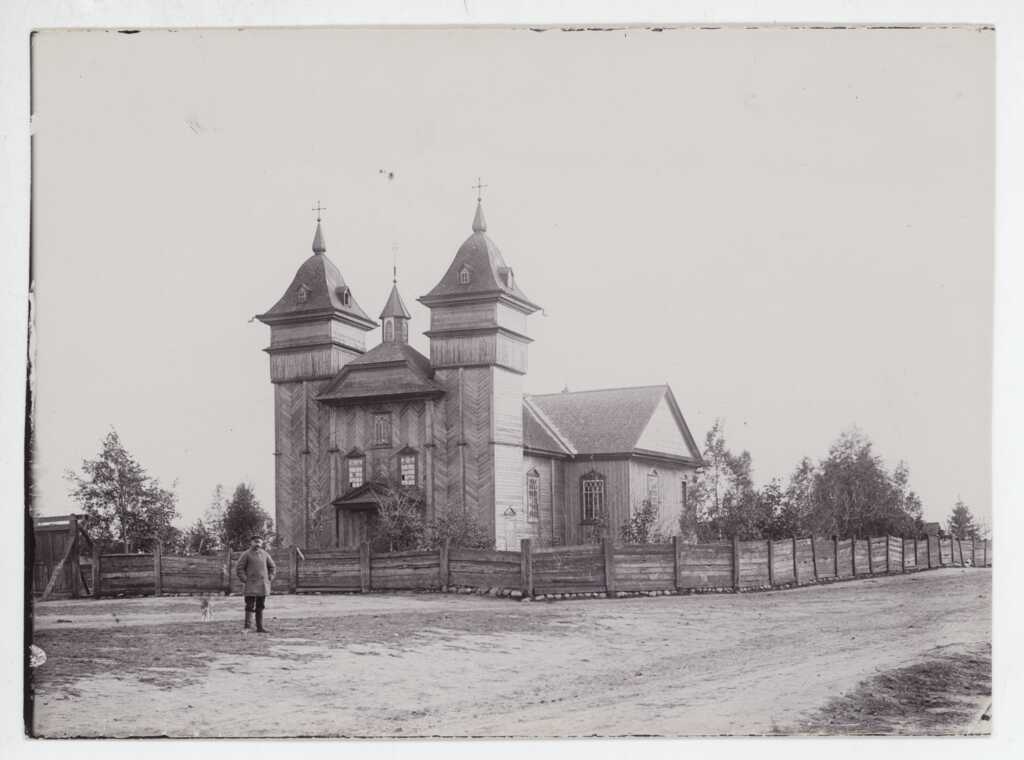
Vilniaus gubernijos [Vievio] bažnyčia (neišlikusi).(Originalus stiklo negatyvas saugomas Lietuvos nacionaliniame muziejuje, Nr. AN 7234).