About the Church
The first wooden church on this site was built in 1475, when the landowner Kotryna Agnieška Astikaitė and Bagdonas Jurevičius laid the foundations for religious life in Širvintos. This wooden church served the local community for more than a century, until in 1674 Mikalojus Žakas financed the construction of a new house of prayer. In the second half of the 18th century the parish already had its own school, a sign of the growth and development of the local community.
The present masonry church was designed in 1847 by the architect Tomas Tišeckis. The building project was approved in 1852, and the church itself went up quickly, from 1855 to 1860. The main initiator of the building work was Viktoras Lupeika, who served as parish priest in Širvintos for almost four decades. Although V. Lupeika encouraged the use of the Polish language, his successor, Father Jurgis Zimkus, began preaching in Lithuanian, thereby reviving the national spirit.
From 1945 until his death in 1988, Father Petras Guobys served at the church. Through his efforts the church was renovated, and the priest himself was buried in the churchyard, leaving a lasting mark on the community's memory.
Architecturally, the Church of St Michael the Archangel in Širvintos has a rectangular plan, with two towers between which a tall pediment rises. Inside are three naves separated by piers, giving the space a sense of grandeur. A sturdy stone wall with pillared gates encloses the churchyard, adding further charm to this historic site.
The church is not only a house of prayer but also an important monument of culture and history, bearing witness to the various periods and figures that have contributed to its existence. It is a place where every corner tells its own unique story, inviting everyone to discover and get to know it.
Gallery and Resources
Archive captions are shown in Lithuanian.
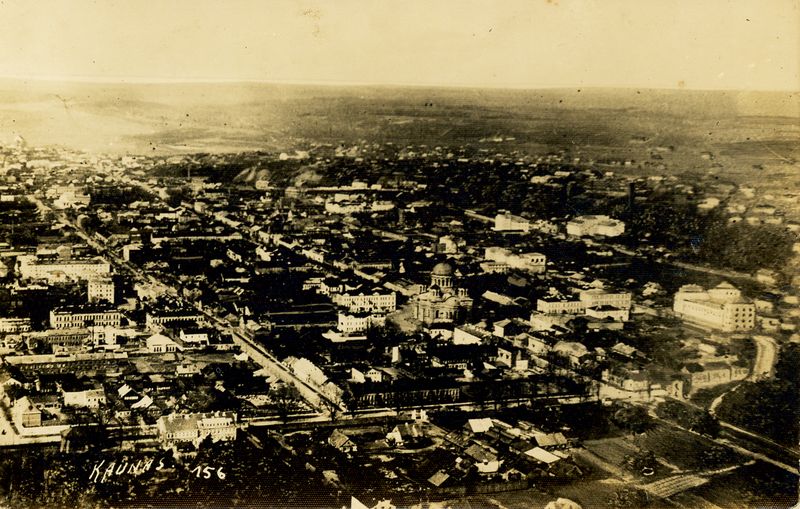
Matyti šv. Arkangelo Mykolo bažnyčia ir kiti pastatai. Kitoje pusėje yra ats. kpt. J. Juodenukio laiškas mamai Viktorijai Juodenukienei. Rašo, kad laimingai nuvažiavo iš Rygos į Kauną. Tekstas parašytas cheminiu pieštuku. Kpt. J. Juodenukis baigė 3 Rygos mokyklą, 1915 m. mobilizuotas į Rusijos kariuomenę, 1917 m. baigė Peterhofo Aleksandro II Karo mokyklą, suteiktas praporščiko laipsnis, vėliau turėjo paporučiko laipsnį. Dalyvavo I Pasaulinio karo kautynėse su vokiečiais, buvo Polocko 28 pėstininkų pulke, 1919 m. kovo mėn. mobilizuotas į Raudonosios armijos 2 darbininkų pulką, iš ten pasitraukė ir tarnavo Latvijos kariuomenės Rezeknės p. p. 5 kuopoje. Dalyvavo kovose su bermontininkais ir bolševikais. 1920 m. grįžo į Lietuvą ir rugpjūčio 3 d. buvo mobilizuotas į Lietuvos kariuomenę ir paskirtas į I atsargos bataliono 5 kuopos j. karininku. 1920 m. suteiktas vyr. ltn. laipsnis, dalyvavo kovose su lenkais, 1922-05-01 suteiktas kpt. laipsnis.1923 m. pačiam prašant paleistas į atsargą, 1924-1925 m. pasienio policijos Ukmergės baro viršininkas, 1925–1926 m. Širvintų pasienio baro viršininkas, 1927–1930 m. tarnavo Tauragės pasienio policijoje, 1930–1940 m. – Seinų-Marijampolės pasienio policijoje. Romualdo J. Juodenio (Juodenukio) archyvas. Aprašė A. Jurevičiūtė.