About the Church
The Basilica of the Resurrection of Christ in Kaunas, often simply called the Church of the Resurrection, is an impressive monument of modern architecture that undoubtedly enriches the landscape and history of the city of Kaunas. It is the largest monumental basilica-type church in the Baltic States and one of the most significant examples of Modernist architecture in Kaunas.
The idea of building this church arose after Lithuania regained its independence in 1922. The inhabitants of Kaunas, then the provisional capital, wanted to thank God for the freedom they had regained. In 1926 a building committee for the church was established, and in 1928 Kaunas City Council donated a plot of land on the former Žaliakalnis marketplace. As many as 15 designs were submitted to the church's design competition, but none of them met all the requirements. Nevertheless, first prize was awarded to engineer J. Krasauskas, second to Feliksas Vizbaras, and third to Karolis Reisonas, whose design was ultimately chosen.
Construction work began in the summer of 1934. The church designed by K. Reisonas was modern and monumental, its structure consisting of reinforced-concrete frames faced with brick walls. The foundations were particularly complex – around 900 reinforced-concrete piles were driven into the "floating" sandy ground. A flat roof was also planned, although the original design had called for a pitched roof.
The Church of the Resurrection was meant to become not only a sacred building but also a national Pantheon, where it was planned to bury eminent Lithuanians. Its spacious interior was designed to hold around 5,000 worshippers, with room for another 2,000 on the roof terrace. The great tower reaches a height of 70 metres, and a Chapel of St Casimir was to be built at its top.
Unfortunately, in 1940 the Soviet occupation halted the construction work. During the German occupation the church was used as a paper warehouse. Later, by order of Stalin, it was converted into a radio factory, during which the interior was heavily altered.
After Lithuania regained its independence, the public began demanding that the church be returned to the faithful. In 1989 the statutes of the Church of the Resurrection restoration council were registered, and a slow but steady process of restoration began. During the restoration, a number of changes were made to the design in order to adapt the church for cultural events as well.
Today the church's roof terrace offers a wonderful panorama of the city of Kaunas, which both the faithful and tourists can enjoy. It also houses a Chapel of Our Lady of Šiluva, dedicated to the memory of those who died for Lithuania's freedom.
The church also has a columbarium, where notable figures such as Feliksas Kapočius and Antanas Paškus are buried.
Despite all the difficult periods it has been through, the Basilica of the Resurrection of Christ in Kaunas has remained a symbol of faith and national rebirth, holding a special place in the hearts of the city's residents and of the whole country in modern Lithuania.
The idea of building this church arose after Lithuania regained its independence in 1922. The inhabitants of Kaunas, then the provisional capital, wanted to thank God for the freedom they had regained. In 1926 a building committee for the church was established, and in 1928 Kaunas City Council donated a plot of land on the former Žaliakalnis marketplace. As many as 15 designs were submitted to the church's design competition, but none of them met all the requirements. Nevertheless, first prize was awarded to engineer J. Krasauskas, second to Feliksas Vizbaras, and third to Karolis Reisonas, whose design was ultimately chosen.
Construction work began in the summer of 1934. The church designed by K. Reisonas was modern and monumental, its structure consisting of reinforced-concrete frames faced with brick walls. The foundations were particularly complex – around 900 reinforced-concrete piles were driven into the "floating" sandy ground. A flat roof was also planned, although the original design had called for a pitched roof.
The Church of the Resurrection was meant to become not only a sacred building but also a national Pantheon, where it was planned to bury eminent Lithuanians. Its spacious interior was designed to hold around 5,000 worshippers, with room for another 2,000 on the roof terrace. The great tower reaches a height of 70 metres, and a Chapel of St Casimir was to be built at its top.
Unfortunately, in 1940 the Soviet occupation halted the construction work. During the German occupation the church was used as a paper warehouse. Later, by order of Stalin, it was converted into a radio factory, during which the interior was heavily altered.
After Lithuania regained its independence, the public began demanding that the church be returned to the faithful. In 1989 the statutes of the Church of the Resurrection restoration council were registered, and a slow but steady process of restoration began. During the restoration, a number of changes were made to the design in order to adapt the church for cultural events as well.
Today the church's roof terrace offers a wonderful panorama of the city of Kaunas, which both the faithful and tourists can enjoy. It also houses a Chapel of Our Lady of Šiluva, dedicated to the memory of those who died for Lithuania's freedom.
The church also has a columbarium, where notable figures such as Feliksas Kapočius and Antanas Paškus are buried.
Despite all the difficult periods it has been through, the Basilica of the Resurrection of Christ in Kaunas has remained a symbol of faith and national rebirth, holding a special place in the hearts of the city's residents and of the whole country in modern Lithuania.
Gallery and Resources
Archive captions are shown in Lithuanian.
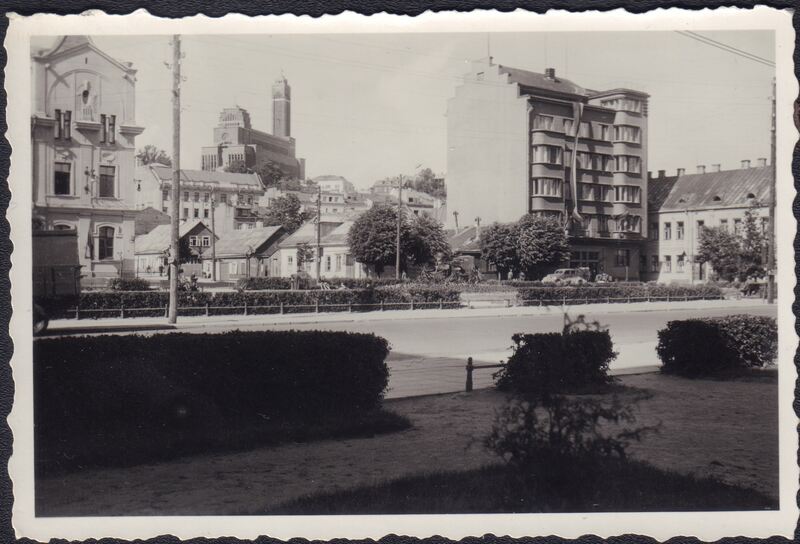
Horizontalaus formato fotografija. Vaizdinėje pusėje, centre matoma Kauno Kristaus Prisikėlimo bazilika. Dešinėje – Jono ir Aleksandros Vailokaičių namas. Kairėje Kauno centrinė elektrinė.

Atviruke vaizduojami Žaliakalnio funikulierius ir Kauno Kristaus Prisikėlimo bazilika. Lietuvių ir anglų k.