About the Church
The Church of the Holy Cross in Kaunas, also known as the Kaunas Carmelite church, is an impressive and multifaceted church in the very heart of the city of Kaunas. Located on the right bank of the Nemunas, this church impresses with its Late Baroque and Renaissance features.
The history of this church began as early as 1510, when the landowner Darata Navobė set aside funds for the building of a wooden chapel and donated a plot of land, along with several buildings and a masonry house in Kaunas. A parish was established in the 17th century, and in 1685, through the efforts of Father Kazimieras Jodkevičius, the present masonry church was built. It was consecrated in 1700 by the Bishop of Vilnius, Konstantinas Kazimieras Bžostauskas. It is thought that its design may have been drawn up by P. Putinis, the well-known architect of the Pažaislis monastery.
Over its long history the church suffered damage from wars and destruction more than once. In 1710–1711 Swedish and Russian troops ravaged the church, destroying much of its property. The Discalced Carmelites, who settled in Kaunas in 1706, established their monastery here and administered two churches – the present Church of the Holy Cross and the Church of St Elijah. Unfortunately, the Church of St Elijah was converted into a military Orthodox church in 1794 and later collapsed.
During the Napoleonic Wars, in 1812, the Church of the Holy Cross was plundered once again. The monastery became a military hospital in 1826, and in 1837 the Russian authorities expelled the monks and the church passed under military control. Over the years the church was used for various purposes: a store for an infantry regiment was set up there, and it was later converted into a hospital church. It was only in 1881, thanks to Bishop Aleksandras Beresnevičius, that the church was returned to the Catholics and reconstructed and restored.
The church is marked by a cruciform plan with a two-tower facade and a low dome above the crossing of the nave and transept. Inside can be found frescoes depicting the Passion of Christ, which were most likely painted before the Carmelite period and date from the end of the 17th century. It is also worth noting that the church has new altars, tall towers and a walled churchyard.
The Church of the Holy Cross in Kaunas and the Carmelite monastery complex are listed in the Register of Cultural Heritage Sites. This is a place where one can sense the spirit of antiquity and admire the beauty and history of Lithuanian sacred art.
The history of this church began as early as 1510, when the landowner Darata Navobė set aside funds for the building of a wooden chapel and donated a plot of land, along with several buildings and a masonry house in Kaunas. A parish was established in the 17th century, and in 1685, through the efforts of Father Kazimieras Jodkevičius, the present masonry church was built. It was consecrated in 1700 by the Bishop of Vilnius, Konstantinas Kazimieras Bžostauskas. It is thought that its design may have been drawn up by P. Putinis, the well-known architect of the Pažaislis monastery.
Over its long history the church suffered damage from wars and destruction more than once. In 1710–1711 Swedish and Russian troops ravaged the church, destroying much of its property. The Discalced Carmelites, who settled in Kaunas in 1706, established their monastery here and administered two churches – the present Church of the Holy Cross and the Church of St Elijah. Unfortunately, the Church of St Elijah was converted into a military Orthodox church in 1794 and later collapsed.
During the Napoleonic Wars, in 1812, the Church of the Holy Cross was plundered once again. The monastery became a military hospital in 1826, and in 1837 the Russian authorities expelled the monks and the church passed under military control. Over the years the church was used for various purposes: a store for an infantry regiment was set up there, and it was later converted into a hospital church. It was only in 1881, thanks to Bishop Aleksandras Beresnevičius, that the church was returned to the Catholics and reconstructed and restored.
The church is marked by a cruciform plan with a two-tower facade and a low dome above the crossing of the nave and transept. Inside can be found frescoes depicting the Passion of Christ, which were most likely painted before the Carmelite period and date from the end of the 17th century. It is also worth noting that the church has new altars, tall towers and a walled churchyard.
The Church of the Holy Cross in Kaunas and the Carmelite monastery complex are listed in the Register of Cultural Heritage Sites. This is a place where one can sense the spirit of antiquity and admire the beauty and history of Lithuanian sacred art.
Gallery and Resources
Archive captions are shown in Lithuanian.
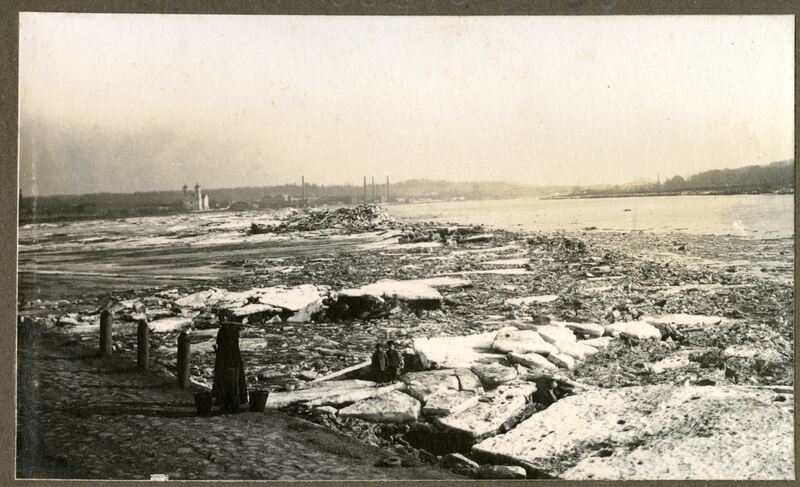
Prie dešiniojo kranto, tarp Kanto ir Birštono gatvių susigrūdę lyčių nuolaužos. Ant krantinės stovi moteris su naščiais ir dviem kibirais, o ant ledo išdykauja du berniukai. Tolumoje matosi Šv. Kryžiaus (Karmelitų) bažnyčia. Pusiau blizgi, priklijuota albumo keturioliktame puslapyje.

Horizontalaus formato fotografija. Vaizdinėje pusėje – pontoninis tiltas per Nemuną. Tolumoje, kairėje pusėje matoma Kauno Kristaus Prisikėlimo bažnyčia, dešiniau – Kauno Šv. Kryžiaus (karmelitų) bažnyčia.