About the Church
The first chapel in Raudondvaris was built as early as 1785. It was a wooden structure that became a filial church of the Vilkija parish in 1795. This locality was for a long time under the patronage of the Counts Tiškevičius. In 1851 Benediktas Emanuelis Tiškevičius granted the church land and an annual financial subsidy. Soon afterwards, construction of a masonry church began, to a design by the Italian architect Laurynas Cezaris Anikinis. Construction took four years, from 1852 to 1856. This church was consecrated in 1857 by Bishop Motiejus Valančius and was given the name "the Ascension of Our Lord Jesus Christ into Heaven".
During the First World War, in 1915, the church was destroyed. Well over a decade passed before work began in 1927 to clear the ruins. The rebuilding plan was prepared by the engineer Vaclovas Michnevičius. Construction of the new masonry church began in 1930 and was completed in 1938. On 3 October of that same year the church was consecrated by Archbishop Juozapas Skvireckas and given a new name, "St Thérèse of the Child Jesus".
The church is notable for its distinctive architecture. It is Historicist in style, with Neo-Baroque and Neoclassical features, has a rectangular plan and is twin-towered. The interior is divided into three naves, separated by piers. Here one can see the Stations of the Cross paintings by Aleksandras Sledzinskis, as well as works by G. Berti, "The Blessed Virgin Mary with the Child" and "The Death of St Joseph". In the side altar are gravestone monuments to the Tiškevičius family, created by the Italian sculptor I. Pampaloni.
During the Second World War, in 1944, two bombs struck the church, but after the war, in 1957, it was renovated on the initiative of the parish priest Antanas Slavinskas. Another interesting fact: the Raudondvaris parish priest Jurgis Kuzmickas is buried in the churchyard, as are some members of the Tiškevičius family, whose mausoleum has not survived, though their memorial stones stand by the rear facade of the church.
It is a place where historical events, cultural heritage and artistic values intertwine, which is why Raudondvaris St Thérèse of the Child Jesus Church is undoubtedly worth your attention.
Gallery and Resources
Archive captions are shown in Lithuanian.
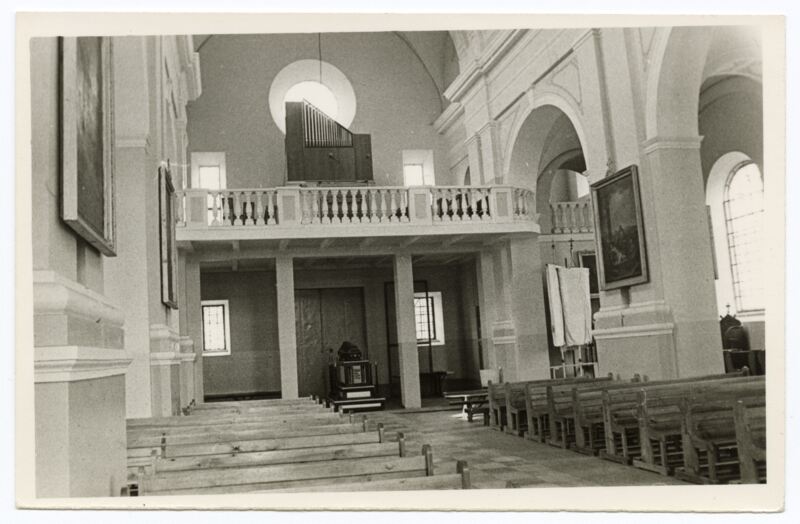
Nuotraukoje Raudondvario Šv. Kūdikėlio Jėzaus Teresės bažnyčios interjeras - centrinė nava. Fotografuota nuo altoriaus į vargonų pusę. Bažnyčia tuščia. Fotografuota norint įamžinti konkretų įvykį - vargonų statymą (?), nes matosi tik dalis montuojamų vargonų. Tuo metu dirbo kunigas Jonas Stankevičius. Prie paradinio įėjimo (po vargonais) ant gražios pakylos padėtas karstas - taip vadinamas katafelis (jis būdavao naudojamas gedulinių Šv. Mišių metu). Reverse ranka grafito pieštuku parašyta "Raudondvario bažnyčia / (vargonai) / Foto 1-V-81 pt.".

Fotoatvirukas "Lietuva / Die Nevėžis bei Raudondvaris / Nevėžis ties Raudondvariu". Fotografas ir leidėjas Vytautas Augustinas. Sukūrimo metai 1931-1941. Fotografuota nuo Romainių kalno. Matosi panorama į Raudondvario pusę. Kairėje Vinco Stašelio vardu pavadintas vienos arkos metalinis tiltas per Nevėžį. Kitame krante - Raudondvario kaimo papėdėje matosi Salomenkos (Šiaudinės) kaimas. Ant kalno stovi Raudondvario Šv. Kūdikėlio Jėzaus Teresės bažnyčia, kuri pradėta statyti 1930 m., jau po metų buvo pastatyta, o konsekruota tik 1938 m. spalio 3 dieną. II Pasaulinio karo metais viršutinės bokštų dalys buvo numuštos - bokštai neatstatyti. Reversas atvirlaiškio tipo: linija vertikaliai padalintas pusiau; dešinėje apibrėžtas plotas pašto ženklui, žemiau horizontalios linijos adresui rašyti; kairėje tuščias plotas, kurio viršuje atspausdinta averso metrika.