About the Church
The Church of St Mary Magdalene at Užventis is one of the most impressive wooden churches in Lithuania, drawing visitors both for its architectural beauty and its historical importance. Situated in Užventis, Kelmė district, it has stood for many years as a beacon of culture and spiritual life.
The church's history begins as early as 1609, when it was granted the village of Minikaičiai (later renamed Šunikiai). The community of the time paid particular attention to education – a parish school was founded at the same time. Almost a century later, in 1703, a new church was built, part of whose timbers were renewed in 1795.
In 1825 the present wooden church was built, and somewhat later, in 1839, a cemetery chapel was erected in the churchyard. This was a period when the local community actively fought for its identity and faith. One of the notable events of this period was the activity of a branch of the Lithuanian Catholic Temperance Society in 1912–1914. This society actively promoted a healthy and virtuous way of life.
In 1937 there were plans to build a new masonry church, but for various reasons the project was not carried out and only the foundations were laid. Despite this, the present wooden church has remained the main site of local religious life.
Architecturally, the Church of St Mary Magdalene at Užventis stands out for its vernacular architectural forms with Baroque features. It has a Latin-cross, hall-church plan, with two annexes and a turret. Inside, a three-aisled structure with five altars dominates. The main facade is distinguished by a half-hipped roof slope and a Baroque-silhouetted turret, which gives the church a particular charm.
The churchyard around the church is walled, and a wooden bell tower stands within it. Also worth mentioning is the grave of the priest Juozapas Rutalė, located in the churchyard. It is the only grave in this churchyard and testifies to this clergyman's importance to the local community.
Inside, the church is marked by simplicity and asceticism. The main nave is more spacious and somewhat taller than the side aisles, which creates a sense of light and space. Such architectural details show the skill and taste brought by the craftsmen of the time.
The church is not only a religious but also a cultural site, which over many years has become an inseparable part of the town of Užventis. Its history, architecture and spiritual significance continue to this day, recalling the values and traditions of the past.
The church's history begins as early as 1609, when it was granted the village of Minikaičiai (later renamed Šunikiai). The community of the time paid particular attention to education – a parish school was founded at the same time. Almost a century later, in 1703, a new church was built, part of whose timbers were renewed in 1795.
In 1825 the present wooden church was built, and somewhat later, in 1839, a cemetery chapel was erected in the churchyard. This was a period when the local community actively fought for its identity and faith. One of the notable events of this period was the activity of a branch of the Lithuanian Catholic Temperance Society in 1912–1914. This society actively promoted a healthy and virtuous way of life.
In 1937 there were plans to build a new masonry church, but for various reasons the project was not carried out and only the foundations were laid. Despite this, the present wooden church has remained the main site of local religious life.
Architecturally, the Church of St Mary Magdalene at Užventis stands out for its vernacular architectural forms with Baroque features. It has a Latin-cross, hall-church plan, with two annexes and a turret. Inside, a three-aisled structure with five altars dominates. The main facade is distinguished by a half-hipped roof slope and a Baroque-silhouetted turret, which gives the church a particular charm.
The churchyard around the church is walled, and a wooden bell tower stands within it. Also worth mentioning is the grave of the priest Juozapas Rutalė, located in the churchyard. It is the only grave in this churchyard and testifies to this clergyman's importance to the local community.
Inside, the church is marked by simplicity and asceticism. The main nave is more spacious and somewhat taller than the side aisles, which creates a sense of light and space. Such architectural details show the skill and taste brought by the craftsmen of the time.
The church is not only a religious but also a cultural site, which over many years has become an inseparable part of the town of Užventis. Its history, architecture and spiritual significance continue to this day, recalling the values and traditions of the past.
Gallery and Resources
Archive captions are shown in Lithuanian.
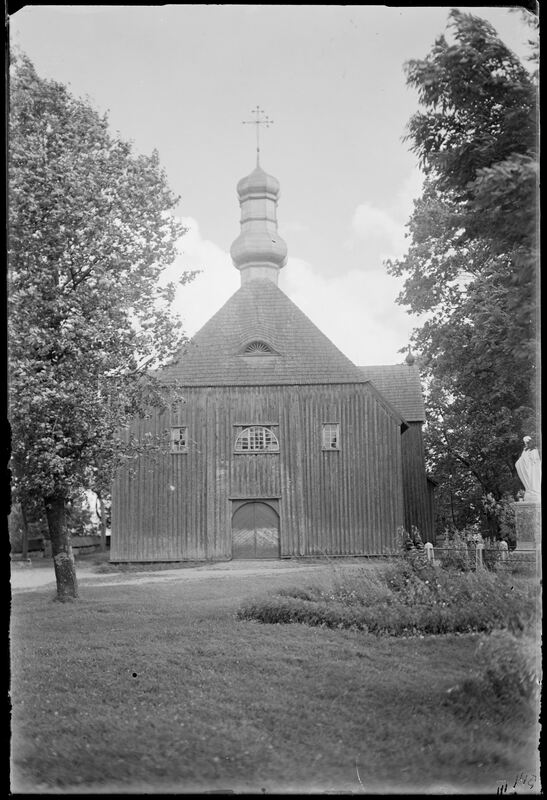
Negatyve įamžinta Užvenčio Šv. Marijos Magdalietės bažnyčia.
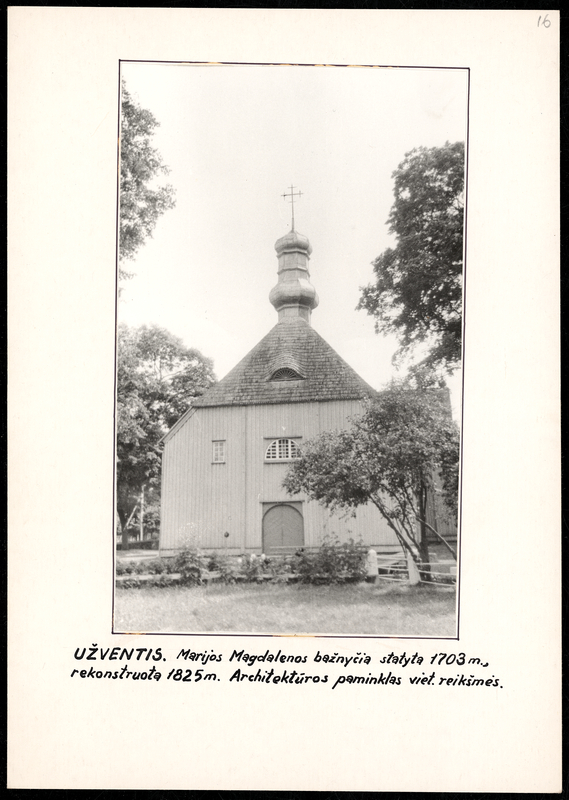
Užvenčio Šv. Marijos Magdalietės bažnyčia. Fotografijos aprašymas ant pasporto: „UŽVENTIS. Marijos Magdalenos bažnyčia statyta 1703 m., rekonstruota 1825 m. Architektūros paminklas viet. reikšmės.“

Užvenčio bažnyčia.