About the Church
The cathedral's history began as far back as 1445, when the Samogitian elder Mykolas Kęsgaila built the first wooden church. Although this church was rebuilt and renovated over time, its foundations remain a symbolic mark of the city's spirit. The present masonry church was built in 1626, after Sigismund Vasa granted financial support – 72 valakai of land.
Legend has it that a huge ox was buried on this site and was covered by the winds, forming the small hill on which the great cathedral now stands. This legend only further reinforces the mystique and historical significance of the place.
The impressive tower of the Šiauliai cathedral reaches as much as 70 metres in height, so it can be seen from afar when approaching the city by any road. The church's appearance was finally shaped in the mid-17th century, although over time it was ravaged by wars and natural disasters.
The Renaissance building is renowned for its architectural details. The bay windows on the church's facade and the turrets of the holy gate with loopholes create the appearance of a defensive fortress. These are the only churchyard gates of this kind in Lithuania, emphasising the cathedral's defensive character.
An important moment in the history of Lithuanian writing was the verse panegyric „Linksmasis pasveikinimas" ("A Joyful Greeting") by the priest Petras Tarvainis, written for the occasion of the church's consecration in 1634. This work is considered the first example of fluent syllabic verse in Lithuanian literature.
Over its long history the church burned down and was rebuilt more than once. At different times it was maintained and cared for by various architects and engineers. One of the most painful events was the fire of 8 July 1880, when lightning burned the wooden top of the tower and destroyed the clock. Today a sundial can be seen on the south wall of the cathedral, considered one of the oldest in Lithuania.
On 28 May 1997 Pope John Paul II established the Diocese of Šiauliai, and granted the Church of Sts Peter and Paul, Apostles, the title of cathedral. Through the efforts of Bishop Eugenijus Bartulis the cathedral was restored, a new altar was installed, and exterior lighting was introduced, creating a special atmosphere during feasts.
The Cathedral of Sts Peter and Paul, Apostles, in Šiauliai is not only a site of sacred significance but also a piece of cultural heritage, bearing witness to the rich history and architecture of Lithuania. A visit to this cathedral will leave an impression on anyone interested in history or religion, or simply seeking peace and beauty.
Gallery and Resources
Archive captions are shown in Lithuanian.
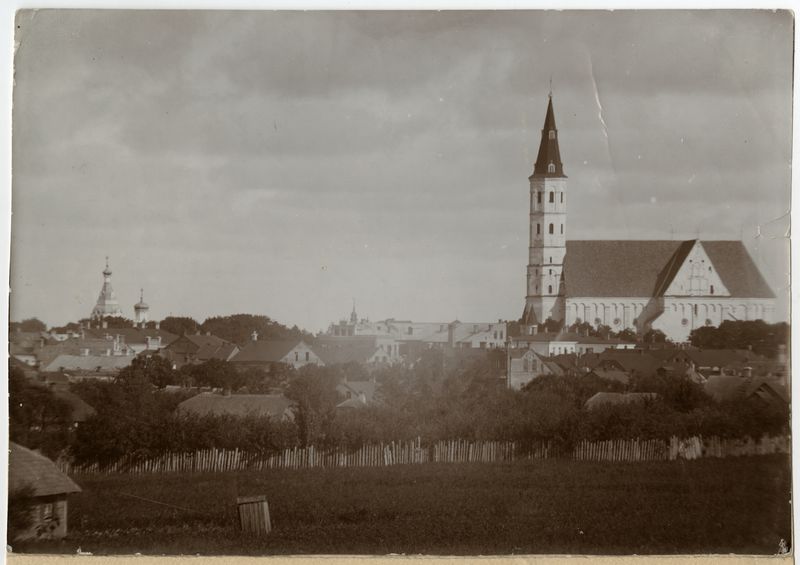
Nuotraukoje vaizduojama Šiaulių miesto panorama iš Varpo arba Dvaro gatvių sankirtos su Vytauto arba Lydos gatvėmis. Matoma miesto Šv. apaštalų Petro ir Pauliaus katedra (dešinėje fotografijos pusėje). Kairėje iš už namų stogų kyla dabartinė Prisikėlimo aišktė ir cerkvė stovėjusi dabartinės miesto savivaldybės pastato vietoje.

Spaudinys vizualiai padalintas į tris dalis. Viduriniosios apačioje sėdi trys siuvėjos. Virš jų surašyti atestato duomenys: „Duotas <...> Akademijos Direktorius"; bei pavadinimas, didelėmis raidėmis – „J. CHMIELIAUSKO / RŪBŲ / KIRPIMO AKADEMIJOS / ATESTATAS". Viduriniosios dalies viršuje įkomponuoti J. Chmieliausko inicialai.
Šoninės dalys atskirtos stulpais, kurių forma ir dekoras būdingas lietuvių liaudies menui. Kairiosios dalies viršuje įkomponuotas skydas su vyčiu. Dešiniojoje dalyje pavaizduota Šiaulių Šv. apaštalų Petro ir Pauliaus katedra, virš jos – Šiaulių miesto herbas.
Spaudo viršų juosia lietuvių liaudies menui būdingos dekoro (augalinių, buities motyvų) detalės.
Autoriaus signatūra atspaudo apačioje viduryje; užrašas apačioje kairiajame kampe.

Šiaulių bažnyčia.