About the Church
The Church of St John Nepomuk in Grūšlaukė is a gem of history and architecture, situated in the small town of Grūšlaukė, Kretinga district. The church has a number of distinctive features and a long, complex history that deserves to be told in detail.
The church's history began back in the 18th century. In 1765 Ignas Oginskis and Elena Oginskienė set aside funds for its construction. In 1771 the church was donated 3 margs of land, and it was built by 1778. Initially the church functioned as a branch of the Salantai parish, but in 1923 it was granted parish rights and became an independent parish.
After the Second World War the church suffered a painful fate – it burned down. But the local community did not give up, and in 1947 built a new wooden church. More than forty years later, in 1990, another building project began near the old church. Designed by architect S. Stipinis and engineer V. Žemaitis, the new church was completed in 2000. The new masonry church took over the name and functions of the old one, which ceased to be used in 1995.
The architecture too tells its own story. The church that stood before the Second World War had a cruciform plan, a typical feature of many churches, associated with Christian symbolism. The wooden church built after the war had a rectangular plan and no tower, resembling a traditional wooden dwelling house. The present-day Church of St John Nepomuk is of masonry, marking the transition from traditional wooden architecture to modern building technologies and design solutions.
The Church of St John Nepomuk in Grūšlaukė is not only a house of prayer but also a place of gathering and cultural memory for the local community. It reflects the faith, persistence and desire of local people to keep their heritage alive. It is a place where the past meets the present, giving meaning and hope for the future.
The church's history began back in the 18th century. In 1765 Ignas Oginskis and Elena Oginskienė set aside funds for its construction. In 1771 the church was donated 3 margs of land, and it was built by 1778. Initially the church functioned as a branch of the Salantai parish, but in 1923 it was granted parish rights and became an independent parish.
After the Second World War the church suffered a painful fate – it burned down. But the local community did not give up, and in 1947 built a new wooden church. More than forty years later, in 1990, another building project began near the old church. Designed by architect S. Stipinis and engineer V. Žemaitis, the new church was completed in 2000. The new masonry church took over the name and functions of the old one, which ceased to be used in 1995.
The architecture too tells its own story. The church that stood before the Second World War had a cruciform plan, a typical feature of many churches, associated with Christian symbolism. The wooden church built after the war had a rectangular plan and no tower, resembling a traditional wooden dwelling house. The present-day Church of St John Nepomuk is of masonry, marking the transition from traditional wooden architecture to modern building technologies and design solutions.
The Church of St John Nepomuk in Grūšlaukė is not only a house of prayer but also a place of gathering and cultural memory for the local community. It reflects the faith, persistence and desire of local people to keep their heritage alive. It is a place where the past meets the present, giving meaning and hope for the future.
Gallery and Resources
Archive captions are shown in Lithuanian.

Fotografiniame atvaizde užfiksuotas Grūšlaukės Šv. Jono Nepomuko bažnyčios stogo fragmentas. Bažnyčia pastatyta 1778 m., sudegė 1945 m.
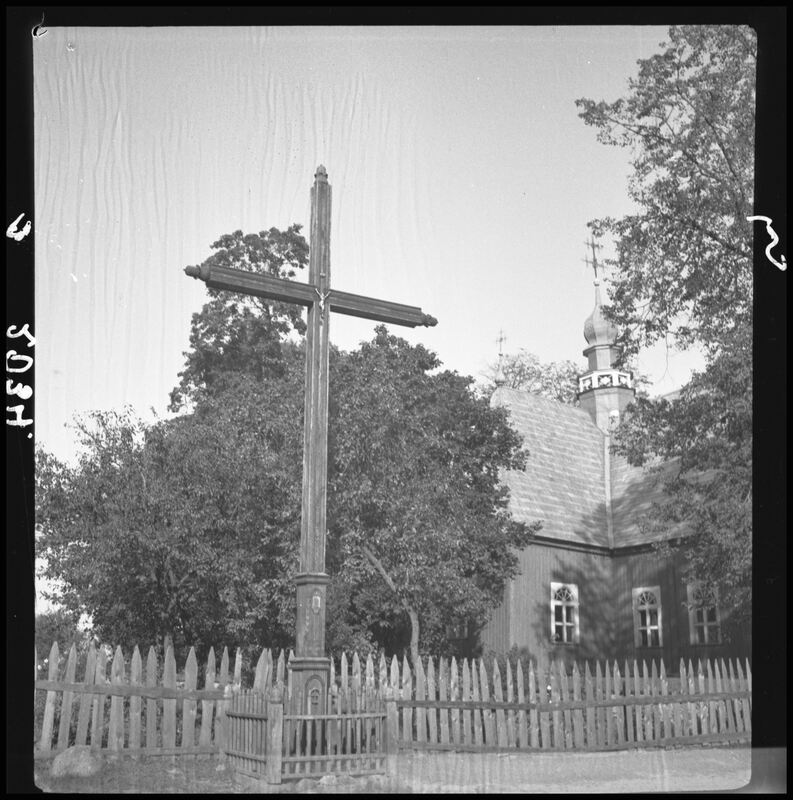
Fotografiniame atvaizde užfiksuotas kryžius šalia Grūšlaukės Šv. Jono Nepomuko bažnyčios. Bažnyčia pastatyta 1778 m., sudegė 1945 m.