About the Church
The church's history begins in the 17th century, when the first chapel was built in Darbėnai around 1620. At that time, however, the parish had no priest, so the chapel's activity was rather limited. Over time the land allotted to the chapel was taken away and returned several times – it lost its land in 1665 and 1735, but in 1737 it again received land and was assigned a priest. After 1740 the settlement became a fully-fledged parish.
In 1782 a new wooden church was built, which unfortunately burned down in 1831 during the fighting of the uprising. At that time services were held in the granary of the Darbėnai manor. Later, to a design by Fridrichas Gasbenas, the present stone-masonry church was built in 1838–1842. But it too could not escape the storms of history: after the 1863 uprising, parish priest Jurgis Valašinskis was deported to Siberia, where he died in Omsk in 1893.
In 1886 the church was partly rebuilt, and a wooden tower was added, which was later rebuilt again in 1911. From 1908 to 1911 a branch of the Lithuanian Catholic Temperance Society operated here, strengthening the social and moral life of the community.
On 24 October 1935 a fire broke out in the tower, causing the church to burn down. Services were then moved to the parish hall, and the church was rebuilt in 1936. Today, next to the church, stands a sculpture erected in 1997 in memory of the Salesian brother Petras Perkumas.
Architecturally, the church has a rectangular plan, a tower and a small turret, and three altars. The churchyard wall is also of stone masonry, and within it stands a 19th-century wooden bell tower, which lends the sacred complex even more authenticity.
Without doubt, the Church of Sts Peter and Paul in Darbėnai is not only a centre of religious life but also an important cultural heritage site, bearing witness to Lithuania's rich and turbulent history.
Gallery and Resources
Archive captions are shown in Lithuanian.
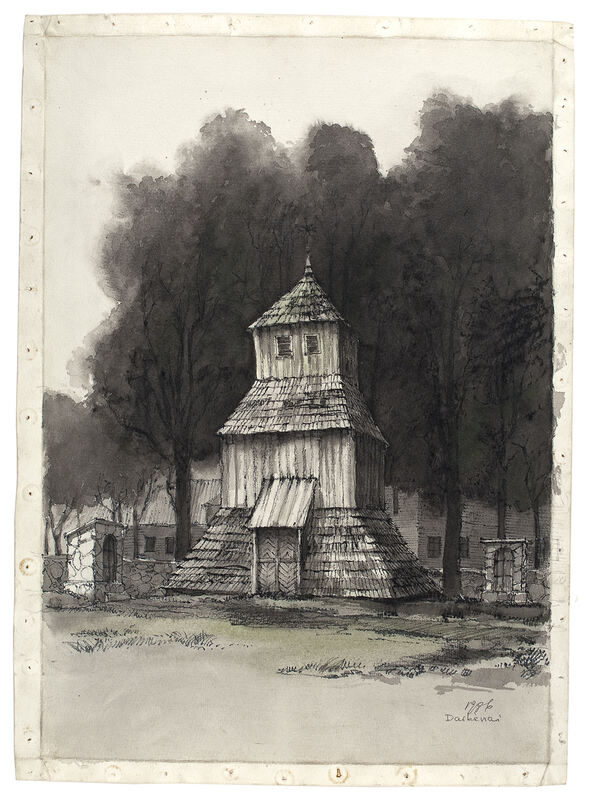
Nors dabartinė Darbėnų Šv. apaštalų Petro ir Pauliaus bažnyčia yra mūrinė, jos šventoriuje stovinti, A. Paslaičio piešinyje įamžinta, varpinė – medinė. Ji kaip ir bažnyčia pastatyta XIX a. Tai Lietuvai įprastas trijų į viršų siaurėjančių tūrių statinys su akustinėmis angomis viršutiniame tarpsnyje.

Spalvota, horizontalaus formato, dokumentinė nuotrauka. Memorialiniai paminklai šalia Darbėnų bažnyčios, Turgaus a., Darbėnai, Darbėnų sen., Kretingos r. sav. Bendras vaizdas iš pietryčių pusės. Fot. Julius Kanarskas, Kretingos muziejaus Istorijos skyriaus vedėjas, 1997 m.
Matosi šalia Turgaus aikštės priešais Darbėnų šv. apaštalų Petro ir Pauliaus bažnyčią esantis skveras, suformuotas 1928 m. pasitinkant Lietuvos nepriklausomybės 10-mečio šventę. Želdinius sodino Skuodo miškų urėdijos miškininkai ir Lietuvai pagražinti draugijos skyriaus nariai. Tais pačiais metais jame buvo pastatytas paminklas Lietuvos nepriklausomybės 10-mečiui paminėti (nugriautas 1962 m., atstatytas 1989 m.). 1944–1945 metais šalia paminklo skvere laidoti raudonarmiečiai (po 1950 m. palaikai perkelti į Kretingos sovietų sąjungos karių kapines). 1989 metais skvere pastatytas tremtinių koplytstulpis, o 1997 m. – paminklas iš Kadagynų kaimo kilusiam vienuoliui saleziečiui Petrui Perkumui (1916–1937).
Nuotraukos kraštai lygūs. Nugarinėje pusėje tarpais atspausti fotografinio popieriaus gamintojo logotipai: „FUJICOLOR / PAPER“, o ties viduriu skersai nugarėlės – nuotrauką spaudusios fotoateljė įrašas: „QSS–2211C <No. 17A> 017 // 829 21 ⁎⁎ N N N 1 072 (027)“.