About the Church
Laukžemės church is first mentioned in 1583, though it is likely that during the Reformation it belonged to the Protestants and later fell into decay. A chapel is recorded as existing in 1636, and already in 1642 the landowner Andriejus Radziminskis built a new church dedicated to St Andrew the Apostle. It is interesting to note that this church was adorned by a painting of Our Lady of Mount Carmel, renowned for its miraculous power, painted in 1729.
In 1752 the church was reconstructed and enlarged by the manor's administrator, Konradas von de Korfas, and in 1793 Antanas Tiškevičius, Bishop of Samogitia, founded the Laukžemė parish here. The present church was built around 1850 through the efforts of Fr Srėbalavičius, and was consecrated by Motiejus Valančius, Bishop of Samogitia, on 24 July 1852.
At the end of the 19th century Fr Feliksas Sereika began chanting the Suplikacijos in Lithuanian, for which he was persecuted by the tsarist authorities. At that time a bell tower was built next to the church, housing an old bell cast in 1740. At the beginning of the 20th century the church was adorned with the stained-glass windows "Flight into Egypt" and "St John the Evangelist", made in Warsaw.
In 1919 parish priest Pranciškus Čepulis organised the first volunteer soldiers of Kretinga county, who set off after Mass to defend Lithuania's independence. During the interwar period various Catholic societies operated around the church, through which the local community was nurtured.
In 1997 the church complex was entered in the list of structures in the register of cultural property, and in 2005 it was recognised as a state-protected cultural heritage site.
Architecturally, the church is a wooden structure with a rectangular plan, a single tower and an apse. Its interior is adorned with three altars. The bell tower, in the western corner of the churchyard, is also wooden, of two tiers, with a hipped roof and an ornamented wrought-iron cross. The churchyard is enclosed by a stone-masonry wall with openwork gates.
The church preserves not only religious but also cultural treasures: a 16th-century sculpture of the Madonna and a bell cast in 1740 by Juozapas Litvinavičius. These historic artefacts reveal the church's rich heritage and its importance to the local community and to the whole of Lithuania.
The Church of St Andrew the Apostle in Laukžemė is not only a place of worship but also a living witness to history. Every corner of it breathes the events of the past, the faith of the people and their struggles for freedom and cultural identity.
Gallery and Resources
Archive captions are shown in Lithuanian.
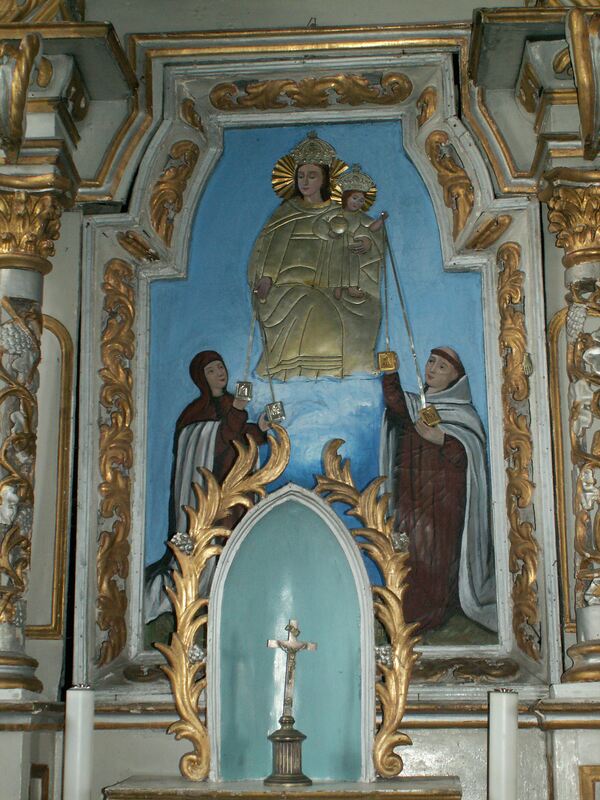
Spalvota, vertikalaus formato, dokumentinė nuotrauka. Nufotografuotas Laukžemės bažnyčios Švč. Mergelės Marijos Škaplierinės paveikslas, kabantis Šv. apaštalo Andriejaus altoriaus apatinėje kondignacijoje, Darbėnų sen., Kretingos r. sav. Fotografavo Julius Kanarskas, Kretingos muziejaus Istorijos skyriaus vedėjas, 2007 m. gegužės 10 d.
Paveikslas vertikalaus formato, tapytas aliejiniais dažais drobėje, puoštas metaliniu aptaisu. Kompoziciją sudaro žydrame fone nutapyta sėdinti Švč. Mergelė Marija su vaikeliu Jėzumi ant rankų, po kurios kojomis klūpo šv. Klara ir šv. Pranciškus (vienuolių pranciškonų II-ojo ir I-ojo ordinų įkūrėjai), kuriems Marija ir Jėzus duoda po škaplierių. Marijos ir Jėzaus atvaizdas, išskyrus veidus, dengtas ornamentuotu geltonos spalvos tauriųjų metalu aptaisu.
Paveikslas tapytas nežinomo menininko 1729 metais. Manoma, kad jis kabėjo senojoje, 1642 m. statytoje bažnyčioje, o apie 1850 m. perkeltas į naujai pastatytą dabartinę bažnyčią. Registrinis kultūros paveldo objektas (unikalus kodas 7962), turintis dailės vertingųjų savybių pobūdį.

Spalvota, horizontalaus formato, dokumentinė nuotrauka. Nufotografuotos Laukžemės šv. apaštalo Andriejaus bažnyčia ir varpinė, Darbėnų sen., Kretingos r. sav. Bendras vaizdas iš vakarų pusės. Fotografavo Julius Kanarskas, Kretingos muziejaus Istorijos skyriaus vedėjas, 2007 m. gegužės 10 d.
Nuotraukoje dominuoja šventoriaus centre stūksanti bažnyčia. Ji medinė, eklektinio stiliaus. Sudėtingas pagrindinis fasadas vertikaliai padalintas į tris dalis: aukštą ir plačią vidurinę ir siauras bei žemesnes šonines. Lėkštu trikampiu skydu užbaigta vidurinė dalis sudaro pagrindą aukštokam kvadratiniam bokštui su pusapskričiu šalmu viršūnėje. Vidurinės dalies apačioje, priešais įėjimą, glaudžiasi portikas, kurio šonuose suporintos kolonos išvagotos kaneliūromis. Kolonų poras viršuje jungia lanko formos stogelis.
Į dešinę nuo bažnyčios, šventoriaus pietvakariniame kampe, stovi keturkampio plano dviejų tarpsnių medinė varpinė, kurios apatinė dalis – piramidinė. Varpinės stogas keturšlaitis, su bokšteliu ir kaltiniu kryžiumi.
Priešais varpinę ir bažnyčią matosi šventoriaus vakariniame pakraštyje stovintis medinis, monumentalus, ornamentuotas, kryžmiškas kryžius. Šventorių juosią akmenų mūro tvora su keturiais keturkampiais, tinkuotais vartų stulpais, prie kurių pritvirtintos ažūrinės, metalinės, kaltinės sąvaros.
Bažnyčia statyta tarp 1850 ir 1852 m., varpinė – 1864 metais. Laukžemės šv. apaštalo Andriejaus bažnyčios statinių kompleksas – valstybės saugomas regioninio reikšmingumo lygmens kultūros vertybių kompleksas (unikalus kodas 1468), turintis architektūrinį, dailės ir sakralinį vertingųjų savybių pobūdį.