About the Church
The Juodkrantė Evangelical Lutheran church, standing in the southern part of the Curonian Spit, is one of the most interesting and significant architectural landmarks of the region. Built of brick masonry, this church beautifully reflects the features of the Gothic Revival style while also telling the story of the locality.
The first Juodkrantė church was wooden, built by the carpenter Klimkus Grigalaitis in the second half of the 18th century. Unfortunately, it burned down in a Midsummer's Eve fire in 1878. The new masonry church was built in 1885 to a design by the renowned German architect Friedrich August Stüler. This architect was famous for his work in Berlin and other German cities, and his design for the Juodkrantė church gave the town a distinctive character.
The church was very important to the local community, especially the Kursenieki and Lithuanians, who made up the majority of the Karvaičiai parish population. At first services were held only in Lithuanian, reflecting the large share of Lithuanian-speaking inhabitants. By the early 20th century, however, the situation began to change, and by 1920 only a small proportion of Juodkrantė residents attended Lithuanian-language services.
After the Second World War the church was closed and stood neglected for a long time, until a Museum of Miniatures was set up there in 1976. The architect Vladas Vizgirda carried out a major renovation and adapted the building's interior to its new function. This was particularly important for preserving this architectural monument.
In 1988 the church was returned to the Evangelical community, but since 1989 it has also been used by the Roman Catholic parish of St Francis of Assisi. This shows the importance and versatility of this sacred building, as it serves different communities and faiths.
Architecturally, the church has a rectangular plan and a single nave, with pronounced Gothic Revival elements that give it particular beauty and grandeur. The features of this style – tall windows, pointed turrets, decorative details – help create a distinctive atmosphere both inside and out.
Today the Juodkrantė Evangelical Lutheran church is not only a place of worship but also a cultural landmark reflecting the rich history and heritage of the Curonian Spit. Everyone who visits this wonderful corner of nature makes sure to see this impressive church too, whose walls hold countless stories.
The first Juodkrantė church was wooden, built by the carpenter Klimkus Grigalaitis in the second half of the 18th century. Unfortunately, it burned down in a Midsummer's Eve fire in 1878. The new masonry church was built in 1885 to a design by the renowned German architect Friedrich August Stüler. This architect was famous for his work in Berlin and other German cities, and his design for the Juodkrantė church gave the town a distinctive character.
The church was very important to the local community, especially the Kursenieki and Lithuanians, who made up the majority of the Karvaičiai parish population. At first services were held only in Lithuanian, reflecting the large share of Lithuanian-speaking inhabitants. By the early 20th century, however, the situation began to change, and by 1920 only a small proportion of Juodkrantė residents attended Lithuanian-language services.
After the Second World War the church was closed and stood neglected for a long time, until a Museum of Miniatures was set up there in 1976. The architect Vladas Vizgirda carried out a major renovation and adapted the building's interior to its new function. This was particularly important for preserving this architectural monument.
In 1988 the church was returned to the Evangelical community, but since 1989 it has also been used by the Roman Catholic parish of St Francis of Assisi. This shows the importance and versatility of this sacred building, as it serves different communities and faiths.
Architecturally, the church has a rectangular plan and a single nave, with pronounced Gothic Revival elements that give it particular beauty and grandeur. The features of this style – tall windows, pointed turrets, decorative details – help create a distinctive atmosphere both inside and out.
Today the Juodkrantė Evangelical Lutheran church is not only a place of worship but also a cultural landmark reflecting the rich history and heritage of the Curonian Spit. Everyone who visits this wonderful corner of nature makes sure to see this impressive church too, whose walls hold countless stories.
Gallery and Resources
Archive captions are shown in Lithuanian.
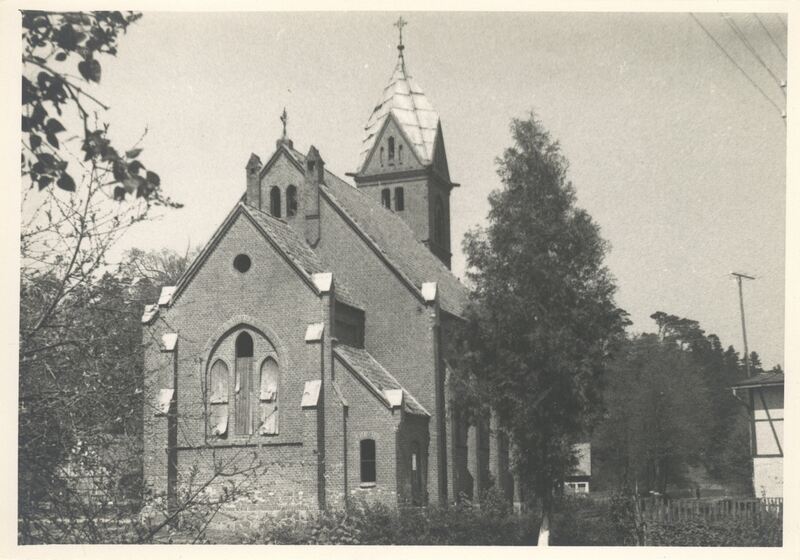
Juodkrantės evangelikų liuteronų (Šv. Pranciškaus Asyžiečio) bažnyčia, pastatyta 1885 m. Neogotikinio stiliaus, stačiakampio išplanavimo. Vaizdas iš presbiterijos pusės. Juodkrantė, XX a. II p.

Dokumentinė fotografija. Juodkrantės evangelikų liuteronų bažnyčia. Parapija įkurta XVIII a. pabaigoje. Nauja mūrinė bažnyčia pastatyta 1885 m. pagal Berlyno architekto F. A. Stullerio projektą. Po Antrojo pasaulinio karo bažnyčia paversta sandėliu. 1976 m. čia įkurdintas miniatiūrų muziejus. 1989 m. grąžinta tikintiesiems.