About the Church
The Laižuva Church of the Holy Trinity is an impressive church with a rich history, whose beginnings go back to the 17th century. Situated near the border between Lithuania and Latvia, this church became not only a place of religious rites but also an important centre of culture and community.
The first church in Laižuva is already mentioned in the 1635 inventory of the Mažieji Dirvėnai district (valsčius). A little later, in 1661, a new church was built, and a parish was established at the same time. It should be mentioned that Ona Pacaitė-Važinskienė was a generous benefactor – she donated to the church 71 valakas of land together with all the people living on it.
In 1773 another church was built, which was in time replaced by the present church. Kazimieras Klimavičius, caring for the spiritual needs of parishioners, published a Lithuanian catechism in 1767, which became an important work of religious literature.
In the building of the present church, a great role was played by the parish priest Antanas Vienažindys. On his initiative, and with the help of parishioners, a barn and a granary were built and the presbytery was repaired. Unfortunately, in the summer of 1884 a great fire broke out in the small town, which destroyed the church and several other buildings. However, through the efforts of A. Vienažindys, a temporary church was built in the cemetery within a few months.
Permission to build a masonry church was obtained only in 1889, and the construction work was directed by the master builder Pranciškus Tramdachas from Latvia, with supervision by the engineer Kryžanovskis from Jelgava. The church was completed in 1892 and consecrated on 22 May. In the period from 1911 to 1914, the well-known Lithuanian writer Juozas Tumas-Vaižgantas served as parish priest in Laižuva, enriching the local cultural life.
During the Second World War, on 28 October 1944, the retreating German army blew up the church. Only the almshouse survived, which after repair became a temporary church and remains in use to this day.
Architecturally, the Laižuva Church of the Holy Trinity has a rectangular plan and no tower. Its simplicity and functionality reflect the practical approach to sacred architecture of the time, while its history reflects the community's strong bond and perseverance.
Today the Laižuva Church of the Holy Trinity is more than just a house of prayer. It is a symbol reflecting the faith, resilience and ability of the local people to recover after difficult trials.
The first church in Laižuva is already mentioned in the 1635 inventory of the Mažieji Dirvėnai district (valsčius). A little later, in 1661, a new church was built, and a parish was established at the same time. It should be mentioned that Ona Pacaitė-Važinskienė was a generous benefactor – she donated to the church 71 valakas of land together with all the people living on it.
In 1773 another church was built, which was in time replaced by the present church. Kazimieras Klimavičius, caring for the spiritual needs of parishioners, published a Lithuanian catechism in 1767, which became an important work of religious literature.
In the building of the present church, a great role was played by the parish priest Antanas Vienažindys. On his initiative, and with the help of parishioners, a barn and a granary were built and the presbytery was repaired. Unfortunately, in the summer of 1884 a great fire broke out in the small town, which destroyed the church and several other buildings. However, through the efforts of A. Vienažindys, a temporary church was built in the cemetery within a few months.
Permission to build a masonry church was obtained only in 1889, and the construction work was directed by the master builder Pranciškus Tramdachas from Latvia, with supervision by the engineer Kryžanovskis from Jelgava. The church was completed in 1892 and consecrated on 22 May. In the period from 1911 to 1914, the well-known Lithuanian writer Juozas Tumas-Vaižgantas served as parish priest in Laižuva, enriching the local cultural life.
During the Second World War, on 28 October 1944, the retreating German army blew up the church. Only the almshouse survived, which after repair became a temporary church and remains in use to this day.
Architecturally, the Laižuva Church of the Holy Trinity has a rectangular plan and no tower. Its simplicity and functionality reflect the practical approach to sacred architecture of the time, while its history reflects the community's strong bond and perseverance.
Today the Laižuva Church of the Holy Trinity is more than just a house of prayer. It is a symbol reflecting the faith, resilience and ability of the local people to recover after difficult trials.
Gallery and Resources
Archive captions are shown in Lithuanian.
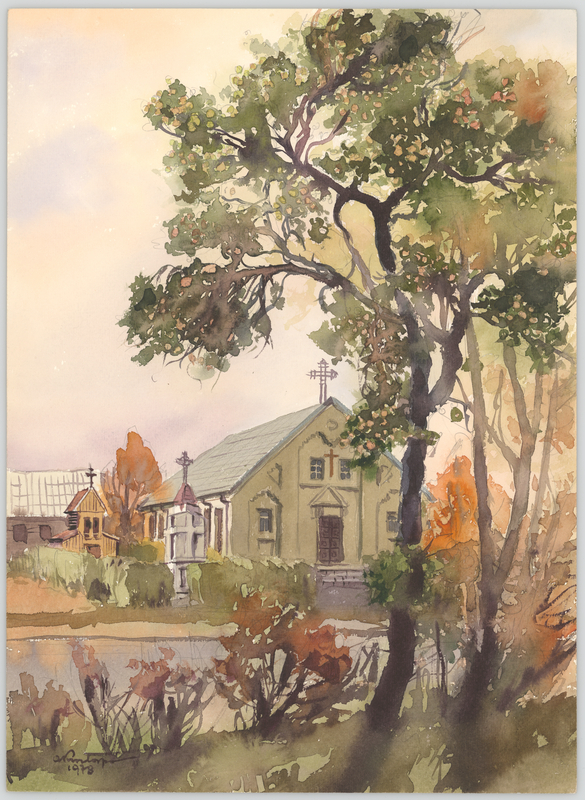
Kompozicijoje – Laižuvos Švč. Trejybės bažnyčia.
Signuotas akvarele averso apatinėje dalyje kairėje, pieštuku reverso viršutinėje dalyje.