About the Church
The Church of the Holy Trinity in Rudamina stands in the small town of Rudamina, Lazdijai district, about eight kilometres northwest of Lazdijai.
The first wooden church here was built as early as 1592 through the efforts of Grigalius and Marija Masalskis. The construction of the present masonry church was initiated by Mikalojus Turčinavičius Sušickis; it was rebuilt at the end of the 18th century, and consecrated in 1803 by Father Augustinas Polikarpas Marcejevskis, who later became Bishop of Seinai. The plastered masonry church, in the Early Baroque style, has a Latin-cross plan, with one nave, two towers, and five altars.
The history of Rudamina also records traces of the insurgents: in 1863 the vicar Jurgis Dailidė read out the insurrection's manifesto here and was shot a year later. At the end of the 20th century the church was renovated by Father Juozas Zdebskis, a defender of believers' rights, who died in 1986 and is buried in the churchyard.
The first wooden church here was built as early as 1592 through the efforts of Grigalius and Marija Masalskis. The construction of the present masonry church was initiated by Mikalojus Turčinavičius Sušickis; it was rebuilt at the end of the 18th century, and consecrated in 1803 by Father Augustinas Polikarpas Marcejevskis, who later became Bishop of Seinai. The plastered masonry church, in the Early Baroque style, has a Latin-cross plan, with one nave, two towers, and five altars.
The history of Rudamina also records traces of the insurgents: in 1863 the vicar Jurgis Dailidė read out the insurrection's manifesto here and was shot a year later. At the end of the 20th century the church was renovated by Father Juozas Zdebskis, a defender of believers' rights, who died in 1986 and is buried in the churchyard.
Gallery and Resources
Archive captions are shown in Lithuanian.
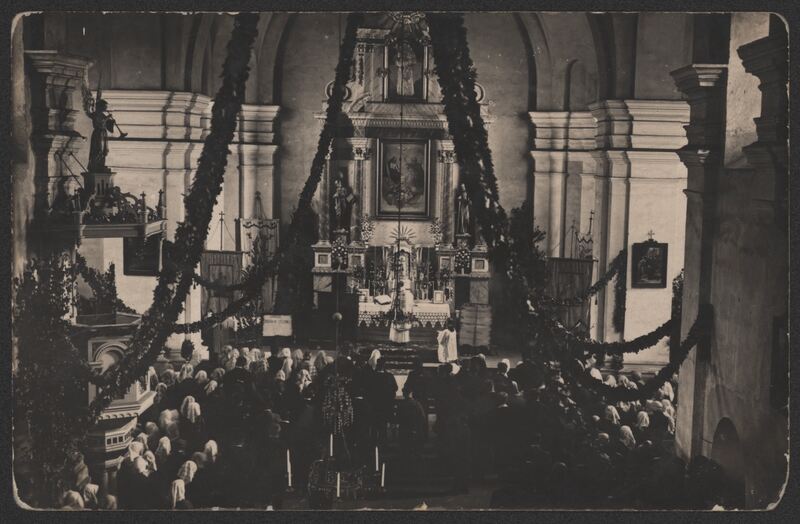
Žolinių atlaidai Rudaminos Švč. Trejybės bažnyčioje.